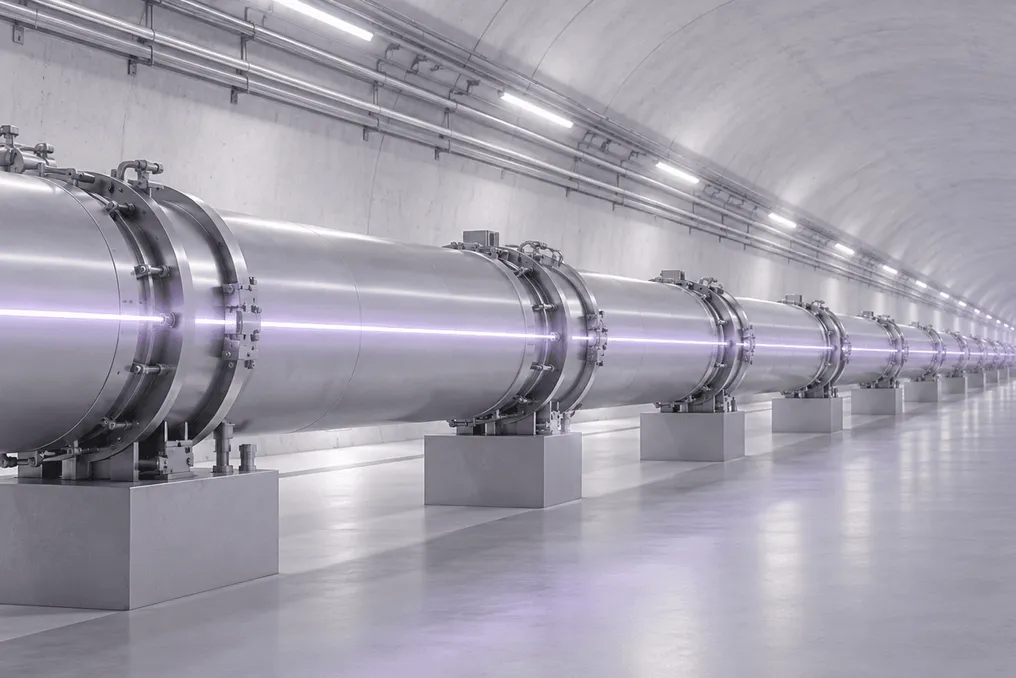
Major construction work on the western section of the S3FEL free-electron superconducting laser in Shenzhen started on September 30th in Guangming Science City. This advances the high-frequency free-electron X-ray laser to an active construction stage. The installation is planned to begin producing light in September 2032.
The S3FEL facility is a central element of the cluster of major research centers in the science city and is being built by the Institute of Advanced Light Source Facilities of Shenzhen (IASF) in collaboration with the local Guangming Science City Development Company. The site area is approximately 405,200 square meters, with a total building area of 232,000 square meters. According to Southern Daily, the facility, which spans about 1.8 kilometers, crosses three hills and a reservoir, requiring over 4.4 million cubic meters of earthworks.
Currently, construction is underway on the western section, including cryogenic halls A and B, a technical building, a beam test hall, and a hall for assembling and testing superconducting radio frequency components. These parts, scheduled for completion by 2028, will be used for commissioning the linear accelerator, conducting research and testing key accelerator components, and for batch integration of accelerator superconducting modules.
The installation is based on a superconducting linear accelerator with a design electron beam energy of 2.5 GeV and a repetition rate of 1 MHz, capable of generating light at wavelengths from 1 to 30 nanometers. IASF asserts that this will be the world's only high-frequency free-electron laser whose strongest range is in the soft X-ray region, thereby filling a gap in China's capabilities in high-frequency soft X-ray free-electron lasers. Conference materials from the design team indicate that it is designed as a complement to the SHINE hard X-ray facility in Shanghai.
By enabling non-destructive tracking of atomic and molecular structures on femtosecond timescales, the facility is intended to function as a high-speed matter camera, providing very high spatial, temporal, and energy resolution. Creators expect it to support research in information technology, life sciences, materials, and energy, and to aid in ultraviolet lithography, quantum materials, and biomedicine.
According to Science and Technology Daily, the total investment in the project amounts to 11.4 billion yuan, making it the most technically complex large-scale structure in Shenzhen's history. It is the first major scientific facility in the city to pass review by the National Development and Reform Commission guidelines, and the first advanced light source in China being constructed and funded by the local government. Its feasibility study was approved in July 2024.
The second batch of preliminary research projects is currently being finalized. Over a three-year period, the team has reported achieving significant milestones in the development of superconducting accelerators, high repetition rate technology, and key experimental station equipment.