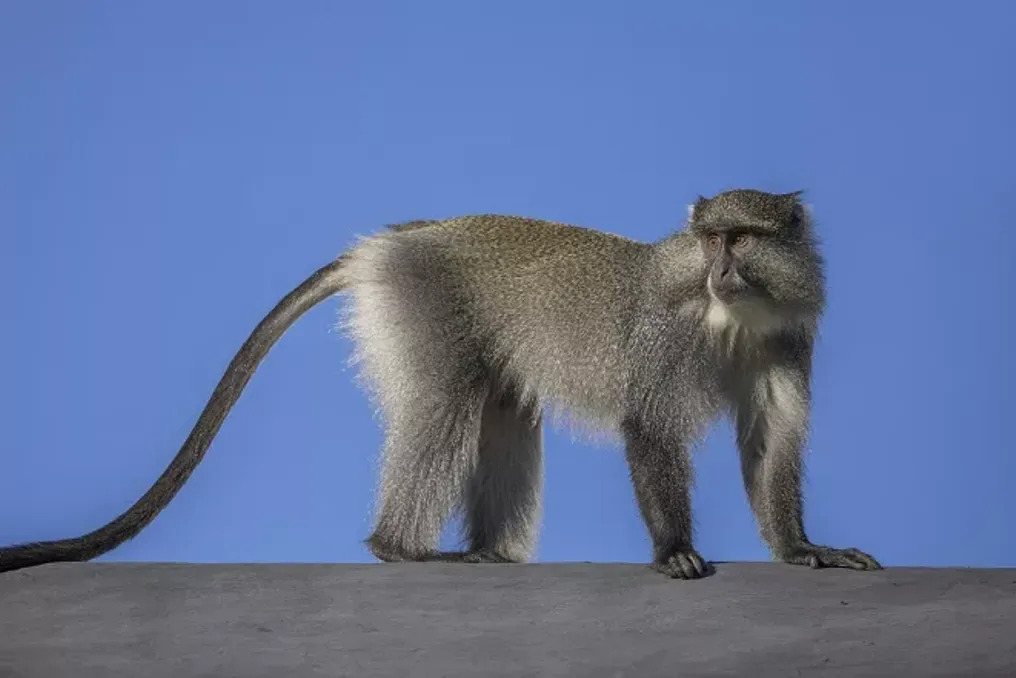
In the upper tiers of South African forests, the samango moves through a world that most people barely notice. Leaves, branches, and vines form a network of feeding spots, shelters, and trails. From the ground, the forest may look like a solid green wall, but from above, the gaps in the canopy are important.
Roads, cleared fields, plantations, or growing cities—such barriers can turn once continuous forest into a collection of isolated patches. The samango offers an interesting way to understand one of the most serious problems facing forests today: habitat fragmentation.
The samango are primates inhabiting the forests of South Africa, found in fragmented areas of local forests from the Eastern Cape through KwaZulu-Natal and Mpumalanga. They are highly arboreal, spending most of their time above the ground, feeding on leaves, fruits, flowers, and other plant material. Their lives are closely tied to the structure and diversity of the forest.
For the samango, the forest is much more than just a collection of trees; the canopy is a three-dimensional landscape. Branches serve as routes between feeding and sleeping zones, and vegetation provides food and protection. This makes connectivity particularly important.
A forest may look lush from the ground, yet become increasingly isolated from other suitable habitat areas. When large areas of native vegetation are divided into smaller fragments, animals end up in ecological islands. Habitat fragmentation occurs when a large, continuous area of habitat is divided into smaller parts. Roads, agriculture, commercial forestry, urban development, and other land-use changes can contribute to this process.
The result is not just a reduction in habitat area, but a change in the landscape itself. A small patch of forest may contain many trees, but it might be separated from another patch by a road or open land. For a species dependent on continuous vegetation, crossing this gap can be difficult or impossible.
Fragmentation can also intensify so-called edge effects. Conditions at the forest boundary can differ from those deep inside, changing in terms of light, temperature, vegetation, and external influences. Over time, isolated populations face additional difficulties. If animals cannot move between forest patches, opportunities for dispersal and genetic exchange can become more limited.
Thus, the samango serves as a vivid example of a much broader ecological question: how to maintain connectivity of wild animal populations in landscapes increasingly used by humans? The answer is not always to create huge new reserves. Conservationists can also focus on connectivity, protecting existing vegetation, restoring degraded areas, and maintaining corridors between important habitat patches. Native vegetation along rivers and other natural features can sometimes facilitate these connections.
The main idea is simple: instead of viewing each forest patch as an isolated green island, conservation planning must consider how these patches function together as part of a larger landscape. This matters not only for the samango. Many plants and animals depend on connected habitats for movement, foraging, reproduction, and responding to environmental changes. Therefore, protecting corridors can benefit the entire ecological community.
Conservation challenges in South Africa cannot always be solved by separating humans from wildlife. People need housing, roads, farms, logging, and other infrastructure. Cities are expanding, industries are operating, and landscapes are changing. The task is to find ways to plan this activity while preserving the ecological connections necessary for wildlife. For an arboreal monkey, a line on a map can mean something entirely different on the ground. A road through the forest can represent a significant habitat break. A plantation may provide vegetation but offer a completely different ecological environment than native forest. A city can gradually surround a forest patch until what was once part of a larger ecosystem becomes increasingly isolated.
This is why conservation is increasingly looking at the broader landscape rather than focusing solely on protected areas. Forest health is not always obvious. The green canopy can hide fragmentation, invasive plants, reduced connectivity, or changes in vegetation composition. Therefore, ecologists look at much more than just the presence of trees. They consider forest diversity and structure, regeneration, habitat quality, and the ability of wild animals to move between suitable areas. The samango gives a visible face to these complex ideas. Next time you walk through a local forest in South Africa, look up. Perhaps a samango is quietly moving through the branches above you, navigating the landscape of leaves, fruits, and tangled canopy. Its world reminds us that forests are not isolated green spots, but living networks. And maintaining these networks in a connected state can help ensure that the forest remains home to many more wonderful little monkeys.
