Located in North Africa, Tunisia possesses remarkable geographical and cultural diversity. Although its total area is relatively small, covering 163,610 square kilometers—placing it among the smaller states of Brazil by size—within a radius of approximately 500 kilometers, very varied landscapes are concentrated.
These landscapes range from arid deserts to ancient medieval fortresses and Roman vestiges, many of which are located in coastal areas. Combined with Berber architecture, characterized by the use of mud bricks and rammed earth, this wealth of scenery provides an ideal aesthetic both for representing futuristic worlds without excessive reliance on visual effects, and for recreating historical environments of other nations.
Due to these characteristics, several Hollywood film productions, some of the most famous of the last century, have chosen Tunisia as a filming location. Below, we detail some films shot in the country and how these settings can be visited.
The Star Wars universe
The Star Wars universe, conceived by George Lucas and initially produced by Lucasfilm, is filled with striking fictional locations that have fascinated millions of fans for decades. A significant portion of the memorable settings in the feature films was filmed in Tunisian soil.
A prominent example is the planet Tatooine, whose name is inspired by the Tunisian city of Tataouine. The interior of the Lars family farm, where the character Luke Skywalker (played by Mark Hamill) resides at the beginning of 'A New Hope,' corresponds to the Sidi Idriss Hotel. This location is an underground cave-style lodging, built in Berber style, situated in the town of Matmata and accessible during the day.
For those wishing to stay longer, there is the possibility of overnight stays at the location, and it is recommended to book several months in advance, especially during high season.
Sidi Bouhlel Canyon
This canyon is one of the most frequented spots by saga enthusiasts. Commonly called 'Star Wars Canyon,' it served as the representation for the Tatooine region, where Luke is attacked by the Sand People and the robot R2-D2 is captured by the alien species Jawas. Furthermore, in Ajim, an old Berber-style bakery was adapted to become the iconic Mos Eisley Cantina, famous for its soundtrack composed by John Williams.
The box office success of 'Indiana Jones and the Raiders of the Lost Ark,' released in 1981, introduced the world to the celebrated archaeologist who gives his name to the film, played by Harrison Ford. Directed by Steven Spielberg and co-produced by George Lucas, it is not surprising that many scenes from this film were also shot in Tunisia.
In this case, the Tunisian desert was not used to create fantastic worlds but rather to portray other countries. The Medina of Kairouan, a historic district of the municipality of Kairouan (a UNESCO World Heritage site since 1988), served as a backdrop for the streets and markets of Cairo, Egypt. This location is a highly visited urban center in the city and can be easily explored.
The Sidi Bouhlel Canyon was also used to illustrate the excavations in Tanis, an ancient submerged Egyptian city that was created specifically for the film.
However, many of these natural attractions can be difficult to find without the help of local guides or agencies. Therefore, there are companies such as Galaxy Tours, specializing in Star Wars and Indiana Jones cinematic tourism in Tunisia. These companies offer short trips or multi-day excursions for visitors merely passing through the region.
Biblical settings in Tunisia
Tunisia also served as a setting for a biblical nature scene. The satirical feature film 'Monty Python's Life of Brian,' released in 1979 and directed by the British comedy group Monty Python, narrates the journey of the prophet Brian Cohen (played by Graham Chapman), who was born in a stable near Jesus Christ in Judea.
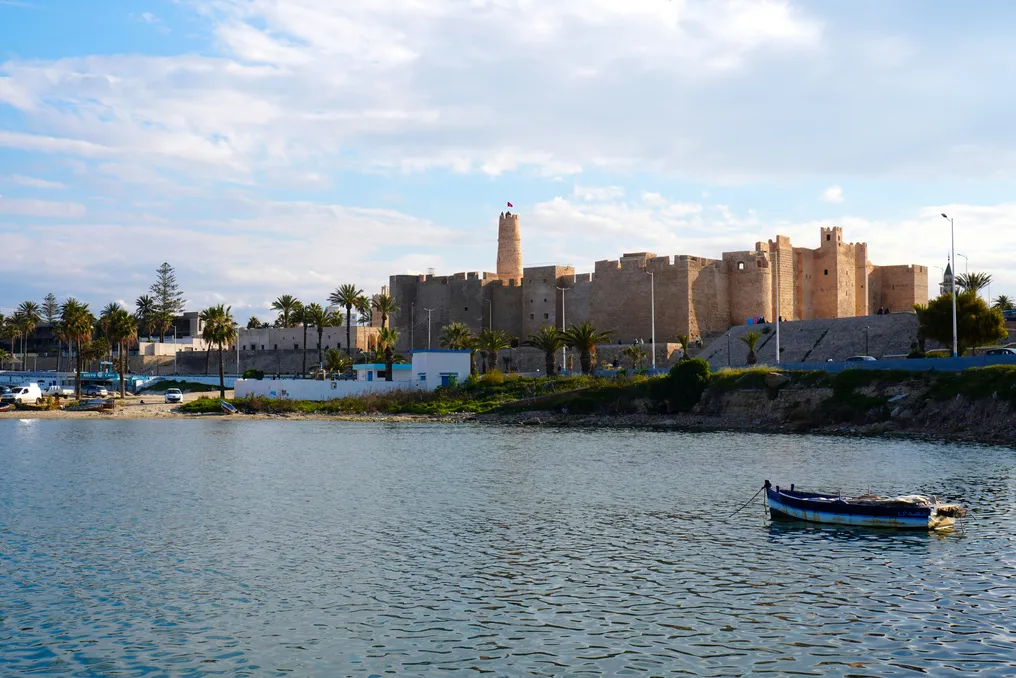
Ribat de Monastir
Thus, the Ribat de Monastir, an impressive Islamic monument, was used as the main setting to represent Jerusalem and the Holy Land. The Roman Theatre of Carthage, another Tunisian historical site, was used for the scene of the Jewish Popular Front, while the desert area of Matmata—where the Sidi Idriss Hotel is located—served as the stage for both the mountain sermon scene and the final crucifixion sequence.
As these are historical structures, these locations can easily be incorporated into conventional tourist itineraries. The Ribat de Monastir, for example, is located in the central region of the city of Monastir, facing the Mediterranean Sea, even providing a beautiful view of the beach.
Additionally, the Roman Theatre of Carthage, located in the eponymous city, in a suburb north of Tunis, the Tunisian capital, is a highly memorable tourist spot for travelers. This structure is part of an archaeological zone and was built in the second half of the 2nd century AD, under the reign of the Roman emperor Trajan.