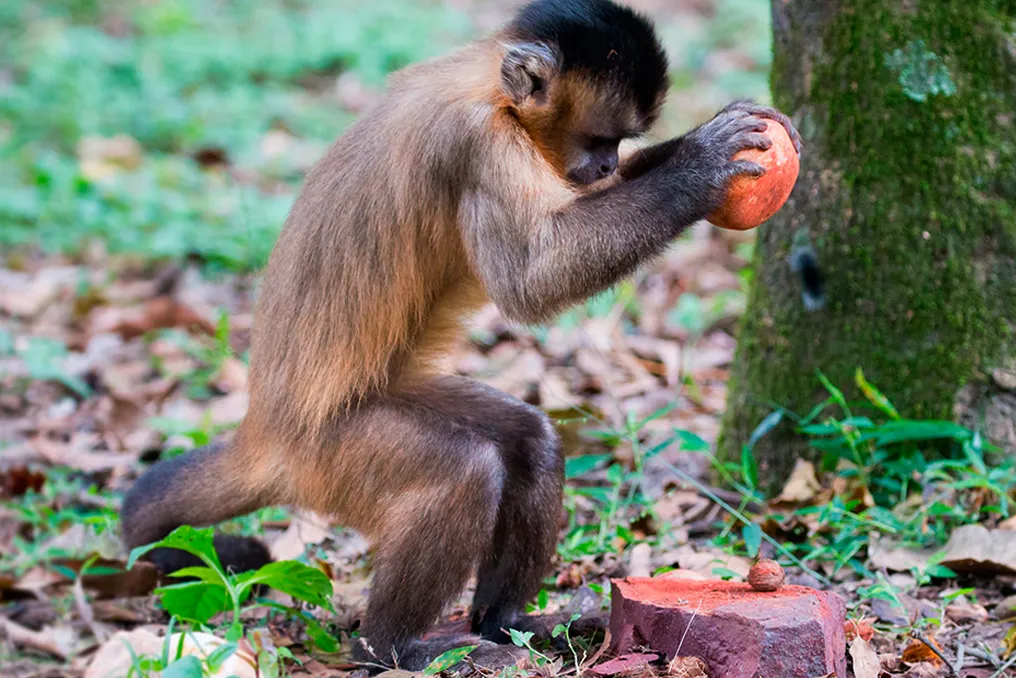
The Serra da Capivara National Park, located in Piauí, is known for housing capuchin monkeys that exhibit great variety in tool use among non-human primates. These animals have been seen using stones to break hard fruits or dig, and also sticks for tasks such as disarming prey. Previously, it was known that these primates were capable of judging tools based on the physical characteristics of the materials. However, researchers conducted an experiment to determine which elements affect the selection of stone tools among the groups.
The study monitored two communities of capuchin monkeys, originating from the Serra da Capivara National Park and the Tietê Ecological Park in São Paulo. The main conclusion was that social indicators related to use influence the process of choosing stone tools by these primates during feeding. As detailed in the work, published in the scientific journal Proceedings of the Royal Society B: Biological Sciences, when the capuchin monkeys were exposed to unused stones, both populations chose the tools considering the intrinsic properties of the materials. However, the monkeys showed a preference for those stones that presented evidence of previous use, regardless of their composition.
In addition to providing additional data on the specific habits of the studied populations, this research can serve as a model to understand the evolution of tool use, both in the primate lineage in general and specifically among humans.
Evolutionary perspective and comparison with humans
Tiago Falótico, one of the study's authors, commented to Jornal da USP that stone tools represent the oldest identified in the human lineage, although this practice is no longer observed today. For this reason, other primates are used as a model to aid in comparing and understanding the factors driving this evolution.
Falótico emphasizes that only four groups of primates use this material as a utensil in their daily activities: capuchin monkeys, chimpanzees, Macaca fascicularis—an Asian species known as the crab-eating macaque, long-tailed macaque, or cynomolgus monkey—and Homo sapiens.
Previous research already indicated that, even when observing each other, capuchin monkeys do not necessarily replicate the movements of other individuals to establish their own habits. Based on this premise, the researchers sought to understand how information left by other animals could influence tool selection and contribute to behavior acquisition.
The work was carried out with two wild monkey populations, under daily monitoring by researchers, and was divided into three phases. In each phase, scientists distributed stones and food in the environment to propose tasks to the animals and analyze their interaction with each material.
Experimental methodology
Falótico reported the procedure, saying: 'We walked around with the small stones and a bag with typical foods of the populations. One person always went a little ahead of where the monkeys were, set up the experiment configuration, and waited for one of them to approach.'
He emphasized that the process was entirely voluntary: 'some animal had to come and use it. When it used it, we collected everything, set it up again, and waited for another monkey to come.'
In the first phase, the researchers investigated whether the animals could distinguish between stones with distinct characteristics and analyzed the function assigned to each. Cashew nuts were offered to the Serra da Capivara monkeys, while Syagrus coconut was given to the Tietê Ecological Park group. Additionally, artificial stones of similar sizes but varied densities were made available.
In most cases, the most resistant stones were used as hammers to fracture the items, while the lower density stones served as anvils—that is, the surface on which the food is supported during breaking.
In the second task proposed, the scientists examined whether identifying social clues could help in tool selection. For this, breaking sites were set up, locations that grouped food and tools.
Tiago Falótico explained: 'We designed two breaking sites for each animal, both with stones of different densities.' However, one of these sites contained scattered coconut remains and stones already stained or marked with use. During this intervention, the sites with social cues were used significantly more by the monkeys.
In the final stage, the group combined stones with and without signs of use, but excluded broken coconut remains, observing which would be selected by the animals. Although they did not show a preference for worn stones for use as a hammer, the already used materials were the most chosen among the options for an anvil.
Social learning and behavioral diversity
Based on these findings, the study confirmed that the behavioral pattern of these animals develops through a social learning model called 'place enhancement' or 'stimulus enhancement'. In this mechanism, the attention of the capuchin monkeys is directed to places or objects that present the presence of other individuals of the same species. This attraction leads the animals to interact with materials that have been previously used, allowing them to understand their characteristics on their own. Thus, the succession of individual learnings causes the gradual dissemination of a common behavior among members of the same population.
Falótico mentioned that his work with the capuchin monkey group in Serra da Capivara began in 2007, during his doctoral studies at the Institute of Psychology (IP) of USP. The first study aimed to describe their tool use repertoire and found that the set of local habits was more vast than observed in other groups. Almost twenty years later, the population is still recognized for presenting the most diverse behavior ever documented for the species.
Besides using stones to break food and dig the soil in search of resources—such as roots, tubers, and small animals hidden in holes—these monkeys exhibit unusual tool use behavior for communication: the local population is the only known where females throw stones at males to signal estrus.
The researcher clarified that this behavioral disparity between populations of different regions depends on a set of ecological and cultural factors. He pointed out that 'the ecological part is represented by the environmental characteristics that influence these customs when determining resource availability for the monkeys.' An example cited is that, in capuchin monkeys and other primates, a certain level of terrestrialism is necessary; animals that rarely go down to the ground do not use stone tools, since the stones are usually found on the ground.
In addition to environmental influence, details about the materials used and the techniques adopted also depend on cultural aspects inherent to each group. The more an individual uses a tool, the greater the chance that they will progressively learn the functionality of that material, develop new behaviors, and indirectly influence other individuals. Falótico observed: 'When this differentiation of customs occurs, it is usually because a behavior was invented by some individual, spread within its group, and remained restricted there.'
For the researcher, studying these populations is crucial to record and preserve the behavioral diversity existing among the species' groups. Even if capuchin monkeys are not threatened with extinction, specific behaviors of certain populations may disappear if these groups are reduced or become extinct. Tiago Falótico warned: 'If these populations disappear, the species will continue to exist, but part of its behavioral diversity will be lost forever.'
This work was carried out with the collaboration of members of the Max Planck Institute and the Neoprego research group, bringing together researchers from USP and institutions in Brazil, Germany, the United States, and Portugal. The article was funded by the Max Planck Society and the State Research Support Foundation of São Paulo (Fapesp).