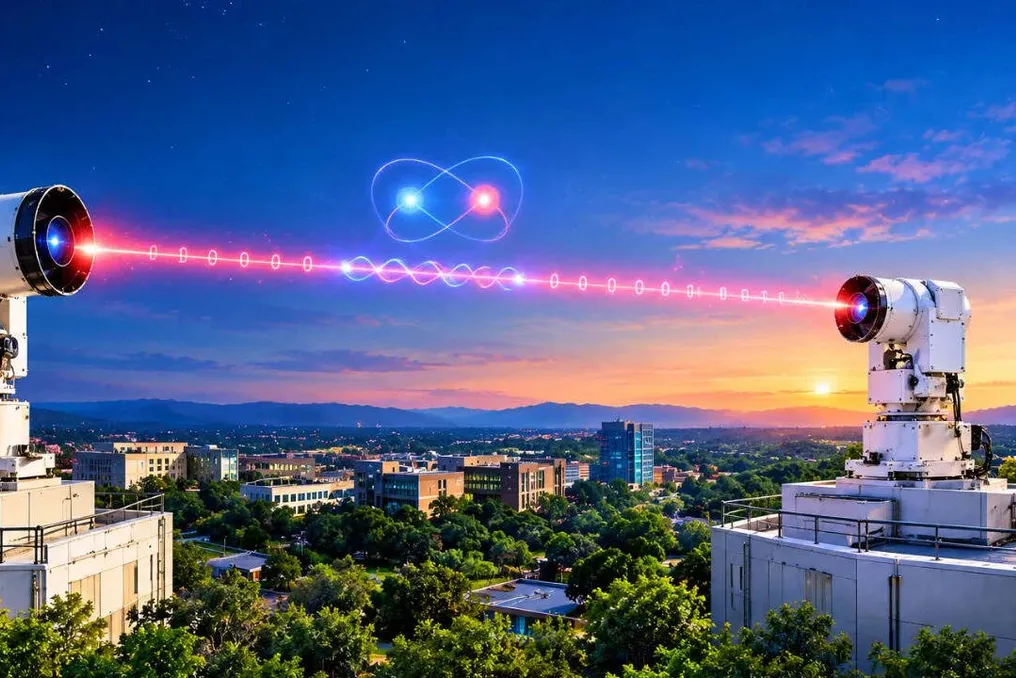
The Indian deep technology startup QNu Labs, in collaboration with the Bhaskaracharya National Institute of Space Applications and Geoinformatics (BISAG-N) and IIT Gandhinagar, successfully demonstrated India's first free-space Quantum Key Distribution (QKD) channel exceeding 5.56 km.
A free-space QKD channel is a highly secure method for exchanging secret digital passwords using light particles that travel through open air or space, bypassing physical fiber optic cables. This method is based on the principles of quantum mechanics: any attempt at external interference or measurement of photons alters their state, making it the most reliable way to transmit data. Unlike traditional QKD, which is limited by signal loss within optical fibers, free-space channels allow communication across open terrain, water, or obstacles where laying cables is difficult.
The technology of optical interaction in free space serves as the basis for transmitting keys between Earth and orbital satellites, forming the foundation for a globally protected quantum network.
As stated by the Ministry of Information Technology and Electronics, the field test conducted on the night of September 27 to 28 allowed for the establishment of a secure quantum communication channel between BISAG-N and IIT-G.
Thanks to the tracking, acquisition, and pointing system from QNu Labs, the test achieved a stable quantum bit error rate below 5% and generated secure keys at a rate of 230 to 260 bits per second. These keys were integrated with the Vedic Kavach platform, which supports post-quantum cryptography developed by BISAG-N, ensuring successful end-to-end encryption and decryption of test messages.
Vinay Thakur, CEO of BISAG-N, noted that the integration of Vedic Kavach with QNu Labs' QKD technology is an important step towards creating practical communication systems resistant to quantum threats. Sunil Gupta, co-founder and CEO of QNu Labs, emphasized that the successful demonstration over a distance of 5.56 km paves the way for creating longer-range quantum-secured networks and satellite quantum communication.
Kmde Manish Tripathi (retired), responsible for ISTF at IIT Gandhinagar, stated that this demonstration provides a valuable experimental environment for developing practical quantum communication technologies and shows how academic settings, domestic technologies, and real experiments can be combined to meet emerging requirements for secure communication. The test lays the groundwork for strengthening India's capabilities in secure communication infrastructure and increasing resilience against new threats associated with the quantum era.