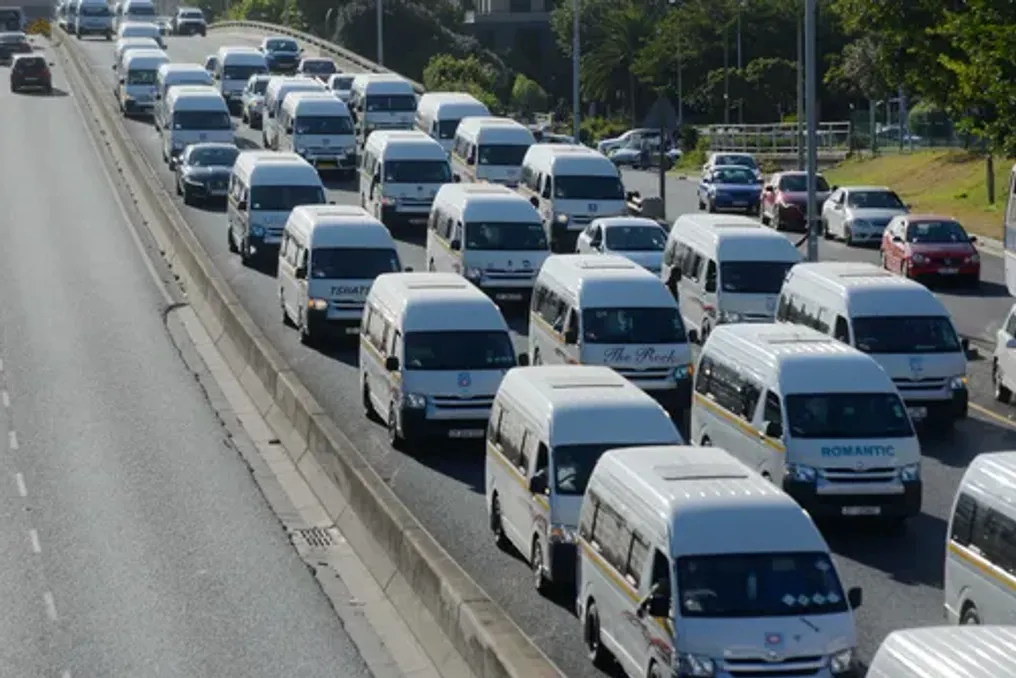
South Africa's taxi industry plays an indispensable role for millions of passengers; however, its significance requires ensuring a higher level of safety, accountability, and professionalism.
During Transport Month, it is important to acknowledge an obvious fact that is often lost in political and programmatic discussions about public transport: daily, millions of South Africans rely on minibus taxis for commutes to work, school, shops, and medical facilities.
The importance of this sector becomes particularly evident when taxi services are suspended. During strikes, operators can paralyze entire communities: workers cannot reach factories and offices, students struggle to attend school, small businesses lose customers, and hospitals and other vital services suffer.
This dependency underscores that South Africa cannot view the taxi industry as a secondary player in the transport system. The government itself has designated minibus taxis as the largest form of public transport in the country, used daily by approximately 15 million people.
From Apartheid Era Necessity to Economic Power
The history of the taxi industry largely reflects the social and economic transformation of South Africa. During apartheid, Black South Africans faced severe restrictions on economic activity and mobility. Communities cut off from formal transport networks were often forced to use private sedan taxis.
Later, minibus taxis became an important response to the inadequate public transport services available to these communities, eventually becoming a major part of the country's transport system. By the 1980s, deregulation facilitated the rapid expansion of Black-owned taxi businesses. Government historical reports acknowledge that this sector became one of the few ways Black South Africans could accumulate wealth and conduct business under severely restricted opportunities.
However, deregulation was both an opportunity and a curse. It opened the market to thousands of operators, but insufficient control and fierce competition for routes and passengers led to the emergence of taxi associations and violent territorial wars. The industry formed its own structures of organization and coercion, sometimes outside effective state control.
Democracy did not erase this history. Instead, the new government inherited an industry that was simultaneously indispensable, entrepreneurial, fragmented, and difficult to regulate.
Public Transport Versus Private Business
Therefore, caution must be exercised in terminology. Minibus taxis function as public transport, but they are private enterprises. They are not identical to state or municipal bus systems. Government transport documents recognized that historically, minibus taxis did not receive direct operational subsidies, although the Taxi Recapitalisation Programme provides capital support through the write-off of old vehicles.
This distinction is significant because taxi operators are expected to provide a public service while simultaneously bearing the financial risks associated with running a private business.
The Long Road to Safer Taxis
In 2006, the government launched the Taxi Recapitalisation Programme, primarily aimed at safety and fleet renewal. The programme was designed to remove old, unsafe vehicles from the roads and assist operators in replacing them with new, standard-compliant ones. The initial write-off amount was 50,000 Rand per qualified vehicle.
The programme was later revised, and the write-off amount was ultimately increased to 124,000 Rand. By September 2018, the government reported that 72,652 old taxis had been written off, and 4.4 billion Rand had been paid out in grants. The very fact that the programme needed revision speaks to the complexity of reforming the sector.
A review conducted by the government itself identified issues such as the availability of new vehicles, the size of the write-off grant, and illegal taxi operations. The industry has also faced changes in technology and competition from e-hailing services.
Despite this, there is another problem that cannot be solved by replacing vehicles or changing rules: cities were never properly designed to accommodate the transport realities of most residents. The spatial planning of the apartheid era displaced Black communities to the outskirts of economic centers, often leaving people living far from their workplaces. This spatial legacy remains visible today.
Our transport infrastructure has not always kept pace with how South Africans actually move. Too many roads lack adequate taxi stops, loading zones, and safe boarding areas. As a result, drivers are sometimes criticized—sometimes rightly—for stopping in unauthorized places, but inadequate infrastructure leaves limited options. At the same time, poor infrastructure is not an excuse for reckless or selfish driving. Taxi drivers who stop in traffic lanes when safe alternatives exist, overload vehicles, ignore traffic signals, or endanger pedestrians must be held accountable. The fact that the industry performs a vital public function does not exempt it from the law.
Professionalism Cannot Be Optional
The task is to achieve both professionalism and practicality. Efforts are already underway to professionalize the industry, formalize its operations, and integrate it more effectively into the broader public transport system. The revised Taxi Recapitalisation Programme went beyond simply writing off old vehicles, addressing issues of commercialization, economic sustainability, and formalizing operations in the industry.
The government is also working on a broader model for public transport financing. Later policy proposals include expanding public transport funding to incorporate the taxi industry. This conversation has long been overdue.
If the government expects taxi operators to perform a vital public service, it must honestly account for the associated costs. If operators want greater recognition, support, and integration into the public transport system, they must accept corresponding responsibilities regarding safety, accountability, licensing, and professional conduct. This cannot be a one-sided process.
No Heroes, No Villains
The taxi industry cannot be romanticized, nor can it be demonized. It has provided a necessary service to millions of South Africans while simultaneously creating significant Black wealth and jobs. However, it has also been associated with violence, intimidation, unsafe vehicles, illegal activities, and resistance to regulation. All these realities can be true at the same time.
Thus, Transport Month should be about more than just celebrating buses, trains, roads, and new infrastructure. It should be about whether the people who depend most on public transport have a system that is safe, accessible, reliable, and properly integrated.
Since millions of South Africans will depend on minibus taxis every morning, the taxi industry will remain central to the country's economy. Ignoring this reality will have serious consequences for us.