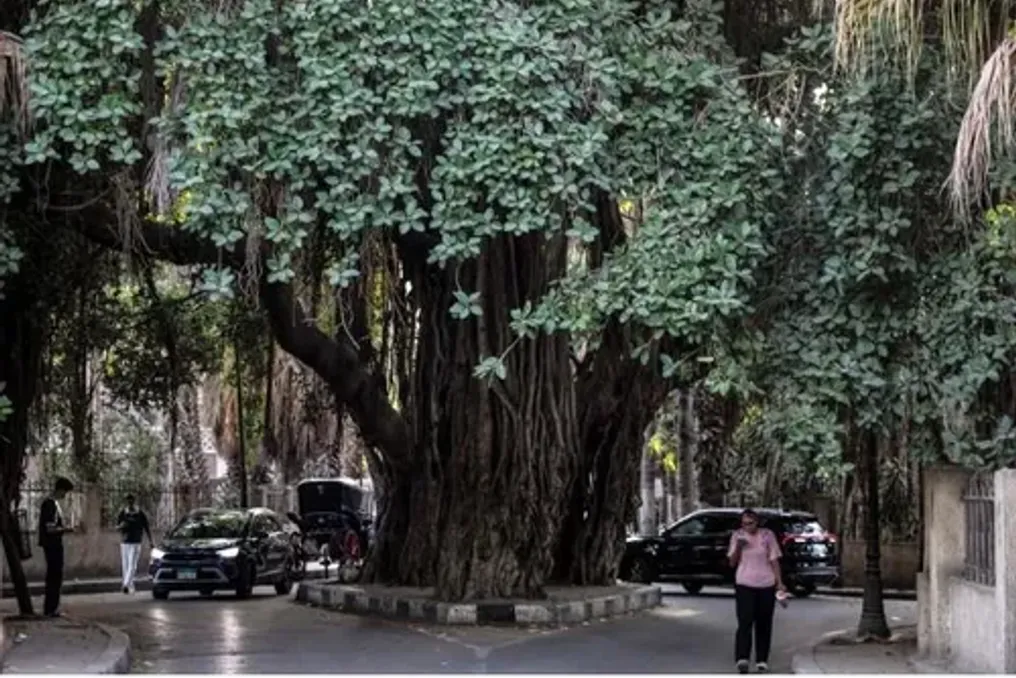
In the capital of Egypt, near the gates of Cairo Tower, a large old tree with thick, aged branches hangs over passing cars on the roadway. This type of ancient tree, coexisting with modern urban life, is becoming increasingly common in Egypt amid growing public and governmental attention to tree preservation and planting.
Earlier this month, Egyptian President Abdel Fattah El-Sisi instructed authorities to increase the number of green areas across the country, while Prime Minister Mostafa Madbouly ordered governorates to accelerate tree planting along main roads. The Ministry of Local Development and Environment subsequently tightened control over the cutting or uprooting of trees and advanced in implementing the presidential initiative to plant 100 million trees.
Parallel to this new greening campaign, work is underway to preserve trees that have stood for decades, and in some cases, centuries. Mohamed Abu Saada, head of the National Organization for Urban Harmony in Egypt, reported that his group is creating a 'national archive' of rare and long-lived trees as part of documenting the country's natural heritage.
According to Abu Saada, more than 2000 rare and long-lived trees are registered in Cairo, Giza, and Aswan, and work is currently being done in the Nile Delta city of El-Kanater El-Hayreya. This idea arose after he saw how people abroad celebrate and preserve a 60-year-old olive specimen. He noted: 'I thought Egypt deserves even more care for its trees, especially considering we have trees older than 200 years.'
Teams are using Geographic Information System (GIS) technology to record the location and condition of trees, transmitting this data to the 'City Memory' organization's mobile application so users can find rare and historic trees nearby. Currently, the project covers palaces and gardens, and Abu Saada plans to create forest trails where visitors can learn about rare and long-lived trees and the stories associated with them.
While one initiative looks to the past to protect Egypt's living heritage, another has focused the last decade on planting new roots for the future. Shagraha, an environmental initiative launched in April 2016, has planted over 750,000 fruit and woody plants in 22 of Egypt's 27 governorates, involving more than 250,000 volunteers, according to founder and CEO Omar El-Dib. He emphasized that the initiative's goal is sustainability, not just photography.
The initiative works in collaboration with local authorities, schools, hospitals, and other institutions to select locations where trees can receive permanent care. Egypt's presidential '100 Million Trees' initiative, launched in 2022, aims to increase green areas nationwide and improve air quality.
Mona Kamal, an Egyptian ecology expert and former head of the Egyptian Environmental Affairs Agency, believes that efforts to plant trees should be evaluated not only by the number of planted specimens but also by whether they will survive and be maintained in the long term. She stated that while planting new trees is valuable, the main goal must be ecologically sustainable, not publicity-driven. The expert particularly noted that protecting mature trees is critical in Egypt's desert climate, where cultivating new ones requires scarce water. She added: 'If you have a 200-year-old healthy trunk, it is a heritage, and it should be preserved.'