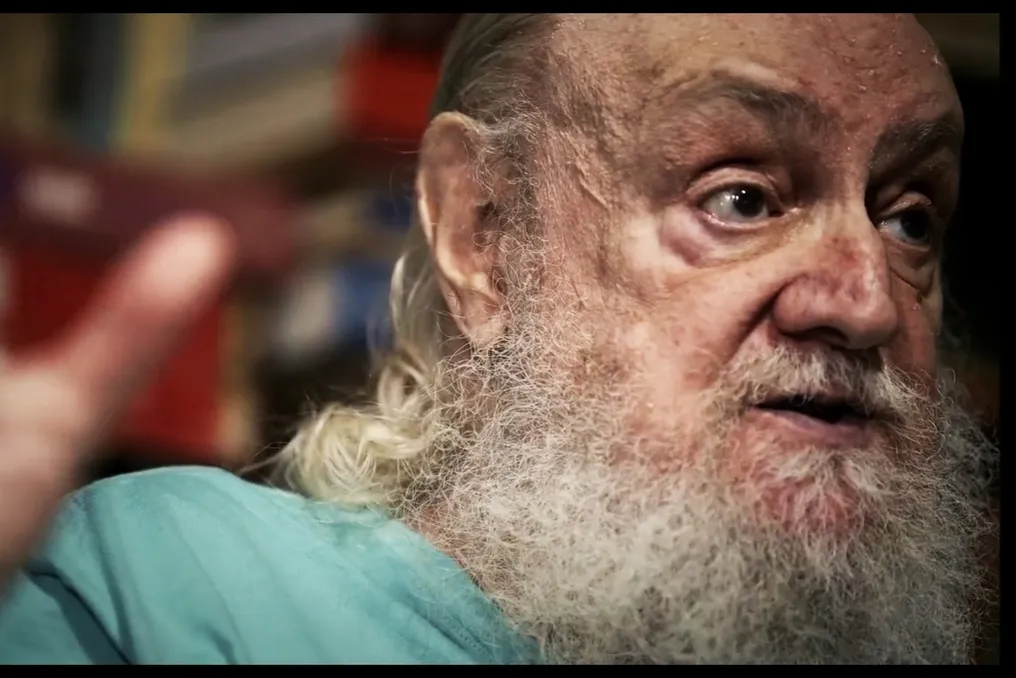
The work 'Aldir Blanc – Response to Time,' a documentary shown at the Rio Festival 2026, focuses on Aldir Blanc's transcendence as a composer of Brazilian popular music. The film, directed and written by Marcus Fernando and Hugo Sukman, features testimonials from the artist, who describes creation as something close to transcendence, despite being an atheist.
The documentary explores the trajectory of Aldir Blanc Mendes (born September 2, 1946, and died May 4, 2020), highlighting his excellence as a lyricist for melodies created with important partners such as João Bosco, Guinga, Moacyr Luz, and Cristovão Bastos.
In its conventional format, the film uses speeches and archival footage to reveal the behind-the-scenes of the Carioca bard Vasco's life, from childhood. One notable scene shows Aldir showing his 'masturbation album' to his grandson Vinicius. Early on, the poet declares: 'I didn't come here to make it easy, no. I came here to create problems.'
Before delving into his creative universe, the script details Aldir Blanc's biographical history. He was a physician with postgraduate studies in Psychiatry, but abandoned his career and his belief in God in 1974 after witnessing the death of his twin daughters, Maria and Alexandra, under circumstances of great suffering.
Due to the guilt felt for having left his mother with physical and mental sequelae after a complicated birth, Aldir dedicated himself entirely to music, starting with João Bosco, his first essential partner in the 1970s. For Aldir, the only recognized miracle was the harmony between his ideas and those of Bosco in musical composition.
After tracing the composer's path to music, the documentary investigates Aldir Blanc's ability to create imaginative, unusual, and unexpected verses, which transformed chronicles of urban Brazil from the artist's microcosm, located in the North Zone of Rio de Janeiro (RJ).
Aldir was born in Estácio and, at three years old, moved to Vila Isabel, a neighborhood associated with Noel Rosa. Later, he settled in Tijuca, where he spent time between his home, where he used to write lyrics in bed, and the bars, which he considers a 'temple' and 'living tradition of Rio de Janeiro.'
The desire to be a composer arose for him in 1965, after watching and hearing Elis Regina defend 'Arrastão' (by Edu Lobo and Vinicius de Moraes) at a song festival. This realization of creative transcendence occurred in 1972, the year the singer recorded 'Bala com bala,' a composition by Bosco and Aldir, a duo revealed that same year.
Aldir Blanc proudly states in the film that 'Bala com bala' was the first of almost 30 songs immortalized in Elis Regina's voice. He emphasizes that his work consists of 'lyricizing the music given to me and I don't touch a note.'
Throughout the documentary, it is evident how sacred the composer considered the moment of creation, stating: 'At that hour, at that moment, no one can do more than me.' Despite his sometimes dark temperament, the Carioca bard seemed lighter in moments shared with his grandchildren and his companion, Mari Lúcia de Sá Freire, besides the bars.
Aldir Blanc's greatest response to time, according to the text, was his survival of COVID in March 2020, at the age of 73. The final credits of the documentary confirm that Aldir Blanc Mendes overcame time through the power of his creation.