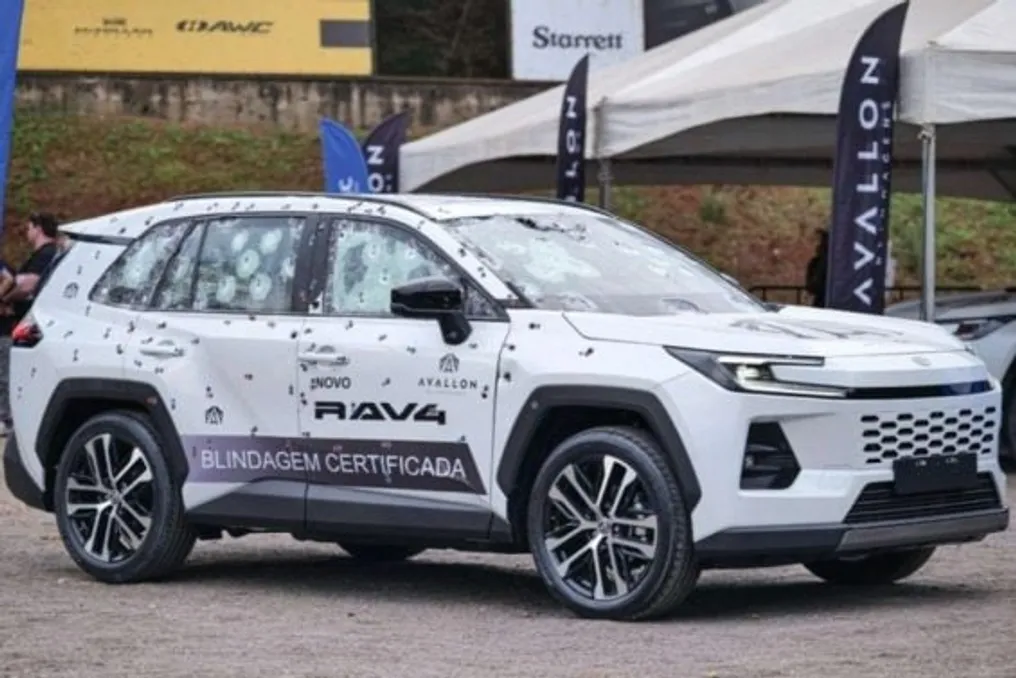
Brazil closed 2025 by registering the sale of 42,800 armored cars, establishing the country as a world leader in this type of protection solution. However, having this armor implies higher costs for vehicle maintenance.
This increase in expenses occurs mainly due to the extra weight generated by the armor, which intensifies the wear of certain components. Additionally, extra care must be taken, as the car operates constantly under a high load.
Other information about tires
The vehicles have specific indications regarding the correct tire pressure, found in the manual or on labels located on the driver's door sill or the fuel tank cap. These indications differentiate the values for an empty car and a loaded car.
According to Fábio Raymundo, after-sales manager at Avallon Blindagens, the recommendation provided to clients is to use the calibration intended for maximum load, emphasizing that there is no need to exceed this parameter.
The tires themselves display a load index, represented by two numbers in the specifications immediately following the wheel diameter, indicating the maximum weight each wheel can safely support.
For Fabio Magliano, training and product consultant for Pirelli for Latin America, changing this load index must be analyzed, as there is no fixed standard for such a procedure. It is essential to evaluate the weight added by the armor, how this weight is distributed across the axles, and whether the original tire load capacity is still sufficient for the final weight of the automobile.
If the load capacity remains within the established limits for the tire, replacement with a higher load index is not necessary. He advises changing the index only if the total weight of the car, plus the armor, exceeds the original limit. In the Brazilian market, there are no tires specifically developed for armored cars.
Fábio Raymundo, from Avallon Blindagens, also mentioned that solutions are available to preserve the vehicle's mobility in case of punctures. The most common is the Run Flat system (or protective belt), a belt installed inside the wheel that prevents the tire from deflating when it is empty, allowing the driver to get out of an emergency.
The extra weight of the armor also accelerates the wear of the suspension and steering systems. These components are subjected to greater demands compared to a similar vehicle without ballistic protection.
Mechanic Ludovico Ballesteros, owner of Pitucha Centro Automotivo, points out that the shock absorbers, shock absorber mounts, and suspension bushings are the most affected parts. Since there is no standardized durability for these items, the ideal is to ask the mechanic for a check during revisions, as driving with a compromised suspension represents a risk.
The increase in weight in an armored car is directly proportional to its size. Mechanics must pay attention to this factor to ensure that the lift has the capacity to raise the vehicle safely. Ludovico Ballesteros adds that it is crucial to be careful when positioning the car on the lift to avoid twisting the bodywork, which can result in glass breakage, as this part becomes more susceptible to twisting after armoring.
The extra costs for the owner do not cease after armoring; maintenance expenses will continue to be higher.