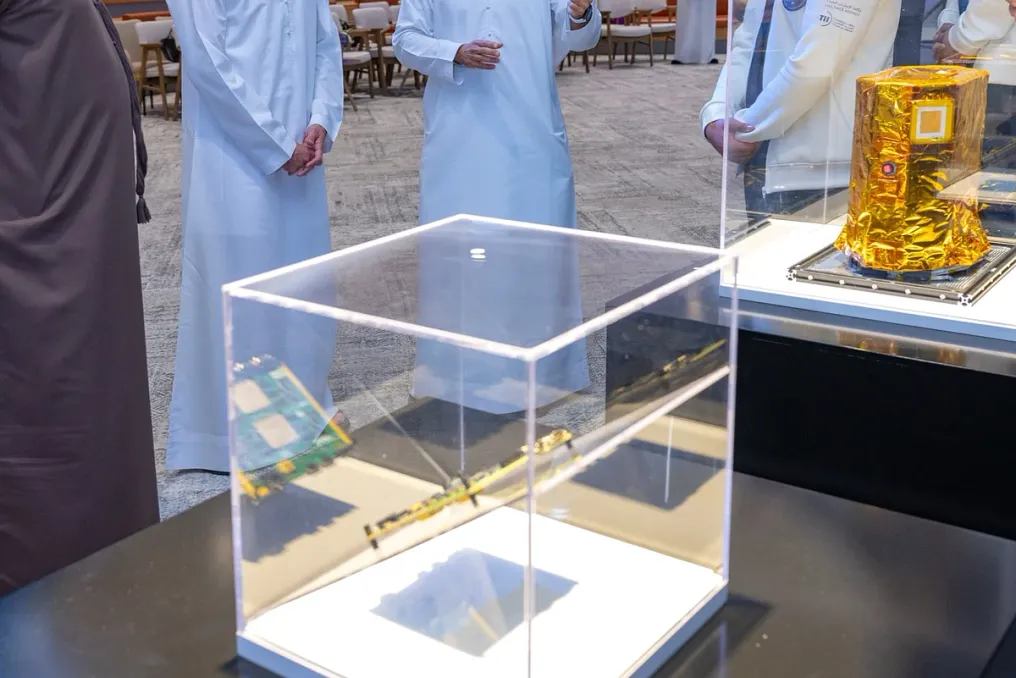
The United Arab Emirates has unveiled a probe for its large-scale mission to explore the asteroid belt. This was announced by Dubai's Crown Prince Sheikh Hamdan bin Mohammed bin Rashid Al Maktoum, who noted that the probe was prepared for flight in less than two years.
In a post on the social media platform X, Sheikh Hamdan stated that the probe was 'developed, assembled, and tested in the UAE' and reached full flight readiness in about two years. He also emphasized the growing significance of Emirati engineers and scientists within the national space program.
The 'Emirates in the Asteroid Belt' (EMA) mission plans to send the MBR Explorer spacecraft on a journey of 5 billion kilometers to study seven asteroids. The launch is scheduled for 2028. To reach the main asteroid belt beyond Mars, the craft will utilize gravitational capture maneuvers around Venus, Earth, and Mars.
Sheikh Hamdan stated that currently over 150 engineers and scientists are working as a unified national team on this task, which covers a 5-billion-kilometer journey to study seven asteroids.
Furthermore, Sheikh Hamdan highlighted the economic growth of the UAE's space sector, which is currently valued at over 44 billion dirhams. He set a goal to double revenues from the space economy by 2031 and place the UAE among the top ten global space economies.
This mission is conceived not only as a scientific exploration program but also as a tool for developing the private space sector, academic capabilities, and advanced technology ecosystem in the UAE.
The UAE Space Agency reported that 50 percent of the project work has been entrusted to private companies based in the UAE. The mission is expected to create opportunities for startups, international partnerships, and investments in the local space industry.
The total duration of the mission will be 13 years: six years for spacecraft development and seven years for the journey through the main asteroid belt. MBR Explorer must make close flybys of six asteroids before reaching the seventh, Justitia, where a lander module will be deployed to collect surface data.
The mission is expected to provide scientists with information on the composition, geology, density, temperature, and other characteristics of the asteroids, helping researchers better understand the formation and evolution of the Solar System. The UAE Space Agency has also identified the potential resource value of water-rich asteroids, including the possibility of utilizing these resources in future space exploration.
For the UAE, this mission is also a way to build internal competencies. Sheikh Hamdan concluded: 'We are proud of the Emirati minds turning ambitious aspirations into achievements, and we continue to invest in people, knowledge, and technology to shape the new future of the UAE in space.'