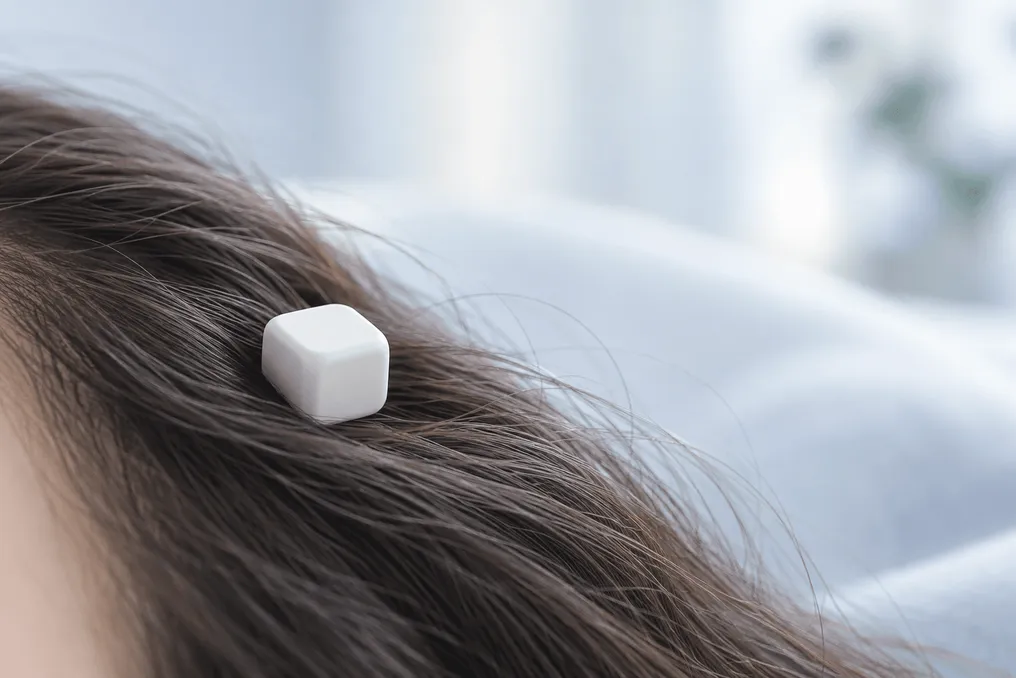
The Brain-Computer Interaction and Human-Machine Integration Laboratory at Tsinghua University, in collaboration with a local company specializing in non-invasive brain-computer interfaces, has introduced a cubic, fully integrated non-invasive BCI system. This system weighs approximately 3 grams and occupies about 2 cubic centimeters.
The university announced the device on September 30th, calling it the smallest and lightest non-invasive BCI system to date. Unlike most non-invasive EEG equipment, which comes in the form of caps, helmets, or headbands, the new system integrates EEG electrodes, a signal circuit, a battery, and wireless transmission into one tiny module.
Thanks to its specially designed structure, the device attaches to the scalp, remaining inconspicuous among the hair. The team notes that it is so light that wearing it feels almost imperceptible.
Overcoming BCI Limitations
The laboratory positions this device as a solution to three problems that have traditionally limited the application of BCI in laboratory settings: form factor, signal quality, and battery life. According to the university, the main performance indicators meet the requirements of GB 9706.226-2021—China's national standard for electroencephalographs. This allows the system to accurately and stably record weak brain signals.
The system is capable of operating at a sampling rate of 1000 Hz and functioning for 8 to 10 hours on a single charge, which is sufficient for prolonged brain-computer interaction tasks.
System Applications
The team indicated a wide range of potential applications. In clinical and consumer fields, the system can monitor physiological and pathological indicators related to EEG for extended periods, as well as support brain-controlled device and game operation. In education and research, it enables multi-user hyperscanning, allowing simultaneous recording of multiple people's brain activity, as well as conducting online cognitive function measurements during learning. Furthermore, the device can be used as a non-invasive signal source for neurofeedback and sleep staging.
The laboratory is also developing this system for workplace safety. With the support of agencies responsible for special operations and emergency management, joint work is underway with leading companies and universities to create a safety management model using BCI and wearable devices for special operations personnel, aiming to protect individuals in hazardous roles.
Haihe Lab, one of the first BCI research groups in China, is supported by the municipal government of Tianjin and established by Tsinghua University. The laboratory works across all levels of development—from chips and electrodes to core algorithms, system integration, and platforms. The university reports that the team has helped bring over 20 medical BCI devices to market, benefiting thousands of patients. Information regarding pricing or the launch date of the new system has not yet been disclosed.