Captain of Western Indies Shay Hope defeats India with a decisive innings
Read more
Aaj Tak
www.aajtak.in

Captain of Western Indies Shay Hope defeats India with a decisive innings

In the third match of the three-match ODI series, held on October 3rd in Mullampur (New Chandigarh) against India, the Western Indies team made a splash by achieving an impressive target of 352 runs.

The central figure in this historic run chase was Western Indies captain Shay Hope, who played an outstanding innings, remained unbeaten, and scored 162 runs under immense pressure. Hope, named 'Player of the Match', shared the secret to his innings, revealing that advice from former Indian captain Mahendra Singh Dhoni helped him develop the correct strategy in a difficult situation.

During the match, India, having won the toss, started the game by scoring 351/7 runs in 50 overs. In response, the Western Indies surpassed this target, scoring 352/5 runs in 48.2 overs, securing a victory by five wickets. Thus, the visitors concluded the three-match series honorably. Notably, the Indian team had already secured the series after winning the first two games.

Shay Hope stated that before the run chase began, a phrase spoken by MS Dhoni echoed in his mind. He mentioned a pleasant conversation with the great player MS Dhoni, who advised him: 'You always have more time than you think.'

This thought formed the basis of Shay Hope's playing strategy. He avoided risk at the start of the innings, stabilizing the game's flow, and progressed by breaking down the target into smaller parts. His goal was to prepare for the final over-attacks. Hope noted: 'I didn't want to focus too much on the result. I needed to concentrate on the process. I tried to divide the game into parts and find a way to score runs in the later stages.'

Shay Hope first reached fifty off 46 balls. After that, he completed his 21st ODI century off 104 balls. However, after reaching a century, his style of play completely changed. In the next 39 balls, Hope scored 62 runs. He maintained the pace of the Western Indies throughout until the end and put pressure on the Indian bowlers.

After Kim Pollard got out in the 41st over, a new problem could have arisen for the Western Indies, but Shay Hope, along with Gudakesh Motie, changed the course of the match. They scored 62 runs without losing a wicket in just 29 balls, allowing the team to reach the target.

Shay Hope also monitored the slow pace of the Indian team's overs. He understood that if India did not complete the overs on time, an extra fielder would have to be placed within the 30-yard circle in the last four overs. He stated: 'I also considered that the Indian team was behind in terms of overs. I knew that in the final stage they would have to bring some fielders inside the circle.'

In Hope's opinion, he took all these circumstances into account while pursuing the target and tried to leverage their advantage in the closing overs.

The significance of Shay Hope's innings is amplified by the fact that he was not limited to the role of a batsman in this match. He also acted as a wicketkeeper throughout the entire Indian innings. He had to start the game behind the stumps after Joel Andrew's injury. That is, after 50 overs behind the stumps, he had to come out to bat. Furthermore, the Western Indies batting lineup was not entirely reliable, placing additional responsibility on Hope. Despite this, he did not lose patience.

Shay Hope revealed that after about 30 overs of the game, he started feeling discomfort in his groin area. Nevertheless, he continued playing and remained on the field until the end. His unbeaten innings of 162 runs demonstrated a magnificent combination of patience and aggression. Initially, he preserved the wicket, and as he approached the target, he started hitting powerful shots.

This run chase was the most successful in the history of the Western Indies in ODIs. It was Shay Hope's second consecutive century in this series. He also scored a hundred in the second ODI of the series, but this time his performance will be remembered not only for bringing the team a historic victory but also for interrupting India's continuous winning streak.
Similar stories

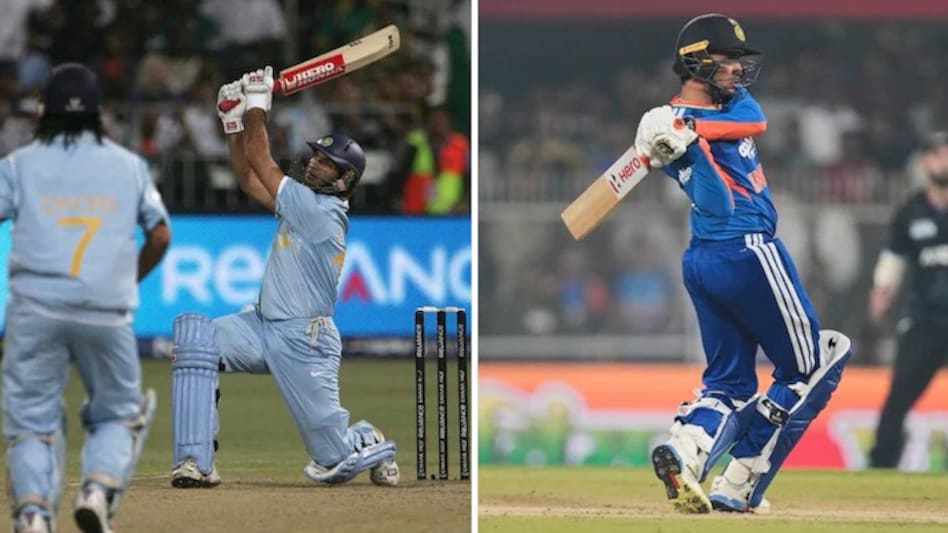
Yuvaraj Singh shows mastery in match against Australia after Abhishek's performance
Read more
www.aajtak.in

Yuvaraj Singh shows mastery in match against Australia after Abhishek's performance

The India Champions team secured a convincing victory over the Australia Champions with a score of 46 runs in the World Championship of Legends 2026. In this match, held at the Sharjah Cricket Stadium, cricket veterans demonstrated their mastery.

In the first game of the tournament, India Champions performed brilliantly, defeating Australia Champions by a margin of 46 points. The game began with India batting first and scoring an impressive 196 runs in 20 overs, losing 7 batsmen. In response, the Australian team managed to score only 150 runs in 16.2 overs. This excellent interaction between Indian players in attack and defense warned opponents of serious competition right from the first match of the tournament.

While young batsman Abhishek Sharma made a sensation in the Asian Games 2026 final, hitting a flurry of sixes against long-time rival Pakistan. On the other hand, the captain and experienced all-rounder of the India Champions team, Yuvaraj Singh, proved that 'the lion is not old yet' while playing in the Legends League (WCL).

In the highly competitive match for the gold medal at the Asian Games held in Itte-Nagoya, Japan, India won the auction and decided to start the game with the batsmen coming out first. Young and explosive batsman Abhishek Sharma hit a powerful blow against the Pakistani bowlers from the very beginning. He scored an impressive 61 runs in just 28 balls, including 7 magnificent sixes. Thanks to this amazing performance, he equaled Yuvaraj Singh's record for the number of sixes in a single innings in India-Pakistan T20 matches. With the innings of Abhishek and Tilak Verma (who remained on the field with 51 runs), India scored a huge total of 211/6 and subsequently restricted Pakistan to 192 runs, winning the gold medal.

While young Abhishek created a storm at the Asian Games, in the Legends Cricket match, the India Champions team, led by Yuvaraj Singh, returned to its old style of play against Australia Champions. As soon as Yuvaraj came onto the field, he started raining down fours and sixes in his usual style. He scored a brilliant 71 runs in just 44 balls. During this innings, Yuvi batted at a strike rate of 161.36, hitting 4 fours and 5 high sixes. His outstanding innings helped the team reach a strong score. Cricket fans were delighted by these powerful performances played in one day by both the teacher (Yuvaraj Singh) and the student (Abhishek Sharma).

India wins match against Japan by two runs despite low score
Read more
www.aajtak.in

India wins match against Japan by two runs despite low score

Despite the perceived large gap between India and Japan, the match at Sanno International Stadium on Tuesday, played in a five-over format, completely changed perceptions of the upcoming rivalry. The Japanese team, whom many considered incapable of facing Indian bowlers, managed to keep India under pressure until the final delivery. Ultimately, India won by only two runs, but this result raised several questions.

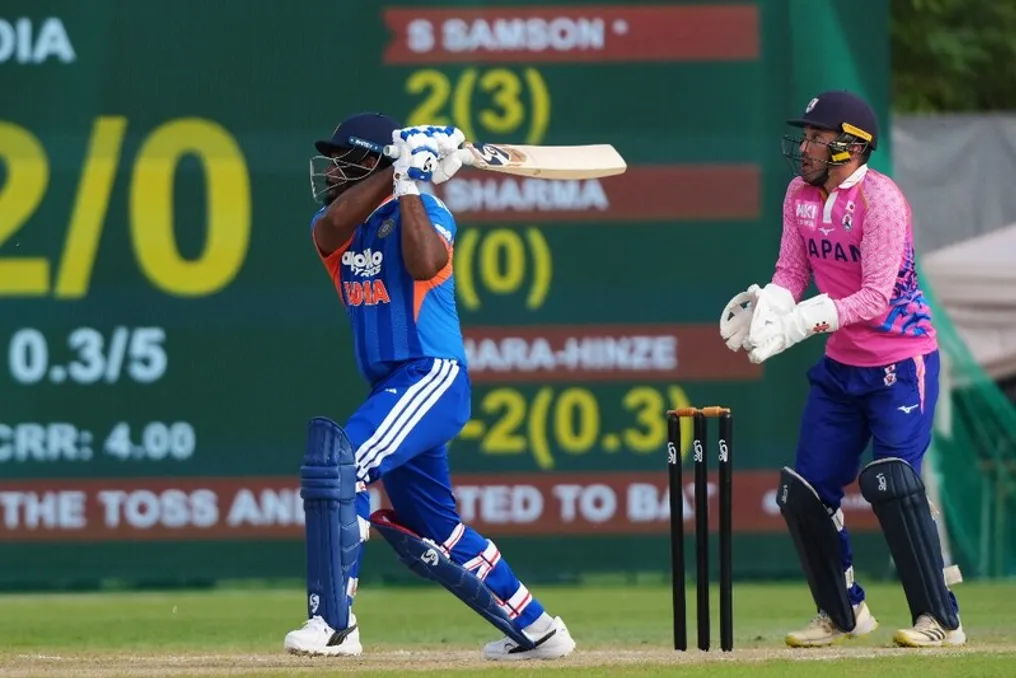
One of the most significant issues was Vaibha Suryavanshi's inability to participate in the match. Due to rain, the game was shortened to five overs. Under these conditions, India kept its starting pair of Sanju Samson and Abhishek Sharma, leaving Vaibha out of the squad. Abhishek returned after coming onto the field without scoring a single run, while Samson managed only 9 runs.

India had the option of using Vaibha for an aggressive game approach, but the team management decided to stick with the established starting combination. The situation was complicated by the fact that the Indian attack stumbled, losing four batsmen while scoring 32 runs in five overs.

Since Vaibha Suryavanshi was not in the squad, he was seen on the field during the match distributing water to the players. The young batsman, from whom bright shots were expected, served solely as a 'water boy' in this game. He was visible on the field handing water to the players, and his facial expression was captured by the camera.

This match also held significance in the context of celebrating the 75th anniversary of diplomatic relations between India and Japan. Both teams are preparing for participation in the Asian Games, where India is scheduled to start its tournament in the quarterfinals. Thus, this confrontation served as an opportunity for India to test its readiness for the Asian Games.

When the match was shortened to five overs due to rain, the question naturally arose as to why the young and explosive batsman Vaibha Suryavanshi was not used. However, the Indian team retained the opening pair of Sanju Samson and Abhishek Sharma, and Vaibha did not get a spot in the squad. The result was the halting of India's score at 32 runs against the Japanese spinners.

The problem for the Indian batsmen was not the strength of the known bowlers, but the Japanese spinners, against whom it was expected that the Indian players would hit powerfully. The pitch was humid, and the ball spun more than expected, which became a weapon for the Japanese bowlers.

Charlie Hara edged Abhishek Sharma for zero. Abhishek attempted a slog sweep but lost his timing. Following this, Ibrahim Takahashi forced Samson to play in the air for 9 runs, and he was caught at mid-wicket. Ishan Kishan also returned with three runs; he continued to try hitting against constant spin and was caught at mid-off.

Captain Shreyas Iyer scored 16 runs, but even he could not play freely due to the slow pace and spin of the pitch. In the Indian innings, only three-quarters were scored.

With such a small target of 32 runs, one might have assumed India would finish the match by several runs. However, in this unusual five-over contest, this small score became a pressure point for India. In the third over, Ravi Bishnoi earned 10 runs for Japan, and Washington Sundar conceded seven runs in the fourth over. In the last over, Japan needed only eight runs.

It was the experienced Akshar Patel who saved India. With over 150 IPL matches of experience, Akshar did not give the Japanese batsmen a chance to flourish in the last over. He placed the ball in such a way that Shirai Patmore and Benjamin Ito-Davis were unable to hit powerful shots.

Due to the rain, the pitch was also slow, which complicated matters for Japan. On the last delivery of Japan, a boundary was required, but Akshar Patel prevented this. Shirai Patmore tried to hit over the line, but the ball hit the pad and went towards the fine leg, and the batsman could only run one run. Thus, Japan's hope for a historic comeback ended, and India won a very tense match by a margin of two runs. Disappointment was evident on the faces of the Japanese batsmen, as they were confident they were very close to one of the greatest turns in cricket.

The drama in the last over intensified when umpire Chris Torgate called two wide balls against Patmore, who was attempting a reverse slog. India's captain Shreyas Iyer expressed disagreement with the on-field umpire Chris Brown. The decision on the second wide was ultimately overturned. This meant that in the final moments of the match, India was fighting not only against the Japanese batsmen but also against the decisions of the umpires.

Vaibha remained out of the game, but the match raised a second question.

Popular