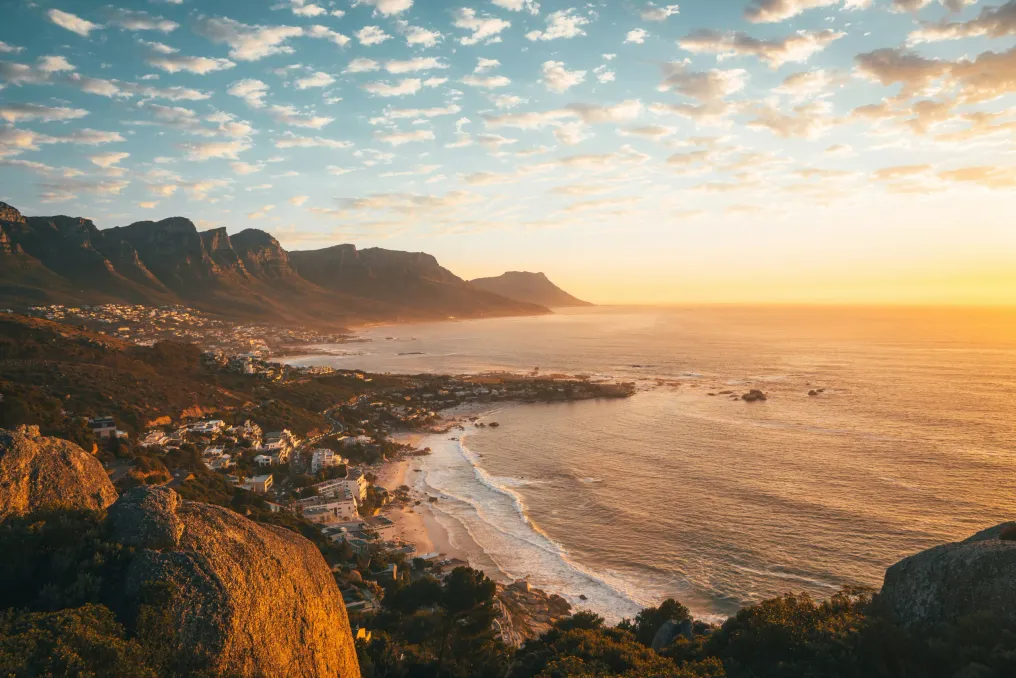
A new study has identified the factors behind the most impressive spots for watching sunsets during the 'golden hour' around the world, covering landscapes from deserts to views of the Atlantic Ocean.
Although the 'golden hour' is often one of the most photographed moments of travel, the research suggests that a memorable sunset involves more than just being in the right place at the right time.
Researchers from Kuoni Travel UK, in collaboration with the founder of British Weather Services and senior meteorologist Jim Dale, analyzed 165 global destinations. The assessment used parameters such as cloud cover, light pollution, precipitation, wind speed, artificial brightness, and average sunset duration.
The results showed that Wadi Rum in Jordan ranked first in the global rating, while Namibia performed strongly, including three locations in the top six. Although Cape Town did not make the top 20, the data provides an interesting insight into the city's long-standing appeal for sunsets.
The study went beyond purely visual appeal, using weather and environmental conditions to determine the suitability of various locations for the 'golden hour'. Cloud cover received the highest weight among factors (35%), followed by light pollution (20%). Precipitation and artificial brightness accounted for 15% each, wind speed for 8%, and average sunset duration for 7%.
Dale explained that the most saturated light is usually observed during sunset and civil twilight, when the sun is close to the horizon. He noted: 'Broken clouds on the horizon can enhance colors, whereas full coverage or fog will spoil them.'
It was also found that low levels of artificial lighting, light wind, and elevated vantage points contribute to stronger 'golden hour' conditions. Wadi Rum scored the highest—95.92 out of 100, followed by Socotra Valley in Namibia with 94.93 and Damaraland with 91.83. Namibia emerged as a standout country, as Socotra Valley, Damaraland, and Etosha National Park made the top six.
A broader look at Africa included the Okavango Delta in Botswana at seventh place, Victoria Falls in Zimbabwe at eleventh, and Livingstone in Zambia at eighteenth. Chobe River in Botswana also placed in the top ten (13th place).
Socotra Valley's ranking was attributed to low cloud cover, no light pollution, and a 'golden hour' period lasting almost 28 minutes, according to the study. Other highly ranked locations included Atacama in Chile, Wahiba Sands in Oman, Uluru-Kata Tjuta National Park in Australia, and the Acropolis of Lindos in Greece.
Despite Cape Town not being in Kuoni's top 20 list, the Mother City boasts several well-known viewpoints where the sunset is an integral part of the visitor experience. The Cape Town tourism company highlights places such as Signal Hill, Lion's Head, Table Mountain, Sea Point Promenade, Bloubergstrand, Clifton, and Sunset Beach as sunset viewing spots, as indicated by Cape Town Travel.
Specifically, Bloubergstrand offers a well-known view across Table Bay to Table Mountain, while Sunset Beach provides another western vantage point over the Atlantic. For Dale, geography and atmospheric conditions work together to shape the colors visible in the final stages of daylight. He emphasized: 'After this, you need minimal light pollution, light wind below 10 mph, and ideally, an elevated viewpoint that lowers the visible horizon and extends twilight.'
The study notes that some atmospheric haze can deepen red and orange hues due to the scattering of sunlight by particles, whereas heavier dust or smoke can obscure the horizon. This explains why the 'golden hour' is not just about finding a spot with a clear view of the setting sun; the conditions on any given day still determine what will be visible in the sky.
For locals and tourists wishing to experience the 'golden hour' without leaving the city, the Cape Town coast offers several options. The Cape Town tourism company previously pointed to Signal Hill for its elevated views of the city and the Atlantic coast, while Sea Point Promenade offers a lower coastal landscape. Table Mountain provides elevated views, depending on operational conditions and cable car descent times.
Further north, Bloubergstrand and Sunset Beach offer views of Table Mountain, while Clifton and Muizenberg Cove open perspectives across the Atlantic coast. For those seeking locations outside the city center, Chapman's Peak Drive also has several viewpoints along the Atlantic coast where the sunset becomes part of the experience.