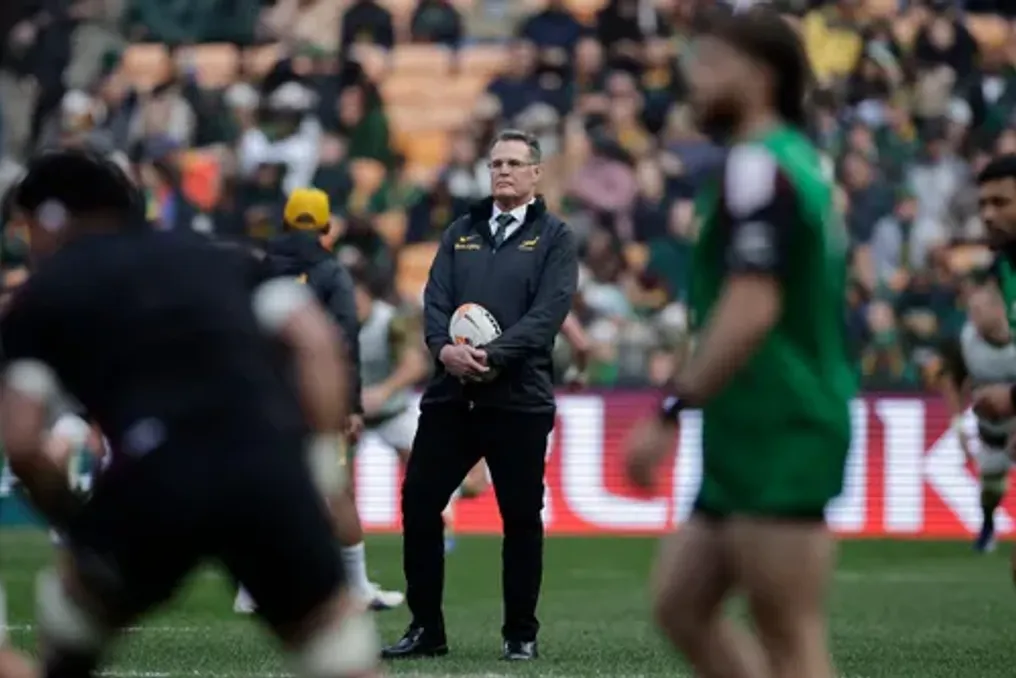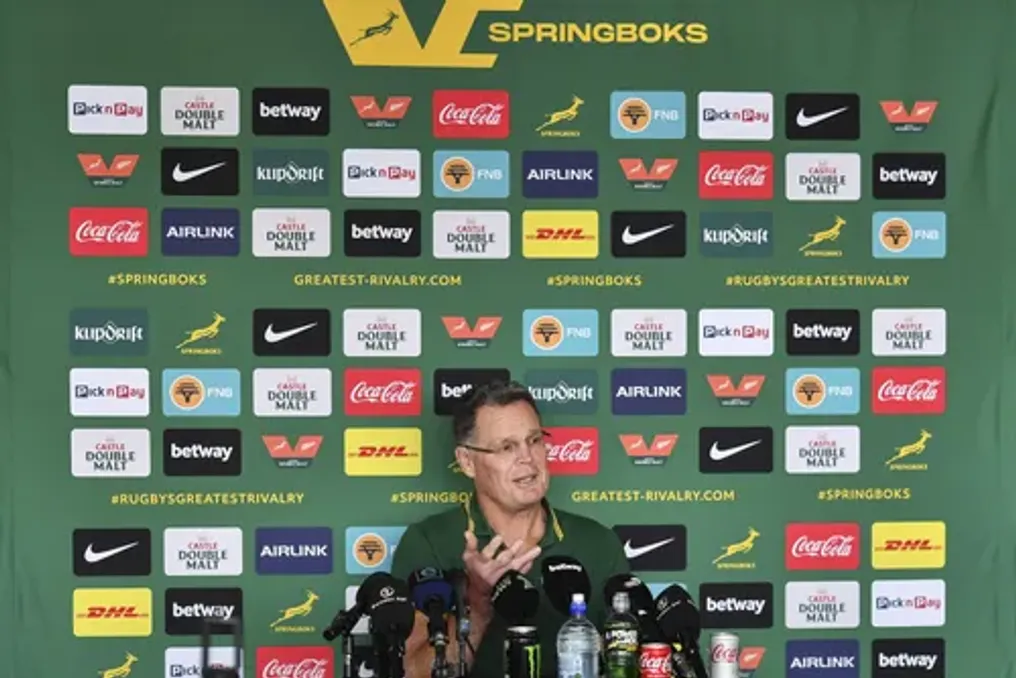
After defeat to Australia, Rassie Erasmus noted the need to respect the Australian team
Read more
IOL
iol.co.za

After defeat to Australia, Rassie Erasmus noted the need to respect the Australian team

Despite dominance in world rugby, the narrow 7-6 scoreline between South Africa and Australia under Rassie Erasmus points to a persistent psychological barrier that arises when the Wallabies team follows a tense confrontation with the All Blacks.

The Clash in Perth

A few days before the match in Perth, Duane Vermeulen was asked at a press conference about why the Springboks traditionally struggle to beat Australia, especially after playing against the All Blacks. This prominent player and current Bok assistant coach dismissed the question, stating: 'When we play against the Wallabies, we just go out to play and have fun.'

However, the question was not so much about tactics as it was about the long-standing inability of the Boks to fully respect the Wallabies as opponents—perhaps not consciously, but on a subconscious level. For the Springboks, the motivation to beat an old rival is as natural as breathing, and they don't need to say any words before a game against the All Blacks.

Of course, in the team meeting before the Perth match, Rassie Erasmus likely warned the players not to drop their pace after a series of games in the 'Great Rugby Rivalry.' He reminded them of the Wallabies' improved form over the last year and that Australia remained undefeated under their coach, Les Kiss. Nevertheless, the Springboks team, which looked stronger on paper, lost again to Australia.

Is it possible that subconsciously the Springboks do not rate the Wallabies highly enough? How else can one explain the frequency with which this extremely successful Springboks team stumbles against Australia?

Since Erasmus took over in 2018, the Boks have played 13 matches against Australia, winning seven and losing six. Thus, the overall record is still in South Africa's favor, but only slightly. This is significant because this period coincided with perhaps the most difficult time in Wallabies history.

Tactical Decisions and Experience

Furthermore, the loss in Perth had a more conscious aspect: Erasmus might have underestimated Australia by changing the team composition too actively. To be fair to the coach, many of his front-row players were exhausted after the four-match 'Great Rugby Rivalry' series against the All Blacks. They had completely depleted their physical and mental reserves.

But the decision to make 13 changes to the starting lineup proved to be a failed gamble. Erasmus learned one valuable lesson from Perth: if he uses substitutes extensively, there is a significant drop in performance compared to his initial lineup.

These 13 newcomers in the starting fifteen are very good players. However, South Africa's front-row players are better. Malcolm Marx represents a significant step up from Johan Grobbelaar; Jan-Hendrik Vessels is not yet equal to Ox Nche; Zac Porteous has a long way to go before he can be compared to Vilko Lowe; and Pieter-Steph du Toit, Jasper Wiese, and Damian Willemse are among recognized players who are exceptionally difficult to replace.

There were suggestions that the depth of the Springboks squad was not as great as advertised after the loss to Australia. This would be an overreaction.

In the next World Cup, Erasmus will not field the Perth lineup against a Tier One level team. He will use his broader squad within the structure of his strongest team. For example, Grobbelaar could play alongside Lowe and Nche if Marx needs a rest, and the drop in performance would be much smaller because the combination around him would be stronger and more stable. After all, that is how squad depth should work.

Aside from bruised self-esteem, Erasmus returned from Perth generally satisfied with the progress since the start of the season, which began with a victory over England in the July 4th Nations Cup. The old guard led the All Blacks to a 3-1 defeat, while Paul de Villiers, Ethan Hooker, Cameron Hanekom, Morne van den Berg, and Roan Nortje demonstrated that they are true professionals.

The Boks remain in exceptionally good health. They have not lost two consecutive matches since November 2022 and have lost only six matches since the start of the 2024 season. Their win ratio in World Cups under Erasmus is something previous Springboks coaches could only dream of. Therefore, Perth should be seen not as a crisis, but as a reminder.

Similar stories

Australian experts' accusations against the Springboks regarding the Eben Etzebeth incident reveal hypocrisy
Read more
iol.co.za

Australian experts' accusations against the Springboks regarding the Eben Etzebeth incident reveal hypocrisy

Accusations of rule manipulation sound unconvincing when directed at the experienced lock player Eben Etzebeth, who has a history of concussions. This is particularly noteworthy given that the union used HIA rules to avoid dominance in scrums.

Australian rugby experts enjoy provoking controversy when it comes to the Springboks. Yet, they possess a remarkably short memory when it concerns their own team, the Wallabies.

Following the Springboks' defeat in Perth, former Wallabies players Michael Hooper and Morgan Tuinui quickly demanded a 'very serious' investigation by World Rugby. They labeled the substitution incident involving Eben Etzebeth as a 'farce.'

In the 67th minute, confusion occurred on the bench after Etzebeth, who sustained a neck injury, could not immediately return to the field, even though the Springboks management initially directed him for a head injury assessment (HIA).

Etzebeth, who has a well-documented history of severe concussions, was cleared from HIA and attempted to re-enter the game. However, the Wallabies bench objected to his replacement, Franco Mostert, claiming the Boks were attempting an illegal substitution.

Considering that Etzebeth missed a significant portion of rugby after a severe concussion with the Sharks in late 2024, and was also withdrawn earlier this year against England due to a head injury, exercising maximum caution regarding his neck and head can hardly be called 'playing on nerves'—it is a basic duty of medical care.

Nevertheless, Australian commentators took a morally high ground, accusing the Boks of deliberately violating safety protocols. This hypocrisy is astonishing.

One need only recall 2024, when the Wallabies demonstrated one of the most blatant and cynical examples of rule manipulation in recent history against the same Springboks.

Faced with a dominant South African scrum, Australia suddenly encountered a 'marvelous epidemic' of head injuries among its starting front-line players and reserves. According to World Rugby rules, if a team loses all capable props due to standard injuries or yellow cards and is forced into undeniable scrums, it faces a penalty of being reduced to 14 players. However, if these front-line departures are classified as 'head impacts' or HIA, the team is allowed to maintain a full squad of 15 players on the field.

Miraculously, the Australian props suffered consecutive head injuries, allowing them to achieve undeniable scrums, neutralize the main weapon of the Springboks in scrums, and keep fifteen players on the field.

Thus, former Wallabies players now appearing on podcasts condemning South Africa for a 'failed attempt to bypass safety rules' due to an obvious medical misunderstanding involving a player with a history of brain injuries is the height of hypocrisy.

Rassie Erasmus's bench strategy carries inherent tactical risks, especially when all players are substituted early in the second half. An unreplaced injury can easily lead to the team being outnumbered.

But equating genuine medical caution regarding a vulnerable veteran lock with systematic cheating is deeply regrettable, coming from a nation that has turned the HIA protocol into a tactical 'lifeline card' to avoid intense pressure in the scrum.

World Rugby could certainly consider communication in Perth to strengthen procedural administrative work between fourth referees and team managers. Nevertheless, if Australian rugby wishes to start pointing fingers at teams manipulating safety protocols for tactical advantage, they should first take a good look in the mirror.

Springboks need to improve defense and attack before the World Cup
Read more
iol.co.za

Springboks need to improve defense and attack before the World Cup

Despite winning the series against the All Blacks, the Springboks coaching staff, including head coach Rassie Erasmus, is not entirely satisfied with the results of recent months. Following a demanding period in the Southern Hemisphere, which included intense rivalry in the Rugby's Greatest Rivalry series against the All Blacks and a match in Perth against the Wallabies, the team must undertake significant work ahead of the upcoming World Cup in November.

The double world champion team remains a global benchmark in rugby, but recent match statistics point to several issues. Weaknesses have begun to show in the Springboks' armor against opponents, including porous defense in wide channels and uncharacteristic errors in finishing attacks within the 22-meter zone.

Although the team's fundamental foundation remains at the highest level, the margin between teams in elite test rugby is extremely small. This requires the coaching staff to define priority areas for work before traveling to the Northern Hemisphere. Considering the upcoming matches against Italy, France, and Ireland, it is urgently necessary to refine these aspects.

To maintain their dominance outside of home grounds, Rassie Erasmus and his management must improve these areas over the next month.

Strengthening Wide Channel Defence

The Springboks' defensive wall showed alarming breaches in the flanks, forcing the team to rely on chaotic defense. Conceding 22 touchdowns in five test matches—averaging more than four per game—is a startling statistic for a team built on defensive solidity. The Boks allowed 129 missed tackles compared to 99 by the All Blacks, as opposing attackers regularly found space on the wings. While efforts in chaos saved them from several certain scores, Jerry Flannery's defensive system must restore its cohesion by November.

Clinical Edge in Wide Attack

Despite demonstrating moments of dynamic ball-in-hand play, South Africa's wide attack remains ineffective in the opponent's 22-meter zone. In the series against the All Blacks, New Zealand scored 17 touchdowns against 14 for the Boks, made more line breaks (35 against 28), and showed significantly greater clinical efficiency upon entering the zone (3.5 points versus 2.6). Although counterattacks showed noticeable improvement during the Baltimore match, it was the direct running and power play of the Boks that helped them gain the series advantage. The team needs to bridge the gap between its power play and execution in the wide attack to maximize the return from numerous entries into the 22-meter zone via scrum and maul penalties, instead of allowing disappointing turnovers.

Lineout Consistency and Defensive Pressure

Although the Springboks' lineout proved very effective against New Zealand—they lost only two throws while forcing eight turnovers from the All Blacks—the set-piece play noticeably faltered in the match against Australia. The absence of Malcolm Marx exposed vulnerabilities in the throws, and the defensive contest mysteriously disappeared in Perth. Lineout accuracy and pressure on the opposition cannot depend on the lottery dictated by player substitutions. Before the World Cup, the Boks must achieve absolute stability at the hooker position and find a player capable of matching Marx's influence so that their primary attacking platform remains reliable.

The Significance of Springboks' Victory Over New Zealand for World Cup Preparation
Read more
iol.co.za

The Significance of Springboks' Victory Over New Zealand for World Cup Preparation

Despite the South Africa loss to New Zealand by a score of 3:1 being a significant achievement that allowed Rassie Erasmus to gain tactical insights and time to prepare for the upcoming World Cup, the true value of this victory may only be revealed in thirteen months, at the tournament in Australia.

The victory over an old rival in such a convincing manner cannot be underestimated. This win is valued higher than winning a Rugby championship title and is comparable to the series of matches against the British and Irish Lions, only surpassed by a World Cup victory. Thus, the series of victories over major rivals holds immense importance for Rassie Erasmus.

Having secured this trophy at the SA Rugby office in Cape Town and cemented the monumental victory, the coach can now fully concentrate on building the campaign for Australia 2027. During the RGR (Rugby’s Greatest Rivalry) series, Erasmus managed to answer many questions, gaining a clearer picture of the players who are likely to make the World Cup squad, as well as those aspects of the game that still require refinement. Importantly, the victory provided him with the opportunity to assess the reserve squad.

Most of the RGR stars will likely be in attendance in Perth on Sunday, September 27th, to watch the refreshed team battle the Wallabies. The success also gives Erasmus the option to keep some heroes—especially those over 30, of whom there are many—at home during the trip to Europe for the November World Cup, where the Boks will play Ireland, France, and Italy, concluding the series in Twickenham.

It is worth recalling Erasmus's cautious comments regarding the World Cup shortly before it began, after the victory over England at Ellis Park on July 4th. He was diplomatic, essentially stating that the Springboks would evaluate the tournament as it unfolded. However, they achieved victories over England, Scotland, and Wales. Nevertheless, the motivation was never to achieve the best position for November; the goal was to achieve combat readiness for the confrontation with the All Blacks.

A crucial point is that next year will host a full Rugby Championship, not a mini-version as is often the case in the year of the World Cup. This means the Boks, All Blacks, Argentina, and Australia will each play six matches, all taking place just a few months before the start on October 1st in Sydney. Erasmus needs to focus specifically on this Rugby Championship.

To do this, he cannot afford to overload his top players in an exhausting end-of-year tour. These players also have club commitments, whether playing in Japan or in the United Rugby Championship. The Sharks, Stormers, Lions, and Bulls teams naturally want their share, and the Springboks might be involved in action in October for the third round of the new URC.

The Boks team is entitled to a mandatory eight-week break in the season. Sharks coach JP Pietersen has designated February and March as the ideal time for the Springboks to rest, and the other three South African franchises could do something similar. However, before Boks fans start reacting negatively to the idea of canceling the World Cup in November, it will never happen under Erasmus's leadership.

Boks has a very deep squad, and the reserves possess a great desire. These players desperately strive to make the World Cup roster, and every opportunity to prove themselves must be utilized. A prime example was the Boks' 42-18 victory over Scotland at Loftus Versfeld in July. Erasmus formed a completely new team for that match after his main players defeated England the previous week. The Scots played with a full squad and were one of the best teams in recent years, but the second Boks team played with confidence and quality to secure the win.

The players who participated in this match will likely bear the brunt of the workload during the November tour, alongside others vying for a spot in the squad. Among the wingers are Ben-Jason Dixon, Cameron Hanekom, Elraig Louw, Evan Russ, Vincent Tsituka, Kobus Wiese, and Roan Vanter, some of whom may also play as playmakers. In the front row are Carlu Seedi, Zack Potten, Boan Vanter, Marnus van der Merwe, Jan-Hendrik Vessels, Johan Grobbelaar, and Ntutuko Mchunu. And among the backline are Morne van den Berg, Sebastian de Clercq, Canaan Moody, Andre Esterhoizen, Embros Papier, Quan Horn, Grant Williams, Edvil van der Merwe, and Aphelele FASSI. This is an impressive squad. Do not be surprised if this group secures another trophy for the Boks in November.

Popular