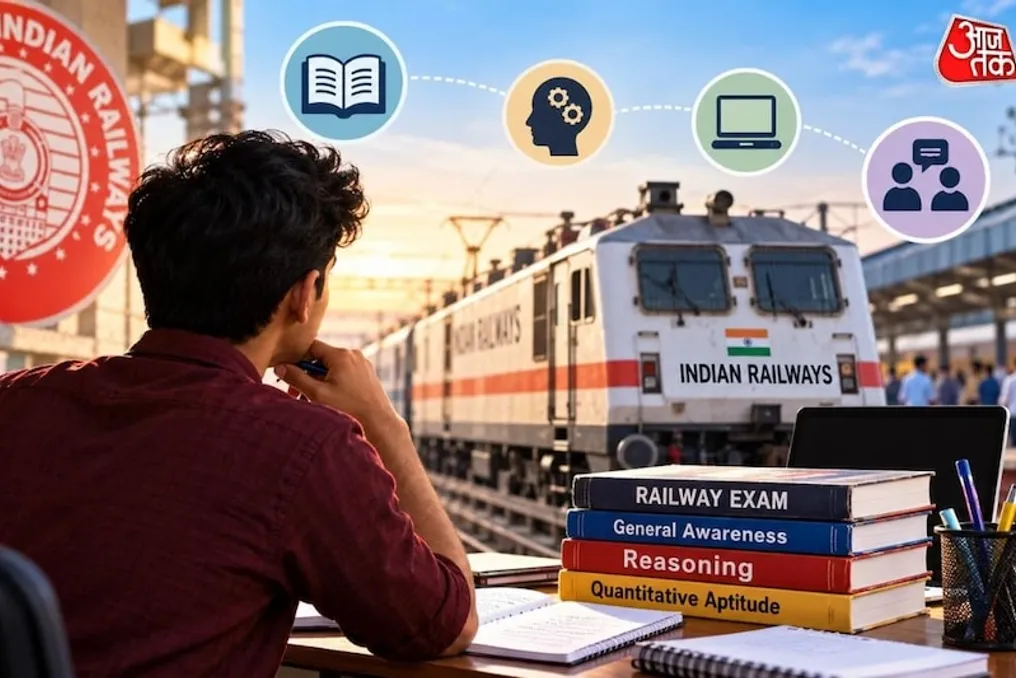
The desire to get a job in the railway industry is often limited to preparing for exams and studying curricula. However, theoretical knowledge alone is not sufficient for successful recruitment into the railways. Skills such as the ability to make decisions at the right time, the capacity to work quickly and accurately, technical understanding, and discipline are important.
The Railway Recruitment Board (RRB) conducts various hiring procedures for different positions, including NTPC, Assistant Loco Pilot, Technician, Junior Engineer, and Level-1. Consequently, the requirements, exams, and necessary skills may differ for each position.
First and foremost, students who wish to build a career in this field must complete their basic education. Most railway recruitment exams require candidates to prepare in relevant subjects depending on the position held. Therefore, the primary task is to strengthen the fundamentals of disciplines such as mathematics, logic, and general knowledge. Instead of just spending many hours reading, it is much more important to focus on regular learning and constant practice. Furthermore, solving past year's problems helps understand the exam structure and the level of questions.
In computer-based railway exams, candidates have to solve a large number of questions within a limited time. Under these conditions, it is extremely important to pay attention to both speed and accuracy. To achieve this, one can dedicate time daily to solving mock tests and practice sets. This helps in understanding how to solve problems in less time and how to minimize errors.
Moreover, many railway vacancies include computer-based exams. Therefore, the habit of taking exams on a computer or having some knowledge in this area can be beneficial for the candidate. For some positions, a separate skills test is provided. For example, in the RRB NTPC graduate recruitment for 2025 for the positions of Junior Clerk cum Typist and Accounts Clerk cum Typist, a computer typing test was conducted. In it, a typing speed of 30 words per minute in English or 25 words per minute in Hindi was set.
If a candidate is aiming for technical positions, such as Assistant Loco Pilot, Technician, or Junior Engineer, knowledge of relevant technical subjects is required. For these positions, simply preparing for general competitive exams is not enough; good knowledge of the relevant specialty, engineering or technical qualification, as well as those mentioned in the recruitment notification, is needed.
There are many types of jobs in the railways, and some positions are directly related to train operation, passengers, technical systems, or safety. Therefore, the candidate must have the ability to work responsibly, follow rules, and remain calm under pressure. Although these qualities are not assessed separately in any exam, they are important behavioral skills during work.
During the railway recruitment process, a medical examination is conducted for many positions. Medical standards may vary depending on the position. For instance, different medical standards are set for various NTPC positions, and medical testing is part of the selection process. Therefore, the candidate should familiarize themselves in advance with the medical standards specified in the recruitment notification for the position they are applying for.
Railway recruitment is not the same for all positions. For example, after the CBT in the NTPC graduate recruitment for some positions, typing tests are conducted, followed by document verification and a medical examination. The process may differ for other positions. Therefore, before starting preparation, the candidate should determine which position they are applying for. Then, the correct approach will be to study the official recruitment advertisement for that specific position to understand the qualification requirements, exam structure, skills tests, and medical regulations.