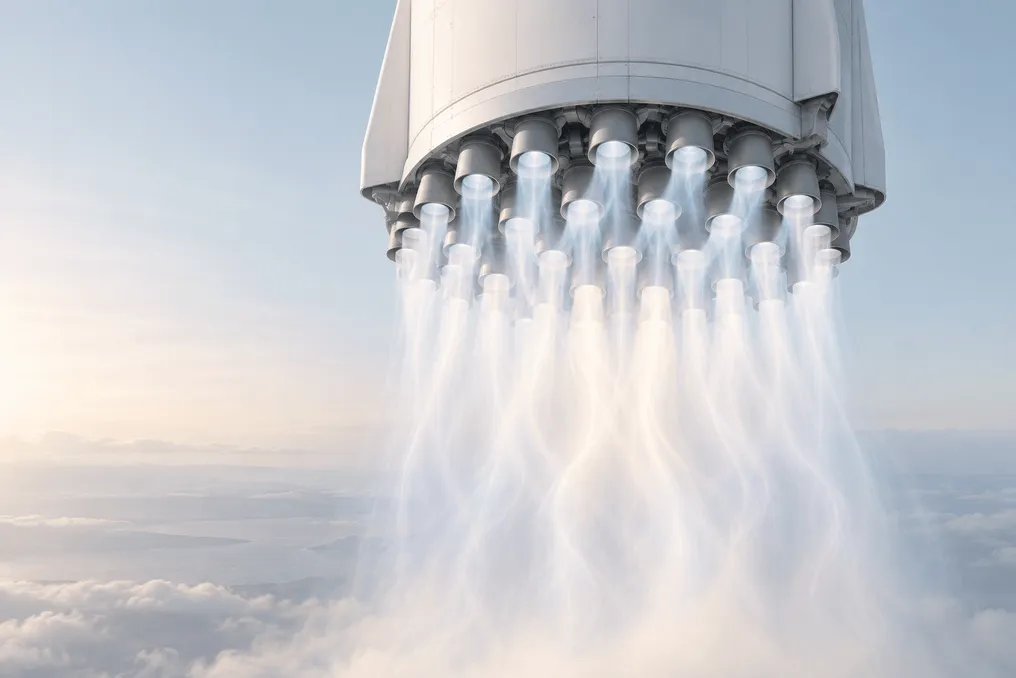
A scientific group from the Xi'an Institute of Mining and Technology conducted the largest known high-precision simulation of supersonic flow related to spacetime. The work modeled the gas exhaust from an array of 33 rocket engines using 6.774 trillion grid cells.
This work was performed using Sugon's heterogeneous computing platform Sugon 8000, utilizing tens of thousands of domestic graphics processors. This was reported by Chinese technology media on October 3rd.
This task is highly significant for reusable rockets, which often use engine clusters. During launch and before landing during reverse burning, supersonic, high-temperature jets from dozens of engines interact at the base of the rocket, creating complex turbulence and shock waves. These pressure fluctuations threaten the structure of the rocket body and its engines, while thermal loads at the jet intersection points test the limits of base heat shielding.
Since physical tests are expensive and allow for the placement of a limited number of sensors, directly observing these interactions is extremely difficult.
Computational Efficiency Results
According to the reports presented, the simulation achieved weak scaling efficiency of 99.01%: when both parallel scale and total grid size were increased fourfold, the average time per step increased by only about 1%. Strong scaling efficiency was 73%, while quadrupling resources on a fixed grid provided a speedup of approximately 2.92 times. The grid update throughput reached 34.029 trillion cell updates per second, equivalent to approximately 0.249 exaflops of application performance on the main computational path.
Instead of the standard multi-step Runge-Kutta temporal integration common in computational fluid dynamics, which requires multiple reads and writes of the full flow field and boundary data exchange at each stage, the team applied the WENO-GKS method related to spacetime. This method allowed advancing each step in a single pass, transforming repetitive memory traffic into local computations at cell boundaries. Furthermore, the 'array of structures' data structure, combining operators and overlaying computations with communications, further reduced memory access and inter-node traffic. The computations were supported by the DTK development environment, the MPI library, and Sugon's job scheduler.
For engineers, this simulation provides data on the pressure history on structural surfaces, which helps analyze local peaks and load distribution, as well as determine optimal locations for installing test sensors. It also calculates heat flux on walls, temperature distribution, and heating duration for thermal protection design, filling gaps between physical measurement points. The team plans to add real geometries and operating conditions of the engines to create validated flow data, and then use this data for artificial intelligence-based models linking design parameters to flow response. This will expand the scope of application from heavy and super-heavy aircraft to the interaction of landing module plumes and jets on high-speed vehicles.
Sugon completed the development of Sugon 8000 in July, making it China's first AI supercomputer cluster with 100,000 cards. The company claims that all system components—chips, computing, storage, and high-speed network—are domestic, and the system is connected to the National Supercomputing Internet.