
After losing the ODI in Mullumpur, captain Shubman Gill expressed dissatisfaction with the team's play and warned the players
Read more
Aaj Tak
www.aajtak.in

After losing the ODI in Mullumpur, captain Shubman Gill expressed dissatisfaction with the team's play and warned the players

In the final match of the three-match ODI series between India and West Indies, held at the Maharaja Yadvindra Singh International Cricket Stadium in Mullumpur on Saturday (October 3rd), the West Indies team won by five wickets.

Captain Shai Hope scored an unbeaten 162 runs, despite a hamstring injury, which helped the West Indies achieve an impressive total of 352 runs in just 10 overs after the game concluded.

After the match, Indian captain Shubman Gill commented on the reasons for the defeat, expressing serious concern about the quality of fielding and how the team handles the over-finish. Gill admitted that the Indian team's fielding did not meet expectations ahead of the World Cup.

During the game, the Indian squad dropped around six to seven catches. According to the captain, losing such opportunities is worrying for any team. He noted: 'There were many good moments, but there is definitely room for improvement in certain areas. Our fielding could have been better. We dropped about 6-7 catches. This is not a good sign before the World Cup.'

The main problem, in the opinion of the Indian captain, was the performance during the final overs. He stated that the team lacks clarity on when to attack and when to employ defensive tactics in the field. Shubman added: 'We need to work on our end-of-match play. When we bowl in the last overs, we are unclear whether we are attacking or defending.'

The Indian captain also mentioned that even if five or six opposing players are out, the team struggles to determine field placements and bowling strategies. Sometimes the strategy for the end of the match begins too early, when it might have required mid-game play.

The biggest contributor to India's loss was West Indies captain Shai Hope. He scored his 21st century in ODIs and secured a memorable victory for the team. This was the largest successful run chase for the West Indies in ODIs. It was Hope's second consecutive stoic innings; previously, he had also scored a century in a match in Guwahati, and in the third match, he surpassed it, dashing India's hopes.

After the game, Shai Hope shared an interesting secret about his brilliant innings. He revealed that a conversation with former Indian captain Mahendra Singh Dhoni helped him improve his approach to the game. Hope said: 'I had a good talk with the great player MS Dhoni. He told me that you always have more time than you think. So I don't focus too much on the result.'

Hope reported that he now tries to focus on the process rather than the final outcome of the match. His attention is focused on understanding the circumstances, breaking down his innings into small parts, and finding suitable moments to score boundaries at the end of the match.
Similar stories

India defeats West Indies in Guwahati, achieving historic success in the pursuit of the target score
Read more
www.aajtak.in

India defeats West Indies in Guwahati, achieving historic success in the pursuit of the target score

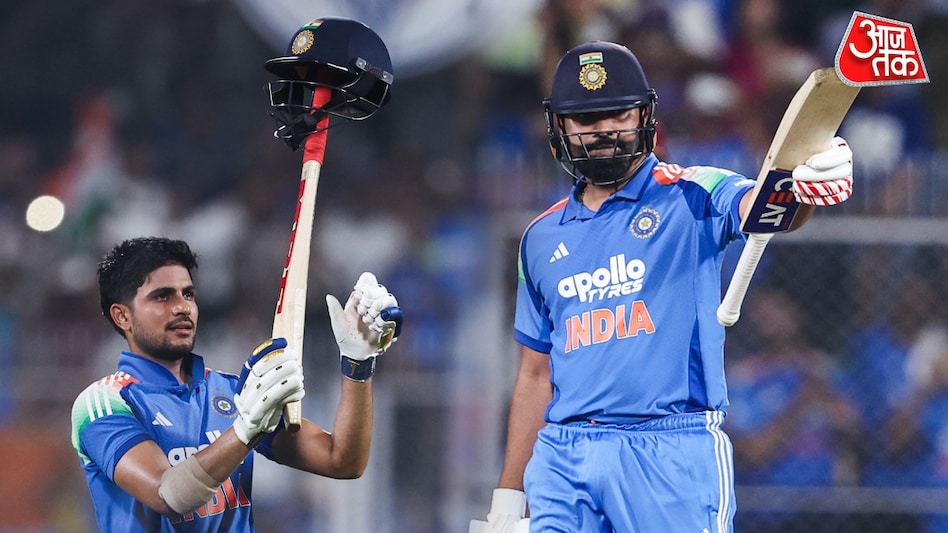
Records were broken in Guwahati: the target of 406 runs was surpassed, and India secured an unassailable 2-0 lead in the series. Although West Indies managed to score an impressive 405/7 on Wednesday (September 30), Shubman Gill's and Rohit Sharma's batting made this target insignificant. India won the match by scoring 406/2 in just 43.3 overs, ensuring a confident lead in the three-match series.

Captain Shubman Gill demonstrated incredible play that entered the ODI record books. He reached a double century off 117 balls, marking the fastest double century in 50-over cricket. In his innings, Gill scored 133 runs, hitting 26 fours and 8 sixes.

This achievement allowed Gill to surpass Ishan Kishan's record, who had previously scored a double century off 126 balls in ODIs. Furthermore, it was Gill's 11th century in ODIs, which he achieved in just 62 balls, making it the fastest century in ODI format.

At the other end of the pitch, Rohit Sharma played in his usual style. He scored 101 runs off 75 balls, utilizing powerful drives down the ground and pick-up shots. During this innings, Rohit also crossed the 12,000-run mark in ODIs, becoming the seventh player globally to reach this milestone and the third Indian after Sachin Tendulkar and Virat Kohli.

The start of the match was very strong: Gill and Rohit attacked the West Indies bowlers, and India scored 100 runs in just 12 overs. Gill completed his half-century in 38 balls, and Rohit in 32 balls.

By the 22nd over, India's score without loss stood at 200 runs. In the chase of over 350 runs, this was the first instance in ODIs where the opening pair scored 200 runs. Both players contributed 255 runs to the team for the first wicket. This partnership was broken after 26.2 overs when Rohit was dismissed after scoring 101 runs. At that point, India needed 151 more runs with 24 overs remaining. Gill continued to play aggressively and led the team to victory.

Prior to this, West Indies created a real storm, scoring 405/7, exposing the weakness of the Indian attacking pace. John Campbell scored 101 runs off 68 balls, Shay Hope scored 104 off 94 balls, and Amir Jangu scored 114 off 77 balls. Campbell reached a century in just 65 balls, displaying an aggressive style similar to Chris Gayle, including 9 fours and 5 sixes.

Hope, who was caught early by Virat Kohli, managed to stabilize the innings and then started scoring runs, hitting 8 fours and 3 sixes. Jangu achieved his second ODI century in just 69 balls, hitting 13 fours and 3 sixes. Thus, West Indies recorded three centuries in ODIs for the first time and surpassed their previous best score of 389 runs.

However, the Indian bowlers faced questions. In the absence of Jasprit Bumrah and Mohammed Siraj, young players were given a chance, but the results raised doubts. Akib Nabi conceded 84 runs in 8.5 overs, becoming the best Indian bowler in terms of runs conceded in his debut ODI. Guruveer Bar took 2 wickets, conceding 96 runs in 10 overs, while Prasidh Krishna took one wicket, conceding 45 runs in 5 overs. Naman Dir sustained an ankle injury during the game and left the field after 6.1 overs.

A positive aspect for India was that Kuldeep Yadav completed his 200 wickets in ODIs, taking 2/65. Ravindra Jadeja also performed well, taking 2/75.

Historical context: India became the second team after South Africa to chase a score of over 400 in ODI history. Previously, the Indian team had reached a score above 400 eight times, but all these instances occurred in the first half of the match.

Kuldeep Yadav reaches 200 ODI wickets, surpassing Shane Warne in balls bowled
Read more
www.aajtak.in

Kuldeep Yadav reaches 200 ODI wickets, surpassing Shane Warne in balls bowled

In the match between India and West Indies, players from the West Indies demonstrated strong play, dealing a serious blow to the Indian bowlers. John Campbell, Shai Hope, and Amir Jangu each scored a century, bringing the West Indies total to 405 runs. In rainy conditions, Kuldeep Yadav recorded a significant record.

In his 123rd ODI match, Kuldeep Yadav completed his 200th wicket, becoming the second fastest bowler in Indian history to reach this milestone. He is only surpassed by Mohammed Shammi, who took 200 wickets in 104 ODIs. Following him are Ajit Agarkar (133), Zaheer Khan (144), and Anil Kumble/Javagal Srinath (147).

Kuldeep secured his 200th wicket of Kemi Paul, who was caught by Virat Kohli in the long-on region after 45.1 overs. This moment marked Kuldeep's achievement of a double century in ODIs. Furthermore, Kuldeep surpassed Shane Warne in the number of balls required to achieve 200 ODI wickets, completing them in only 6319 deliveries. Among spinners, only Shaklan Mushtaq (5451) and Rashid Khan (5782) achieved this result with fewer balls. Following Kuldeep are Adam Jampa (6385), Adil Rashid (6881), and Shane Warne (6983).

Despite the record attack by the West Indies, Kuldeep remained among the few Indian bowlers who managed to partially contain the pace of the game. In his full quota of 10 overs, he took 2 wickets, conceding 65 runs, resulting in an economy rate of 6.50.

Before the West Indies reached 405 runs, Campbell scored 101 runs off 68 balls, Hope scored 104 runs off 94 balls, and Jangu scored 114 runs off just 77 balls. This was a rare sight in one ODI match where three batsmen score a century.

Popular