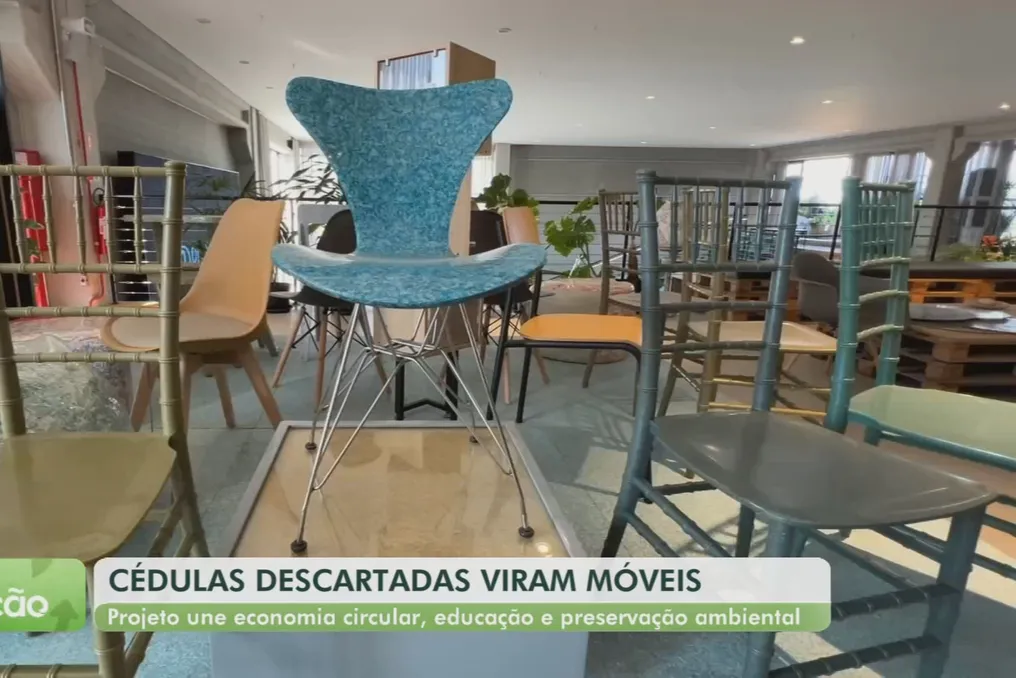
In São Roque, in the Sorocaba region of the state of São Paulo, tons of waste generated by the Mint are reused as raw material to manufacture furniture and other items that equip a public school. This initiative is part of a project developed by Instituto Transforma in collaboration with the Brazilian Mint, integrating the themes of sustainability, technology, and education at the School of the Future.
Many of the objects, such as desks, tables, and cabinets, appear to be made of common materials but contain an unusual raw material: banknotes that never entered circulation. These papers, which would otherwise be destined for disposal, are transformed into furniture. During the banknote manufacturing process, printing errors, cutting failures, or coloring problems can prevent the money from being released into circulation.
Patrício Mariano Malvezzi, CEO of Instituto Transforma, explained that currency paper has distinct characteristics from traditional paper. He stated that currency paper is not ordinary paper, but rather a security paper composed of cotton cellulose fiber, along with other components, which gives it resistance. According to the project, approximately 200 tons of this currency paper are discarded annually.
In the factory, pieces of the banknotes are mixed with resin and subjected to heat and pressure processes. The result is a rigid and durable material, suitable for use in the production of various pieces. This method exemplifies the circular economy, as a material that would be considered waste returns to the productive cycle instead of being produced, used, and discarded.
The School of the Future serves over a thousand students
The School of the Future, located in São Roque, began receiving students this semester, counting more than a thousand enrolled students from the 1st to the 9th grade, distributed across 37 classes. A total of 29 classrooms were equipped with furniture produced, among other materials, using recycled currency paper. Among the items, a table tennis table stands out, considered the first of its kind made with this recycled material.
Ezequiel Silva, the school director, mentioned that the purpose is to make students understand the possibility of reusing different types of materials. He emphasized the importance of cultivating in the students the perception of material reuse, promoting care for education and sustainability that extends beyond the school environment.
In this single year, 50 tons of currency paper waste were used in the project. There are plans to develop two other units with the same proposal in São Roque. Furthermore, the initiative includes planting native species and partnerships focused on the study and conservation of wild animals in the region.
The idea of converting discarded materials into knowledge was also implemented in Adolfo, in the São José do Rio Preto region of São Paulo. In another city, a school created its own currency to stimulate recycling and reading. Students exchange recyclable materials for a currency called 'green money' at the institution's entrance, where each kilogram of recyclables equals one green note.
Creuza Gandini do Amaral, the school coordinator, reported that the initiative was born from a joint idea between the school community and families and gained great adherence. She commented that it is very positive for children's awareness to realize that they can reuse items like bottles and bottle caps.
Recyclables are turned into books and teaching materials
'Green money' can be used by students during the book fair organized by the school. After making their purchases, students have the amount transferred to the exhibitors, with the total used at the fair coming from the sale of recyclable materials collected by the students. Last year, students spent almost R$ 5 thousand on books and other items during the event. Luís Otávio was the student who accumulated the most green money, totaling over a thousand notes, and his father, Gustavo Clemente, reported that he learned early on how to separate recyclable materials even during June festivals.
More than 100 kilograms of recyclables per month
The project also involves students' families, resulting in the monthly collection of more than 100 kilograms of recyclable materials, which cease to be incorrectly discarded and return to the utilization chain. Fernanda Cruz dos Santos, the school director, aims for learning to transcend the limits of the school unit. She expressed the desire to show students the importance of caring for the place where they live, reinforcing that parental support contributes to the consciousness that students will carry throughout their lives.