Foreign Pilgrims from Russia, Italy, Ukraine, and Germany Performed Pindanda Ritual in Gaya
Read more
Aaj Tak
www.aajtak.in

Foreign Pilgrims from Russia, Italy, Ukraine, and Germany Performed Pindanda Ritual in Gaya

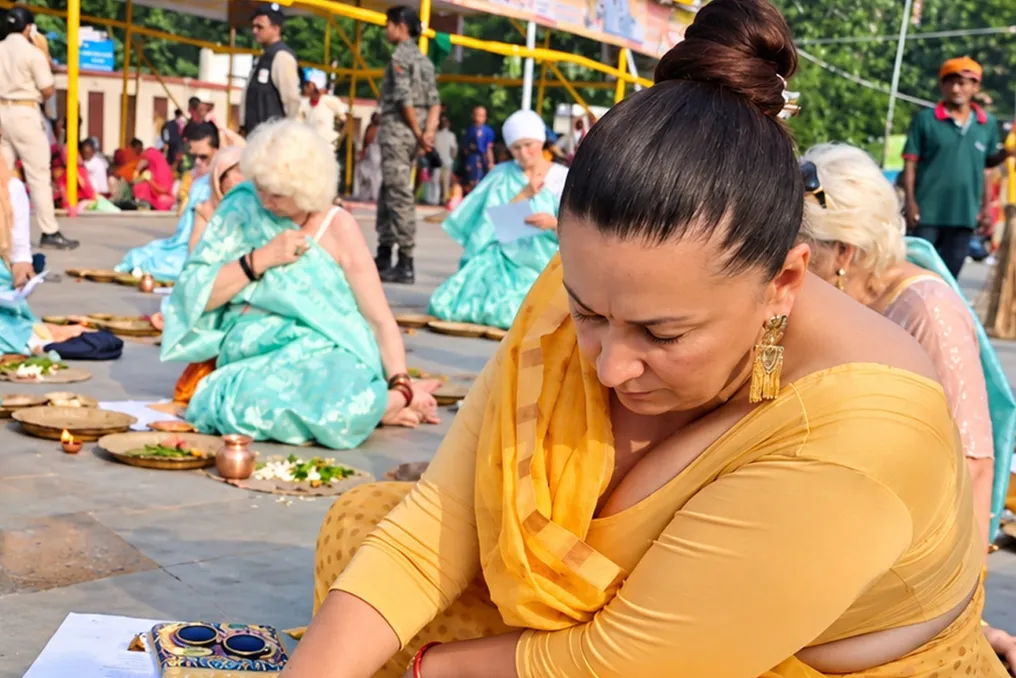
The Pitr Paksha festival is taking place in the holy land of Gaya, lasting for 15 days. During this period, pilgrims arrive not only from the country but also from abroad. Foreign pilgrims come here to perform pindanda and tarpan with the aim of attaining peace and freeing the souls of their ancestors.

Among these pilgrims are people from countries such as Russia, Ukraine, Italy, and Germany. All of them performed pindanda and tarpan for their ancestors according to established rituals.

During the Pitr Paksha festival, many foreign pilgrims visited Deva Ghat, located near the Vishnu Pad temple. They performed pindanda and tarpan on the banks of the Falgu River in accordance with Vedic traditions. The district administration provided security measures for foreign pilgrims at the sites of the pindanda.

An international woman from Ukraine, Alice Jandra, reported that she was impressed by Hinduism (Sanatana Dharma). She came to Gaya with the desire to ensure the liberation of her ancestors. Alice also mentioned that pilgrims from other countries arrived with her, who are also performing pindanda and tarpan.

Elder priest Loknat Gaud, who conducts pindanda for foreign pilgrims, stated that during the Pitr Paksha festival, female pilgrims from many countries, including Italy and Germany, arrived in Gaya. He noted that these pilgrims had adopted Hinduism in their home countries.

According to available information, initially, all these female pilgrims practiced Christianity. However, after learning about the virtues of Sanatana Dharma, they decided to adopt this religion. Loknat Gaud added that when these pilgrims asked him about the first steps in Sanatana Dharma, he was explained that salvation is possible only through performing Shraddha (ancestral rites) for the ancestors. After that, the foreign pilgrims traveled to Gaya to perform pindanda for their ancestors.

Similar stories

Foreign Pilgrims from Ukraine, Russia, Italy, and Germany Perform Pindandana in Gaya for Ancestors
Read more
www.aajtak.in

Foreign Pilgrims from Ukraine, Russia, Italy, and Germany Perform Pindandana in Gaya for Ancestors

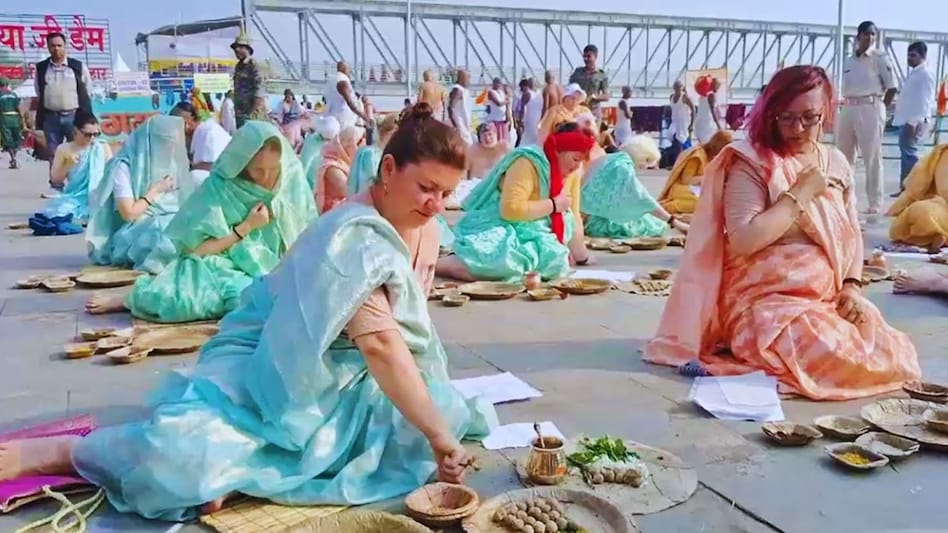
On the banks of the Falgu River in Gaya, in the Devaghat area, an unusual sight is observed: besides local residents performing pindandana for their ancestors, foreign pilgrims from countries such as Russia, Ukraine, Italy, and Germany are arriving. These devotees conduct pindandana and tarpana rituals in accordance with Vedic traditions.

During the Pitr Paksha fair, the flow of pilgrims from various parts of the country and the world continues. On the banks of the Falgu River, near the Vishnu Pad temple, many foreign pilgrims have performed pindandana and tarpana, striving to ensure peace of mind and liberation for their deceased ancestors.

The presence of foreign pilgrims has attracted attention. People from different cultures and countries received assistance from local priests to complete the pindandana and tarpana rites. Alisa Jandra from Ukraine shared that she was impressed by Hinduism and came to Gaya to pray for the liberation of her ancestors.

According to Alisa, performing this ritual in Gaya was a special experience for her, as Gaya is considered an important religious place for pindandana and tarpana. During Pitr Paksha, a large number of people from different regions of the country gather here, and this year among them are also foreign citizens. People from Russia, Ukraine, Italy, and Germany performed pindandana on the banks of the Falgu River in Devaghat.

Priest Loknat Gaud, who conducted the ceremonies for the foreign pilgrims, reported that people arrived from different countries. He noted that some of them are interested in understanding Hindu traditions. These pilgrims expressed a desire to perform pindandana based on the belief in the salvation and peace of mind of their ancestors, after which they were administered the pindandana and tarpana procedure according to Vedic customs.

Due to the presence of foreign pilgrims, the district administration took measures to ensure safety in Devaghat. Since a huge number of pilgrims gather in Gaya during the Pitr Paksha fair, the authorities organized a system to maintain order at the ghats and in major religious sites.

Some pilgrims remembered their ancestors, having come from Russia, while others came from Ukraine, and pilgrims from Italy and Germany also performed the same religious rites on the banks of the Falgu River. Photographs of Devaghat emphasize that people from different countries have become part of one religious tradition. Foreign pilgrims performed pindandana and tarpana under the guidance of local priests. Now, international pilgrims also participate in the religious ceremonies held in Gaya during Pitr Paksha, making pindandana for the peace and liberation of ancestors an important part of their journey.

395 thousand pilgrims gathered in Gaya for the annual Pitr Paksha fair to perform rituals.
Read more
www.aajtak.in

395 thousand pilgrims gathered in Gaya for the annual Pitr Paksha fair to perform rituals.

In the city of Gaya, Bihar state, a continuous stream of pilgrims from various countries and regions is arriving for the world-renowned 15-day Pitr Paksha festival. Pilgrims perform pindadan, Sharaddha, and Tarpan rituals, praying for the salvation of their parents, spouses, brothers, sisters, and their children.

According to religious beliefs, performing pindadan and Sharaddha in Gaya during Pitr Paksha holds special significance. It is believed that performing these rites in the vicinity of the Vishnu Pad temple and on the banks of the Falgu River brings liberation (moksha) to deceased ancestors and deliverance from ancestral debt and salvation for their descendants for many generations.

Pilgrims arrive from different parts of the country to fulfill these rituals. One pilgrim, who came from Uttar Pradesh, reported that the local administration provided good conditions for all arrivals. He noted that the pilgrims are conducting the rituals according to established traditions.

Pilgrims also mentioned the religious history associated with pindadan. According to legend, a demon named Gayasura lived in Gaya. The gods performed a Yajna over him for one hundred years. After the ritual was completed, Gayasura began to move, causing concern among the gods. Then Lord Vishnu appeared and placed his foot on Gayasura, which took his life. Subsequently, Lord Vishnu asked Gayasura to make a wish. According to the legend, Gayasura wished that any person who came to Gaya and performed pindadan for their ancestors would attain moksha, and their ancestors would reach heaven.

Pilgrims believe that it is because of this wish that people still come to Gaya to perform pindadan. There is also a religious belief that the Vishnu Pad temple contains the footprints of Lord Vishnu, where pindadan is also performed.

Sevok Ram, a pilgrim from Maharashtra, stated that the conditions for pilgrims are good and no one is experiencing difficulties. He came to perform pindadan for his parents, brother, sister, and their children. He added that, according to beliefs, pindadan in Gaya leads to the ancestors attaining moksha and moving to heaven.

Sevok Ram recounted another religious story: legend says that Lord Shri Rama and Mother Sita came to Gaya to perform pindadan for King Dasharatha. When Shri Rama went to fetch materials for worship, King Dasharatha's hand extended from the river, and he asked Mother Sita to give him pinda. According to belief, Mother Sita made sand in the form of pinda and handed it to King Dasharatha. Sevok Ram emphasized that Lord Vishnu knows that the ancestors of those who perform pindadan from a pure heart attain moksha.

Pilgrims have also arrived from places such as Rajasthan and Guwahati. They are all performing pindadan and Sharaddha, praying for the salvation of their ancestors. The District Administrator of Gaya, Shashank Shubhankar, reported that there were a very large number of pilgrims in Gaya on Monday. He specified that 395,950 pilgrims were registered in one day. Furthermore, 9,768 pilgrims utilized medical assistance, and 70 elderly people used wheelchairs.

During the festival, aid to pilgrims is provided through a missing persons system. The District Administrator reported that on Monday, 87 people went missing in the festival area and were found by their families. According to the District Administrator, the total number of pilgrims who arrived in Gaya has reached 460,200. Pilgrims from various parts of the world continue to perform pindadan, Sharaddha, and Tarpan near the Vishnu Pad temple and on the banks of the Falgu River, praying for the salvation of their ancestors.

Popular