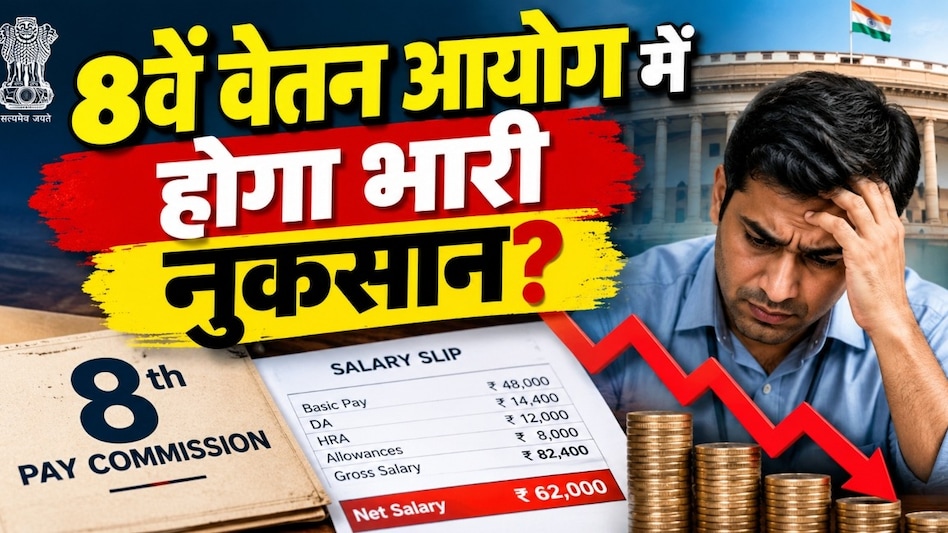
Delay in implementing the 8th salary attestation committee could lead to a loss of 300 thousand rupees
Read more
Aaj Tak
www.aajtak.in

Delay in implementing the 8th salary attestation committee could lead to a loss of 300 thousand rupees

The wait for the implementation of the eighth salary attestation committee continues, but currently, the committee is only holding meetings with representatives and stakeholders. It has a general deadline of 18 months to prepare the report. It is anticipated that the report may be submitted after May of next year, after which the government will make a decision on the matter.

Against the backdrop of the delay in implementing the eighth salary attestation committee, various questions arise among civil servants regarding potential losses in case of this postponement. According to one report, it is estimated that level 7 employees could incur losses of 300 thousand rupees if the implementation is delayed.

It is being discussed that the eighth salary attestation committee may come into force or become effective on January 1, 2026, making central staff eligible for significant allowances (erier). Some experts believe that the calculation of erier can be based on the difference between the revised basic salary and the previously received basic salary.

The situation with benefits such as HRA may develop differently. This is where the probability of potential losses arises. If the new salary is introduced quickly, the employee can promptly receive benefits calculated based on the revised base. However, if the implementation is prolonged and the erier for the corresponding benefits is not paid during this period, employees may face substantial losses.

Speaking of potential losses for level 7 employees, their current basic salary is 44,900 rupees. Applying a conformity coefficient of 2.1 within the framework of the eighth salary attestation committee will increase the basic salary to approximately 94,290 rupees.

With the current basic salary of 44,900 rupees, the HRA benefit is 10,776 rupees at a rate of 24 percent. However, with a basic salary of 94,290 rupees, based on the assumed conformity coefficient of 2.1, the same HRA benefit will amount to about 22,630 rupees. The difference between these amounts is approximately 11,854 rupees monthly.

If the government introduces the eighth salary attestation committee by January 2028, erier payments for the basic salary may be made. Nevertheless, they may suffer losses in terms of HRA, as shown in the above calculations. That is, a level 7 employee may lose 11,854 rupees monthly in HRA.

If the implementation occurs in January 2028, which means a delay of 25 months, the employee could incur losses of 296,350 rupees.

Similar stories

Discussion of the 8th Departmental Commission Council: Calculation of Allowances Upon Introduction of New Salary in Mid-2027
Read more
www.aajtak.in

Discussion of the 8th Departmental Commission Council: Calculation of Allowances Upon Introduction of New Salary in Mid-2027

If the recommendations of the 8th Departmental Commission Council appear around mid-2027, and the new wage system is implemented later, central employees will face the issue of allowance payments (arrears). The reason is that if the government sets new wage rates from January 1, 2026, a backlog may arise from that date even with a late notification. However, it has not yet been determined what effective date the government will set, so employees' attention is focused on both the allowances and the implementation date.

The seventh departmental council was formed in February 2014, and its recommendations came into effect on January 1, 2016. Employees received allowances for the period between the effective date and the actual payment. This past experience serves as a basis for discussing potential allowances under the 8th departmental council, although what happened with the 7th council cannot be considered a hard rule for the 8th. The final decision will only be made after the government determines the effective date.

According to Manjit Singh Patel, chairman of the All India NPS Employee Federation, during the 7th departmental council, the calculation of allowances was based on the new wage matrix. It involved calculating the difference between the previously received salary and the revised base rate. According to him, this example did not include the House Rent Allowance (HRA).

Consider a hypothetical example: if an employee's base salary was 18,000 rupees, and they were paid a 125% allowance for Disability Allowance (DA), the total amount was 40,500 rupees. Using a fitment factor of 2.57, the revised base salary becomes 46,260 rupees, and after combining the DA, the disability allowance starts from zero again. According to this calculation, the monthly difference between the old and new pay is 5,760 rupees, which amounts to 69,120 rupees over 12 months. This is only an illustrative example; the actual allowance may vary depending on the new wage matrix, DA, allowances, and the final government decision.

If the government sets the new wage system from January 1, 2026, but the notification appears in 2027, the wage gap for the period from January 2026 until the notification date may be paid as an allowance. If the government considers January 1, 2026, as the effective date of the 8th departmental council, the difference between the adjusted qualification and the actually received salary will be considered every month from January 2026 until the new system comes into force. Thus, the longer the delay in the notification, the longer the potential allowance period may be.

Special caution is required here. It cannot be stated now that every employee is guaranteed to receive an allowance from January 1, 2026. A press release from the Press Information Bureau (PIB) dated October 28, 2025, stated that, based on previous trends, it is expected that the recommendations of the 8th Central Departmental Council will affect the situation around January 1, 2026. Manjit Singh Patel, chairman of the All India NPS Employee Federation, asserts that if the effective date of January 1, 2026, is approved, the allowance must be paid from that date. Nevertheless, the final picture may become clear after the release of the final report of the 8th departmental council.

It is expected that the recommendations of the 8th departmental council will affect about 5 million active central employees and about 6.9 million pensioners. However, each employee's allowance will not be the same. The final amount will depend on the base rate established in the new wage matrix, how DA is adjusted, and what rules the government sets for other allowances. Therefore, no single amount can currently be considered a fixed allowance from the 8th departmental council.

The process of previous departmental councils has also not always been the same. The 5th departmental council took about 19 months, and the 6th departmental council took about 32 months. The recommendations of the 7th departmental council were implemented within a few months after the set effective date. The 8th departmental council has been given 18 months to prepare the report. If the process drags on and the new wage system is implemented later, the decision on the effective date will be the most important for employees.

Currently, although there is hope for an allowance from January 1, 2026, this cannot be considered a final decision. If the government introduces new wage rates from January 1, 2026, the wage difference for the period when the notification is released later may be received as an allowance. However, the actual allowance amount will only be known after the government makes a final decision regarding the new wage matrix, base rate, DA, and other allowances. Therefore, the utmost attention is currently focused on the report of the 8th departmental council and the effective date set by the government following it.

Popular