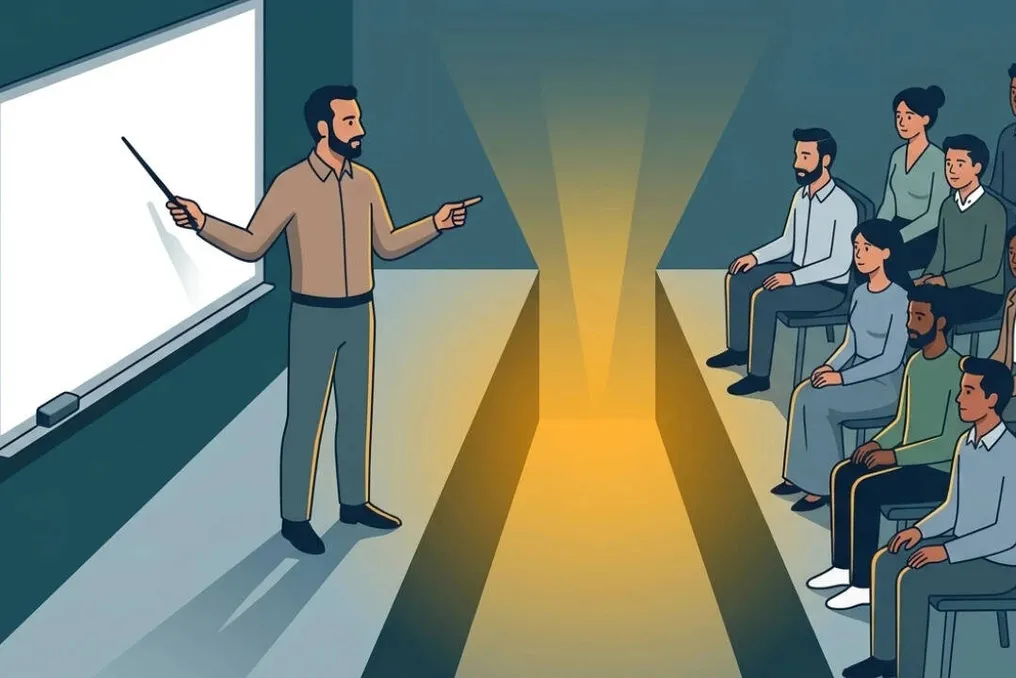
In an engineering college in Bengaluru, a computer science lecture is taking place for fourth-year students. The instructor is conducting a technical lesson while simultaneously monitoring attendance and handling administrative tasks. Among the rows sits a student trying to calculate train schedules between Bengaluru and Pune, attempting to explain to an employer that a Pre-Placement Offer (PPO) might be jeopardized by the mandatory in-person attendance of one elective subject.
This scene reflects the mounting tension within India's higher education system. For graduates, the college has ceased to be solely a diploma-obtaining process. Amid increasing competition in the job market, students are increasingly focusing on internships, practical skills, early employment, and mental health support. However, the institutional structure surrounding them remains tied to attendance thresholds, credit requirements, standardized assessment, and administrative compliance. College faculty members are at the center of this conflict.
According to the All India Survey on Higher Education (AISHE), while target Student-Teacher Ratio (STR) in higher education ranges from 15:1 to 20:1, the national average hovers between 24:1 and 27:1. In government and state institutions, this figure can reach 35:1 or 50:1, with individual undergraduate lectures accommodating 80 to 120 or more students per section.
The pressure is exacerbated by faculty shortages. Central universities report faculty vacancy rates ranging from 29% to 34%, with senior professor vacancies often exceeding 50%. In technical institutions like IITs, NITs, and IIITs, unfilled positions range from 30% to over 50%. This forces teachers to perform multiple roles simultaneously: academic instructors, implementers of institutional policy, career counselors, and often unofficial listeners for struggling students. Furthermore, they must manage UGC academic performance metrics, NAAC and NIRF documentation, alongside a heavy teaching load.
The Modern Classroom: More Than Just Academic Education
For today's students, especially those in their final year, the classroom is closely linked to what happens after graduation. A college instructor at an engineering college notes: 'A student might come because they are confused about internships, worried about employment, or simply don't know how to cope with what is happening at home. We try to listen, but there is a limit to what a subject teacher can realistically handle.'
From the student's perspective, the final year can feel like a race against time, where academic requirements run parallel to internships, job hunting, and preparing for the job market. Pranav Vats, a final-year Computer Science and Engineering student in Bengaluru, describes student priorities: 'When a guy comes to college, he ultimately wants to get a job. He doesn't want to maintain a CGPA above 9 every semester. He just wants to get into a good company and succeed in his career both financially and in terms of growth... I have been doing internships since my first year. And during all the interviews I went through, nobody asked me about my CGPA. They just asked: okay, what do you know, what practical skills do you have, and how well do you understand the market and the business you are about to work in.'
This shift creates a complex balance for faculty. Students may view practical experience as more directly related to work, while instructors remain responsible for ensuring students complete prescribed courses, credits, and attendance requirements.
When Attendance Conflicts with Career
The tension becomes particularly evident during the hiring and internship season. Pranav describes a situation where he secured an opportunity to intern in Pune after passing an interview: 'Two or three months ago, I passed an interview. I passed it. I went to Pune. And then I got permission from the college. They gave me this confirmation letter that I could go and do my six-month internship, and all that. But suddenly, two months later, they say no, you must fulfill your academic requirements and everything else... This company is very good. I am doing very well there. And they offer me a PPO. I could take it. But now this company won't let me. The college says you have to attend classes once a week. As a student, it is impossible for me to travel from Pune to Bangalore every week to attend some silly lecture that is not even part of my curriculum, which is not even part of my degree in computer science... It's just an open elective.'
He reports that discussions with his mentor, head of department, and other authorities did not resolve the issue. 'What they told me was: 'Do you want the degree or the internship certificate? So finish your graduation formalities first, and then go and do whatever you want.' They basically just want to fulfill what the college needs. And besides, you can do whatever you want. We don't care.'
Pranav asserts that similar situations have affected other students, including those working or interning in Bengaluru itself. He says: 'There is one guy who got hired at Nokia in Bangalore. And he said: 'Sir, I cannot attend this lecture this week because I got hired at Nokia here.' They said: 'You must do it. I don't care. You must meet this academic requirement.'
However, for faculty, understanding the student's situation does not necessarily mean changing the rules. An instructor explains: 'The final year is especially difficult because everything seems to be happening at once. Students are completing projects, dealing with attendance and exams, while worrying about employment and what they will do after graduation. You can see how this pressure grows, especially when the student's plans don't work out.'
The instructor clarifies the dilemma: 'There are situations where a student gets an internship or an off-campus opportunity and genuinely needs flexibility. As a teacher, you can understand why this opportunity is important to him. But you are also responsible for adhering to academic requirements. This can put the teacher in an awkward position because you can sympathize with the student without having the authority to change the rule.'
The Faculty Becomes an Institutional Buffer
Thus, the teacher often finds themselves caught between three sets of expectations. Administration demands attendance, course completion, and documentation for institutional needs. Students expect empathy, career counseling, and flexibility. Parents expect academic performance, safety, and career outcomes.
The instructor has to explain the institutional decision to the student without having any influence over that decision. The instructor explains: 'Sometimes the student is upset with the institution, parents are worried about the student's grades, and the department is concerned about academic requirements. The teacher ends up in the middle. We are expected to explain one side to the other, even if we ourselves do not control the decision.'
For students, this can reinforce the perception that teachers exist primarily to ensure attendance and assign grades. Pranav states directly: 'They don't care; they just need these things to attend classes, they need attendance, they need grades, that's it... If you go to an off-campus event where most applications are currently being submitted, nobody asks you about your CGPA. They just need your practical skills. But this question of CGPA or any course we are taught in college has nothing to do with what we will be doing in our offices.'
When personal problems intrude into the classroom. The pressure is not limited to academic matters and employment. Faculty are increasingly expected to recognize when students are experiencing emotional difficulties, even if they are not trained to provide professional mental health support.
The instructor notes: 'You spend enough time with the class to notice changes. If a student who is usually active suddenly stops talking, misses classes, or stops submitting assignments, you notice it. The hard part is deciding whether to ask, 'Is everything alright?', because you don't know if the student wants you to enter this part of their life,' says Prakash.'
The instructor describes the boundary: 'There is a very fine line between caring for a student and intruding. If I ask too many questions, it can seem intrusive. If I ask nothing, I might miss something important. Teachers are constantly trying to determine where that line is.'
At the same time, instructors acknowledge their own limitations. Prakash says: 'I want my students to know they can come to me, but I also have to be honest about my limitations. I can listen, I can help them think through the problem and direct them to the right person. But I am not trained to conduct therapy, and pretending otherwise can be harmful.'
The Problem of Counseling Deficit and Stigmatization
Many institutions have counseling centers or mentorship programs, but the availability of the service does not guarantee that students will use it. Pranav says that his mentorship system is mainly focused on academic issues: 'One mentor is assigned to every 20 or 30 people. So any college-related problems, you can discuss with them, and they can find a solution... [But] there is nothing like that through which we could discuss our careers... They are strictly for subjects.'
He also notes that students face peer pressure regarding seeking counseling. 'We have one person hired... if you have any emotional problems or anything like that, you can sign up for a session,' says Pranav. '[But] if you go to a counselor, there is this peer pressure. If you go to a counselor or maybe discuss things with a teacher, you will look weak.'
'This worries students a lot, and no one talks about it because everyone feels that if I tell about it, I might feel weak, and people will think I am not mature enough to handle my problem on my own... I talk about this with some friends who end up going down the same path... but mostly I deal with my pressure alone,' adds Pranav.
When behavior changes significantly, instructors must also balance intervention and confidentiality. Prakash says: 'If I feel a student's behavior has changed significantly, I cannot just say, 'It's their private matter.' There are situations where it is necessary to involve the appropriate support system. But you must also be careful about confidentiality and not turning the student's difficulties into a public issue.'
The Emotional Burden on Faculty
While attention to student stress is growing, the pressure on faculty can remain largely unnoticed. An instructor managing a class of 80–120 students may also deal with staff shortages, administrative work, grading, meetings, and institutional documentation. A difficult conversation with a student does not necessarily end when the class is over.
The instructor believes that teachers need institutional support if they are expected to take on these additional responsibilities. Prakash argues: 'I don't think teachers don't want to take on a big role. Most teachers care about what is happening with their students. But if it is expected that we should identify emotional distress, provide career guidance, solve academic problems, and offer support.'