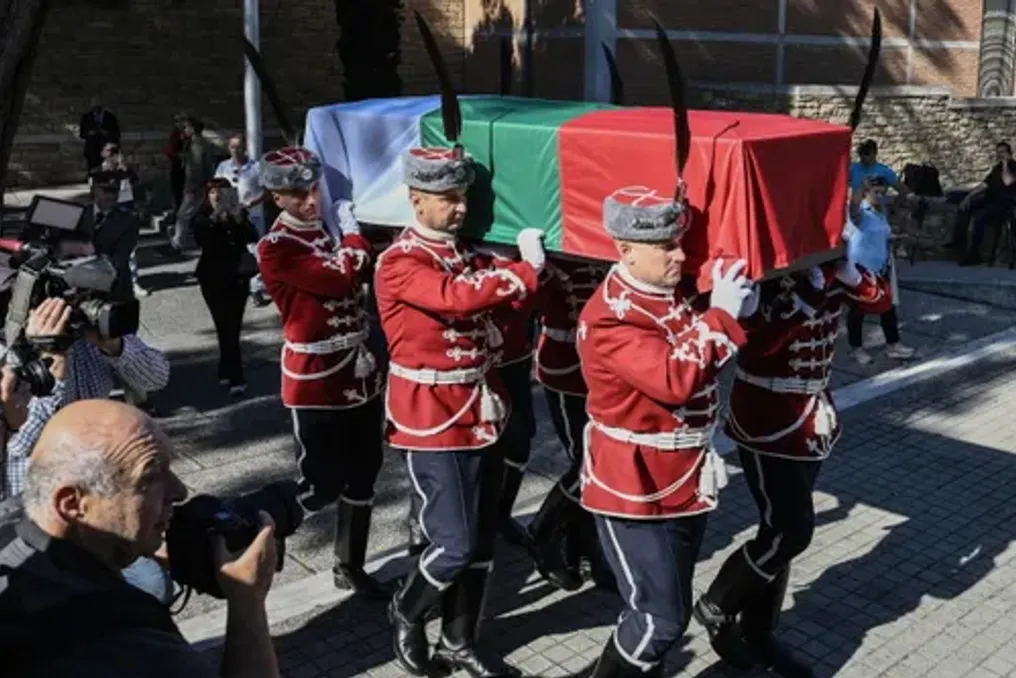
The remains, which may belong to Tsar Samuel—one of the last major rulers of the First Bulgarian Empire—are returning 'home' on Saturday, more than a thousand years after his death. The return ceremony took place at the Museum of Byzantine Culture in Thessaloniki.
This week, Greece and Bulgaria reached an agreement on this return, which Bulgarian Prime Minister Rumens Radchev called 'historic.' Radchev stated that the remains 'belong to our two peoples,' attending the ceremony with his Greek counterpart Kyriakos Mitsotakis.
In exchange for the return of the remains, Greece will receive 48 items that Bulgarian troops captured from churches and monasteries in northern Greece during the First World War. Samuel ruled from 997 to 1014 and led several campaigns against the Byzantine Empire with his brothers, one of whom he later executed.
He gradually expanded his power over a vast territory in the Balkans, making the Prespa and Ohrid lakes region, which is now mostly in North Macedonia, his base of power. However, after 1001, the Byzantines prevailed, decisively defeating Samuel's army in 1014. It is said that Samuel died of shock upon seeing thousands of his defeated soldiers returning home blinded by order of the Byzantine Emperor Basil II, known as the 'Bulgar Slayer.'
Samuel's state fell under Byzantine rule four years after his death. While Radchev noted that future generations will be able to honor the memory of their ancestors, Mitsotakis highly praised the remains, calling them of 'immeasurable cultural, spiritual, and emotional value.'
Bones of Contention
However, Bulgaria is not the only country claiming Samuel; a huge statue of the tsar stands in Skopje, the capital of North Macedonia. His legacy has become a subject of dispute between the two neighboring states, as Macedonians consider him their ruler. The daily newspaper Skopje Sloboden Pechat called the transfer another battle for history, while the Albanian-language daily Koha stated: 'The bones are returning, the conflict remains! Samuel is again (disputed) between Skopje and Sofia.'
Some historians have compared this dispute to the struggle between France and Germany over Charlemagne. In 2022, a bilateral commission recommended presenting Samuel as the head of a state that 'most modern historians consider the Bulgarian Empire,' based on the territory of present-day North Macedonia. Dimitar Bechev, a researcher from the Carnegie Europe analytical center, noted: 'Samuel holds an important place in the historical narrative for both Bulgaria and North Macedonia. This initiative aims to emphasize the Slavic character of the Macedonian population.'
The alleged remains of Samuel were discovered by Greek archaeologist Nikolaos Moutsopoulos in the 1960s. Moutsopoulos was excavating on the Greek island of Agios Achilleios on Lake Prespa, near the border between Greece and Albania and not far from the border with North Macedonia. They discovered the skeleton of a man about 1.6 meters tall, along with remnants of rich silk fabric edged with gold and decorated with bird motifs. The attribution of the remains to Samuel is based on characteristics such as the burial site, the luxury of the clothing, the age of the deceased, and an old fracture.
Decades of Negotiations
Bulgaria officially began negotiations for the return of the remains in 2007, and this issue became a serious problem in relations with Greece. This week's deal also caused disagreements within Bulgaria regarding who should claim the merits, with history playing an important role in this month's presidential elections.
The incumbent Iliana Yotova, supported by Radchev and promoting ties with both Moscow and the EU and NATO, uses patriotic rhetoric, starting her campaign in Veliko Preslav, the former capital of the First Bulgarian Empire. Analyst Bechev observed: 'Radchev seeks to attract the patriotic electorate,' arguing that, unlike other nationalist parties, 'he delivers results.'
Free trips are being organized for the occasion of the transfer to the capital, and about 750 police officers are guarding the center of Sofia. According to the state broadcaster BNT, the remains attributed to Samuel will be placed in a white marble sarcophagus mined in the Prilep region of North Macedonia. They will rest in the Church of Saint Sophia—a 6th-century basilica that gave its name to the Bulgarian capital.