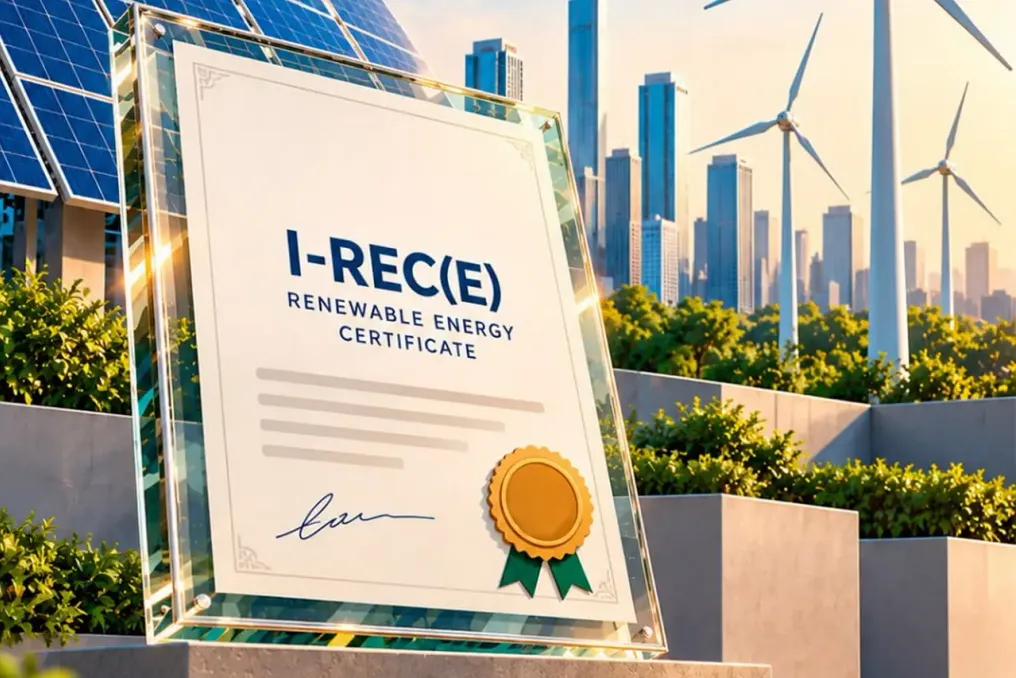
Uzbekistan issued over one million I-REC(E) certificates in the green energy sector
Read more
UzDaily
uzdaily.uz

Uzbekistan issued over one million I-REC(E) certificates in the green energy sector

As of October 2, 2026, Uzbekistan has issued 1,018,453 international I-REC(E) certificates for 'green energy'. This volume is almost 2.3 times higher than the figure for the entire year of 2025, when 446,520 such certificates were issued.

The increase in the number of issued certificates indicates growing interest among enterprises in using electricity generated from renewable sources as part of Uzbekistan's transition to a 'green' economy.

The Ministry of Economy and Finance named Sanoatqurilishbank, UZAUTO MOTORS JSC, Uzbektelecom JSC, Agrobank, and Uzbekneftegaz JSC among the large companies that used I-REC(E) certificates in 2026.

A significant share of the total volume was obtained as a result of a deal ordered by Uzbekneftegaz JSC. The company Uzbekhydroenergo JSC issued 800,000 I-REC(E) certificates for this company.

International I-REC(E) certificates are used to confirm that a certain amount of consumed electricity was produced from renewable sources. Companies can also reflect this information in their ESG reporting concerning the environmental, social, and corporate aspects of their activities.

Furthermore, the use of such certificates may be relevant for firms operating in export markets, as it allows them to document the application of renewable energy in production processes.

The Ministry of Economy and Finance emphasized that the I-REC(E) system is becoming increasingly important in decarbonization and energy transformation processes. These certificates allow companies to demonstrate the use of renewable energy and ensure transparency of relevant practices, supporting sustainable development goals and fulfilling climate commitments.
Similar stories

Uzbekistan's external debt for the first half of 2026 exceeded $84 billion
Read more
podrobno.uz

Uzbekistan's external debt for the first half of 2026 exceeded $84 billion

According to the Central Bank, Uzbekistan's total external debt as of the end of the first half of 2026 reached $84.1 billion. Over the past year, this indicator showed an increase of $11.9 billion, which is an increase of 16.5%.

At the beginning of July, the state external debt amounted to $41.7 billion, while corporate debt was estimated at $42.4 billion. Compared to the previous year, the total debt level was at $72.2 billion. During this period, state debt increased by $4.9 billion, and corporate debt increased by $7 billion.

The Central Bank specified that the corporate external debt includes loans from the private sector that do not have state guarantees. In this case, the state is not responsible for such obligations; payments are made by the enterprises and banks themselves.

The regulator also refers to the International Monetary Fund's assessment, which notes that Uzbekistan's debt burden remains low, and most of the attracted funds were obtained on favorable, preferential terms.

It was previously reported that at the end of the second quarter of 2026, Uzbekistan's state debt reached $48.3 billion. Of this amount, $40.7 billion was due to external obligations, and the remaining $7.6 billion was domestic.

Industrial electricity consumption in Uzbekistan is set to increase by 40% by 2030
Read more
podrobno.uz

Industrial electricity consumption in Uzbekistan is set to increase by 40% by 2030

Electricity consumption in Uzbekistan's industrial sector is projected to increase by approximately 40% by 2030. The consumption volume will rise from 38 to 53.5 billion kilowatt-hours. This additional load on the energy system will be driven by the development of electric transport and data centers.

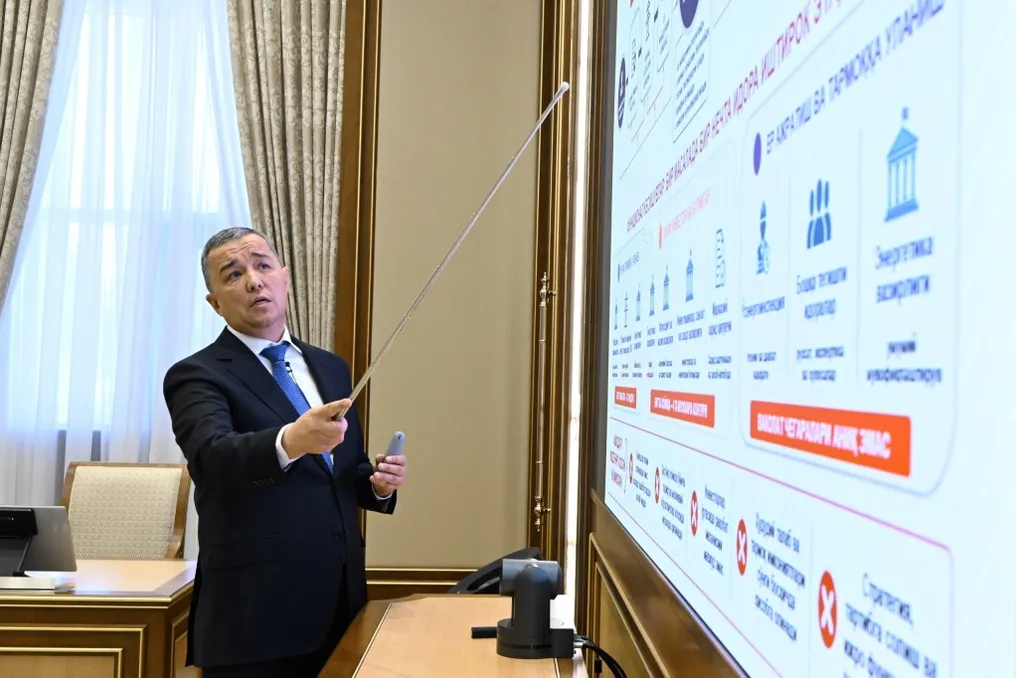
Shavkat Mirziyoyev reviewed a presentation on the prospects for power industry development, provided by the president's press service. It was noted that the current capacity of solar and wind stations already exceeds 6.3 gigawatts, and the number of hydroelectric power plants (HPPs) has surpassed 100, reaching a capacity of about 2.5 gigawatts.

According to approved plans, generating capacity should reach 46.1 gigawatts by 2030, ensuring the production of about 129 billion kilowatt-hours. More ambitious goals have been set for 2035: capacity should grow to 57.2 gigawatts, and output to 154.7 billion kilowatt-hours.

As part of the plan implementation, 26 energy storage system projects with a total capacity of 4.2 gigawatts have been formed, 17 of which are already under implementation. By 2030, the construction of nine 220-kilovolt substations and seven 500-kilovolt substations is planned, along with the laying of nearly five thousand kilometers of new power lines. In Karakalpakstan, the possibility of connecting wind farms with one-gigawatt data centers is being considered.

The President emphasized the need to develop plans that account for high rates of economic growth, as well as ensuring an adequate reserve of capacity. A new project management methodology has been proposed: first, the required demand is determined, then the necessary infrastructure and capacity are planned, and only after that is the investor selected through a competitive selection process.

The distribution of responsibilities between agencies is defined as follows: the Ministry of Economy and Finance will handle demand forecasting, the Ministry of Energy will develop the strategy, and the agency for energy market development and regulation will oversee tariffs. Furthermore, a long-term concept for the fuel and energy complex development until 2050 is provided, with mandatory review every five years.

At the meeting, the President was shown changes in the country's transport network. It is planned that by 2030, the volume of transport services will double, 9.1 billion dollars in investment will be attracted to the industry, and the export of transport services will reach 5.7 billion dollars.

Popular