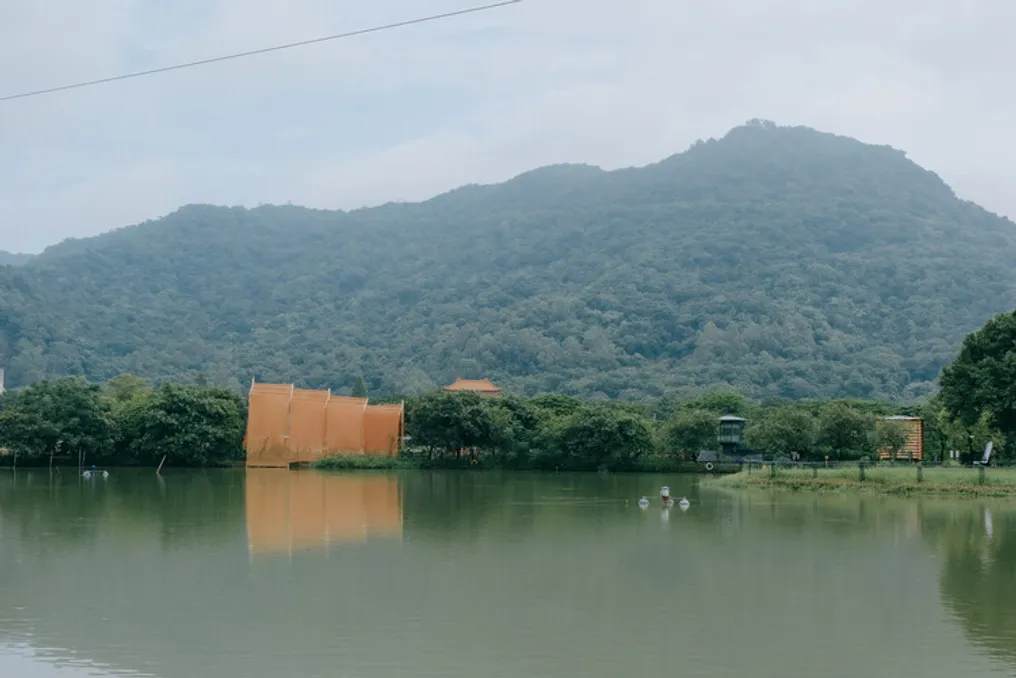
The architecture firm Multi-Architecture conceived an installation for the area called 'Yugengyueyun Section - Fishing and Cultivation Huts 2.0,' upon invitation from Artist Qiaoshan – Art Field Nanhai. This project integrates the historical context of Nanhai, known for its system of 'mulberry dikes and fish ponds,' a vital productive cycle where mulberries and silkworms are cultivated in the dikes, while fish are raised in the ponds, promoting mutual nutrition between land and water.
In this environment, fishing nets transcend their merely labor function, assuming a role as natural and familiar elements of daily life when used for drying.
Historically and even today, the site maintains continuous landscapes formed by mulberry dikes and fish ponds. In the past, the pond landscape presented distinct characteristics from the current one; it was dense and lush, with the local variety known as 'water-shade winter melons' growing over the dikes, forming a vegetative cover that blocked the view of the sky. This configuration generated a strong sense of confinement and a unique bodily spatial experience.
Fishing nets constitute the most accessible and traditional tools within this dike and pond system. Additionally, since the location was originally part of a covered passage within the park, the nets offered a viable solution to provide basic shading, thus becoming the inherent architectural language of this enclosed space.
Due to budgetary restrictions and the infeasibility of the dikes supporting heavy construction equipment, the architecture team collaborated with the structural engineering team at iStructure to determine the installation's volume. An agreement was reached to maximize the volume, even with the limited budget. Dimension is a fundamental aspect of earth art; the low cost of the nets allowed the occupation to be expanded from a small space to a larger one, extending to the water's edge and establishing a dialogue with Xiqiao Mountain, effectively integrating the mountain and water into the site.
The metal structure supporting the nets is based on the *sanjiao zeng*, a traditional triangular net used in marine fishing. The fork-like shapes evoke a sense of vernacular charm and randomness, harmonizing structural logic with a rustic and expressive aesthetic. These structures are arranged following the terrain, descending from higher to lower areas.
Over this structure, the fishing nets are handled through processes of 'overlapping' and 'draping,' creating a dual modality of 'movement' and 'stillness.' The overlapping nets are fixed and anchored on both sides, while the upper section hangs like fluid curtains. When the wind blows, the net coverings sway slowly above, resembling a vast entity that seems to breathe.
The internal path traces an S-shape, following the arrangement of the structural pillars. The pavement, made from a combination of reclaimed gray bricks and broken stone slabs, balances a natural and rustic aesthetic with the functional need to allow maintenance workers to circulate through the area using cargo tricycles. Tropical plants of various heights are interspersed along the sides; together with the fishing nets, they intensify the feeling of enclosure, recalling the traditional agricultural period of the ponds and dikes. Stone slab platforms, typical of the waterfronts of Foshan villages, were also relocated to this space.
The incorporation of a misting system stems from an intuitive and bodily perception of the South. Guangdong frequently alternates between dry, intense heat and dense, dewy humidity. Mist plays a dual role: irrigation and landscape component, mirroring the southern climate and inducing a soft, diffuse atmosphere. With the changing seasons, the interaction between humidity, light, and vegetation ensures that the space maintains a state of gradual and continuous evolution.
When lifted, unfolded, and raised from the water, the fishing nets—expanding to an extraordinary magnitude—see their original practical function diminish, but the associated experiences emerge: the forms molded by wind resistance, the persistent humidity after rain, the imaginary evocation of work, and the lasting bond between humans and water. Xuegu, a volunteer guide, mentioned that the place reminds her of childhood Guangdong. This subtle resonance, where a feeling of familiarity intertwines with immediate sensory experience, was exactly what was intended to be achieved.