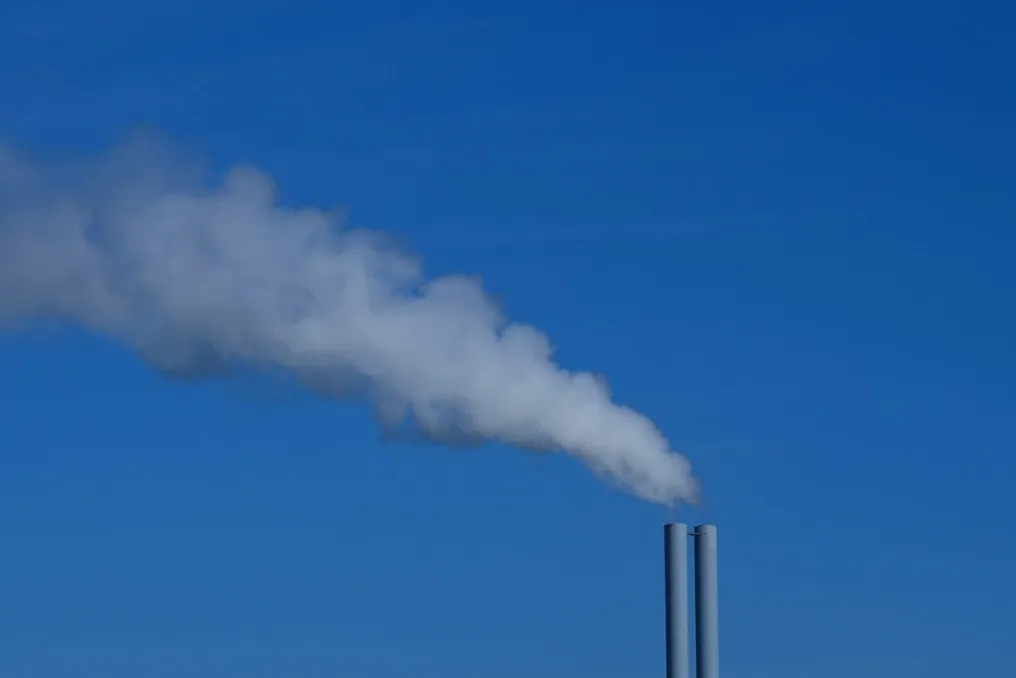
The conflict in Iran has caused an unexpected change in global carbon dioxide ($ ext{CO}_2$) emission estimates for 2026. Initially, projections indicated growth, but revisions by the International Energy Agency (IEA) have started to signal a slight reduction in emissions linked to the use of oil, gas, and coal.
According to an analysis by Carbon Brief, a British portal focused on climate change, the projected decrease is approximately 0.5% compared to 2025. In absolute terms, this equates to about 190 million tons less $ ext{CO}_2$. This figure is considered significant, given that drops in global fossil fuel emissions are uncommon events.
However, caution is necessary, as this contraction represents only a small fraction of the nearly 40 billion tons of $ ext{CO}_2$ released annually from burning these fuels. Furthermore, the estimate is a general projection for 2026 and may be modified depending on the duration of the conflict, energy prices, and the ability to replenish fuels in the following months.
Analysis of Current Data
The data reveals that fossil fuel emissions could end 2026 about 0.5% below the 2025 level. Oil is the main factor in this change, with the IEA's forecast shifting from demand growth at the beginning of the year to an estimated reduction of 2.5 million barrels per day in September. Gas also saw its projections decrease due to supply restrictions and rising prices.
In contrast, global coal consumption is expected to increase, reaching a new record this year. It is crucial to note that an annual reduction in emissions does not necessarily imply a decrease in atmospheric $ ext{CO}_2$, as the world will continue to emit tens of billions of tons, increasing the gas concentration.
IEA data, verified by g1, illustrates the evolution of the projection throughout the year. Initially, in January, the projection pointed to 281 million tons above 2025 emissions. The revision of oil demand reversed this scenario to 260 million tons below. Subsequently, the new forecast for gas deepened the drop to 454 million tons below 2025. The projected growth in coal mitigated part of this reduction, resulting in the most recent estimate of a balance of about 191 million tons less $ ext{CO}_2$ than in 2025. The total variation between the January expectation and the current projection amounts to approximately 472 million tons of $ ext{CO}_2$.
This difference of 472 million tons refers to the change in the annual forecast since January and does not mean that this amount stopped being emitted. Part of this change stems from forecasts made before the conflict that did not materialize, and not just from an absolute reduction in already recorded consumption.
Low Reduction, Upward Trend
Since the Industrial Revolution, $ ext{CO}_2$ emissions from industry and fossil fuels have shown constant growth, rising from approximately 22.5 billion tons in 1992 to 38.6 billion in 2024. There have been few significant drops during this period; after the international financial crisis, there was a drop in 2009, but growth quickly resumed the following year. The Covid-19 pandemic in 2020 caused a substantial reduction, followed by a recovery.
Given this history, experts argue that any predicted drop for 2026 does not allow one to conclude at this time that global emissions have begun a permanent downward trajectory. Claudio Angelo, coordinator of international policy at the Climate Observatory, warns against confusing a cyclical fluctuation in the energy market with a structural transformation of the energy system.
According to Angelo, the most relevant aspect of the crisis may manifest less in the outcome of a single year and more in the decisions made by governments, companies, and consumers in response to high costs and supply difficulties. He emphasizes the need to observe what the conflict is doing to global energy markets, rather than just focusing on the locally reduced carbon tonnage.
The conflict's impact primarily affected oil and gas. With supply interruptions and price increases, the IEA's forecast on global oil demand was progressively reduced throughout 2026. Thus, the war did not result in a uniform decrease across all fossil fuels, but rather in an alteration of their composition.
Angelo suggests that persistently high oil and gas prices may accelerate existing trends, such as investment in renewable sources and electrification. However, he stresses that it is premature to determine if such changes will be lasting. There are signs in both directions: the pursuit of clean technologies advances in large markets, while countries increase coal use and oil and gas producers maintain expansion plans.
The IEA itself predicts a recovery in oil demand in 2027, indicating that some of the reduction seen this year may disappear when supply conditions improve.
History reinforces the need for caution. During the pandemic, fossil fuel emissions fell by about 5% in 2020, a decline greater than currently projected. The following year, they began to grow again. There is also a fundamental distinction between emitting less and reducing $ ext{CO}_2$ in the atmosphere. Even if the 0.5% drop is confirmed, the planet will continue to add billions of tons of $ ext{CO}_2$ to the atmosphere, as the gas persists for long periods, only slightly slowing the rate of accumulation.
Recent measurements demonstrate this disparity: the global average $ ext{CO}_2$ concentration reached 423.9 parts per million in 2024, according to the World Meteorological Organization (WMO), exceeding pre-industrial levels by about 52%. In 2026, readings at Mauna Loa, Hawaii, a key monitoring station, are expected to again exceed 430 parts per million during the annual peak.