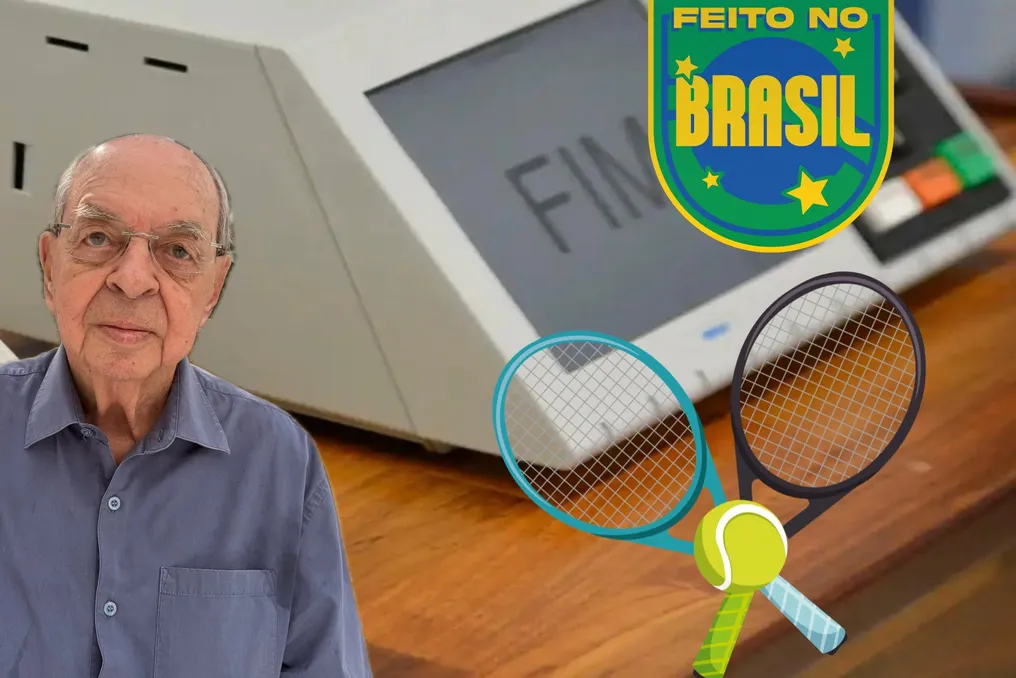
The electronic voting machine, today a fundamental symbol of Brazilian democracy, had its conception originating from a casual conversation during a tennis match. This discussion led to a device that ended up revolutionizing the electoral process in Brazil.
Minister Carlos Velloso even referred to the device as 'tupiniquim,' a term meaning something essentially Brazilian. He explained that the search for international solutions had not presented adequate alternatives to the specificities of the Brazilian scenario.
The journey to develop this equipment began when Paulo Camarão was appointed Secretary of Informatics of the Superior Electoral Court (TSE) and took the lead of the responsible teams. This group consisted of engineers and researchers from the National Institute for Space Research (Inpe) and the Aerospace Technical Center (CTA).
The technicians involved in the development were nicknamed 'the ninjas,' and they were Paulo Nakaya, Mauro Hashioka, Antônio Ésio Salgado, Oswaldo Catsumi, and Giuseppe Janino, all under the coordination of Paulo Camarão.
Defining requirements of the equipment
During meetings, rigorous criteria were established that the ballot box should meet. One of the initial points of political resistance was the requirement for a numeric keypad, as the candidate's mark was often their name, which made it difficult to fix the vote solely by number. However, after continuous negotiations with Congress, this requirement was approved.
Another crucial feature was that the voter would need to see their choice on the ballot box screen before confirming the vote. In total, 22 technical requirements were defined that guided the entire system development.
Among these requirements were the ability to operate without dependence on the internet or other networks, have its own battery so as not to depend on the electrical grid, be robust and easy to transport to remote locations, such as indigenous villages, and, above all, be intuitive to use.
National success and democratic impact
According to the TSE, the result was extremely positive. The electronic voting machine managed to integrate the screen, keyboard, and CPU into a single unit. Its keyboard, similar to that of a telephone, allowed people with visual impairments or illiterates to interact with the new device without difficulty.
In 1996, the system was already capable of registering and counting the votes of more than 32 million citizens, which represented one-third of the electorate at the time, with the production of over 70 thousand units.
The TSE emphasizes that the implementation of the electronic voting machine was the successful Brazilian solution to replace paper ballots, which had historically been susceptible to fraud. The equipment strengthened the social perception that a representative democracy is sustained by the sovereign will of the people, guaranteed by transparent and free elections free of suspicion.
Thirty years of evolution
The electronic voting machine celebrated 30 years this May. On May 13, 1996, the TSE sent the first computerized voting machines to the states, marking a significant moment for democracy.
Paulo Camarão affirms that the project remains relevant after three decades, being constantly improved with each election and resisting criticism and attempts at destabilization.
The TSE details the main technological advances that have occurred in these thirty years:
- Security: Implementation of an unprecedented global security architecture that restricts operation only to authentic systems within the machine, complemented by the use of advanced cryptography and more resistant physical seals.
- Transparency: Inclusion of multiple mechanisms to assess the integrity and validity of both the vote and the final count.
- Biometrics: Since 2008, fingerprint identification has been progressively incorporated to assist poll workers in validating voter identity.
- Accessibility: Features for people with hearing and visual impairments have been introduced and improved, including headphones, voice synthesizer, Braille keyboard (present since the original UE96), and support for Libras interpreters on the screen.
- Efficiency: The renewal of models has made the electoral process faster, reducing the time required for vote registration in polling stations.
- Sustainability: The devices have begun to consume less energy and have been designed for greater durability and ease of recycling, contributing to environmental protection.