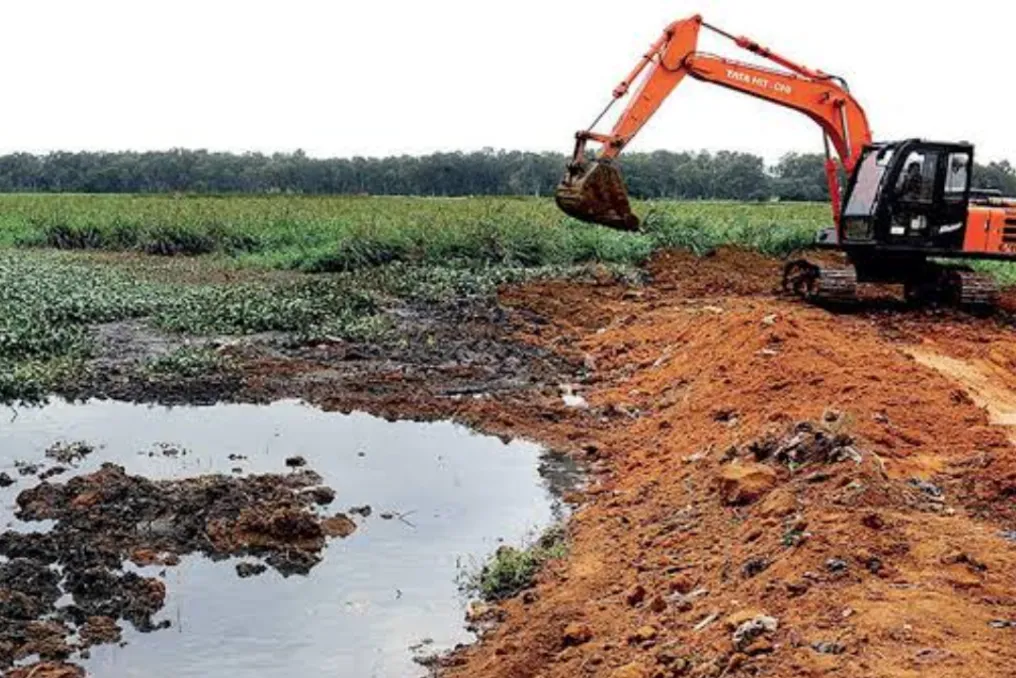
For a city built around lakes, such as Bengaluru, the question of how to revive the lakes has been sought for many years. Usually, the solution lies in obvious physical aspects: silt removal, dam repair, weed clearing, fixing water intake channels, and ensuring shoreline accessibility.
Now, the state of Karnataka is preparing to implement similar work on a large scale. According to a PTI report from September 22, 2026, a program worth 150 crore rupees has been developed to revitalize 500 lakes in seven water-scarce districts. Of these, 135 are located in the urban and rural areas of Bengaluru.
The proposed measures include silt removal, strengthening and raising dams, repairing canals and water intake channels, as well as landscaping. This project is being implemented with the support of the World Bank.
These 500 lakes are distributed across the following districts: Rural Bengaluru (68), Urban Bengaluru (67), Bidar (44), Chikkaballapur (90), Kalaburagi (49), Tumakuru (96), and Kolar (86).
However, the experience of Bengaluru shows that simply returning water to a lake is only part of the restoration process. The question arises: what should a truly healthy urban water body look like?
First Test: What enters the lake?
When inspecting a lake in Bengaluru, one must ask what flows into it. Historically, Bengaluru's lakes formed a single cascade where water moved between reservoirs through the natural landscape of the city. A technical assessment conducted by the World Bank in 2025 under the Karnataka Water Security and Sustainability Program notes that the existing lake network can help the city manage both floods and droughts.
Nevertheless, this function directly depends on the quality and volume of water entering the system. Sewage is one of the most serious problems. A study published in the journal Frontiers in Water in 2026 examined eight urban lakes in Bengaluru and reviewed various methods for combating sewage. Researchers found that using diversion channels can improve water quality in the lake by preventing sewage inflow. However, there is a nuance: pollution does not disappear just because it is diverted. Sewage can be directed downstream, potentially negatively affecting fisheries, groundwater recharge, and flood regulation.
Therefore, researchers believe that the most preferable solution is effective sewage treatment, and they also point to the creation of artificial wetlands and other local interventions that can support biodiversity and ecosystem services. This is critical for the 135 Bengaluru lakes included in the restoration list, as a lake can be cleared of silt and its dam repaired, but remain threatened if sewage continues to flow in.
Thus, the first sign of a healthy lake is not merely the presence of water, but that the water entering it is controlled.
Second Test: What happens inside the water?
A lake may look renewed after restoration but still not be ecologically healthy. The shoreline might become cleaner, but what is happening beneath the surface? Researchers from the Indian Institute of Science assessed Bengaluru's lakes using parameters such as dissolved oxygen, biochemical oxygen demand, chemical oxygen demand, nutrients, and temperature, as well as biological indicators.
One review of restored lakes found that only Jakkur, Devasandra 1, Ullal, and Handrahalli lakes recorded good water quality based on the water quality index. Many other restored lakes remained in poor or very poor categories, with continuous sewage inflow cited as one of the problems. This highlights the distinction that is easily lost when lake restoration becomes purely civil engineering activity. Restoration differs from construction.
IISc researchers caution against approaches they call the 'concrete bowl,' where natural vegetation and wetlands around the lake are replaced by hard surfaces. This vegetation is not just decoration. Riparian plants are capable of absorbing nutrients and serving as breeding and feeding grounds for birds, insects, and other organisms. Wetlands also play a role in filtering water before it enters the main lake.
Third Test: What returns?
A healthy lake must support life. This makes birds, insects, aquatic organisms, and local vegetation not just pleasant additions to the landscape; they can serve as indicators of ecosystem health. IISc researchers studied biological communities in Bengaluru's wetlands, including diatoms, mollusks, aquatic insects, butterflies, and birds, alongside water quality parameters. Their work showed a link between water quality and the organisms found in these wetlands, noting that pollution-tolerant species are more often preserved in heavily polluted waters.
Recent rains brought plastic into Doddakalsandra Lake—a recurring problem in Bengaluru's lakes. This breaks down into microplastics, polluting the lakes and threatening groundwater. There are also examples where restoration was accompanied by measurable ecological changes. In Venkateshpura Lake, ATREE's work combined water quality monitoring with the use of local vegetation, floating islands, habitat creation, and aeration. ATREE reported that the average dissolved oxygen content increased from 1.74 mg/L to over 5 mg/L after installing submersible aerators.
The lake also registered the return of species such as the pied avocet and the Eastern darter, as well as butterflies and amphibians. The return of a predatory bird, such as the pied avocet, can indicate that the lake supports the food chain upon which this bird depends. In other words, the lake begins to function as an ecosystem, rather than just holding water.
So, what does 'healthy' mean?
A healthy urban lake should have cleaner inflows, functioning water intake channels, sufficient dissolved oxygen levels, working wetlands and local vegetation, as well as aquatic and terrestrial biodiversity and connection to the wider water system. It must be capable of storing water, slowing runoff, supporting groundwater recharge, and providing habitat.
This does not diminish the importance of silt removal, dam repair, or canal restoration, as these measures may be necessary parts of lake management. However, research conducted in Bengaluru shows that this is only part of the task. The true test will come when the rains return.
3