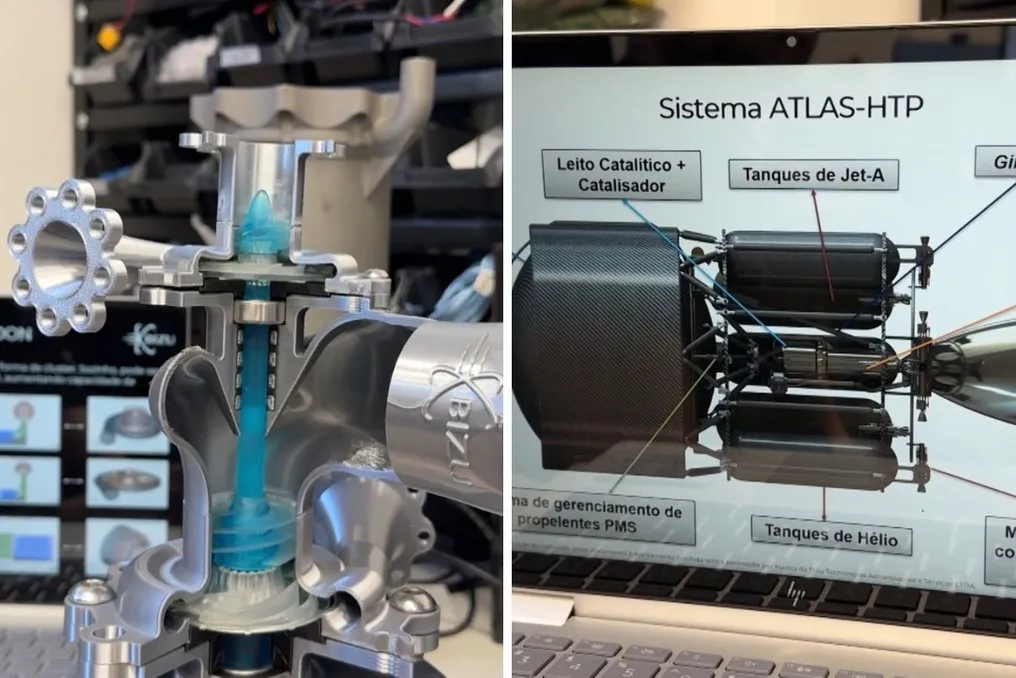
In São José dos Campos, in the interior of São Paulo, there are several initiatives focused on advancing technologies for the space sector. A company, together with researchers from a local university, is working on projects covering engines, propulsion systems, and controls intended for rockets and satellites.
A company based in São José dos Campos, whose founders are engineers trained at the Aeronautical Technological Institute (ITA), was selected to receive an investment of R$ 25 million from the Financing Agency for Studies and Projects (Finep), an entity linked to the Ministry of Science, Technology and Innovation (MCTI).
This funding will be used for the development of liquid propulsion projects, a technology applicable in different phases of the rocket launch process. Among the components being created, a motor designed for the final phase of the launch stands out, whose function is to place a satellite into orbit.
Raphael Galate, co-founder and CFO of the company, explained that the Finep project includes products under development, such as the engine that ignites at the end to put the satellite into orbit, and the turbopump, which enables the creation of engines operational from takeoff, known as first-stage engines.
Dependence on foreign rockets
Currently, Brazilian institutions and companies that need to put satellites into orbit continue to depend on foreign-made rockets. Progress in developing national technologies has the potential to increase Brazil's autonomy in accessing space and strengthen the country's capacity to create and manage its own systems.
According to Finep, mastery over space technologies is intrinsically linked to national sovereignty. José Henrique Pereira, innovation manager at Finep, commented that global sovereignty today depends heavily on access to space, aligning with the New Space trend, where smaller companies and startups offer space access solutions with greater economic viability.
University research
Part of this development takes place within the University of Vale do Paraíba (Univap), also located in São José dos Campos. Researchers from the institution's laboratory are dedicated to developing a specific catalyst to decompose hydrogen peroxide, a substance that can be used in propulsion systems.
The purpose is to create a technology applicable in systems used in spacecraft. José Augusto Jorge Rodrigues, a professor at Univap and technical manager of the project, emphasized the importance of national technological development given Brazil's current dependence on other countries. He stated that, considering world geopolitics, such projects are crucial to ensure a certain technological independence in the sector, given that the country has high external dependence and needs to initiate this movement.