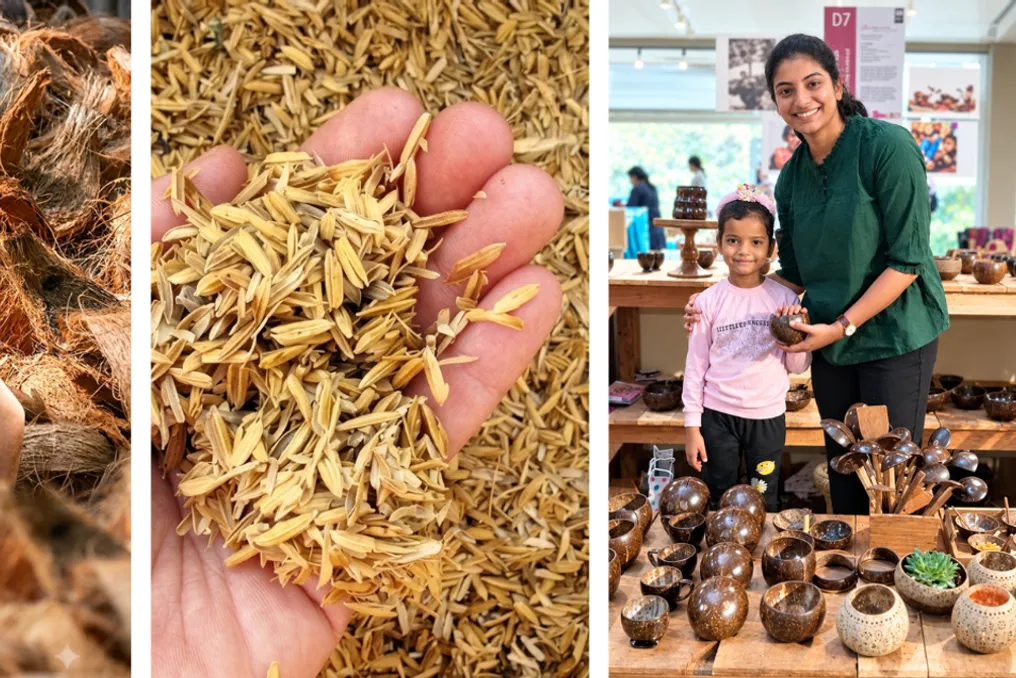
Four Indian startups are using agricultural waste, including coconut shells, to create new products
Read more
The Better India
thebetterindia.com

Four Indian startups are using agricultural waste, including coconut shells, to create new products

Coconut shells often end up as the last element remaining after extracting water and flesh, and are usually discarded or burned. However, several startups in India approach such residues differently.

Agricultural waste, such as coconut shells and husks, rice husks, and ash from its burning, is being transformed into everything from kitchenware and gardening supplies to furniture panels and industrial materials. The main idea is to use farm waste as raw material for useful things instead of viewing it as trash.

Below are four Indian startups that are finding innovative ways to give agricultural waste a second life.

In Kerala, where coconuts are part of daily life, Maria Kuriyakose noticed the potential in what most people were simply throwing away. In 2019, she founded Thenga Coco as a small backyard experiment to turn discarded coconut shells into useful handicrafts.

Today, this women-led startup receives shells from local oil mills and temples, transforming them into bowls, spoons, soap dishes, teacups, salad bowls, smoothie bowls, plant pots, and candle holders. To maintain naturalness and suitability for daily use, the shells are polished with coconut oil instead of chemical lacquers.

Furthermore, behind these products is a story of providing livelihoods. Thenga Coco collaborates with local artisans, especially women in rural Kerala, many of whom can work flexibly from home. Thus, what starts as a discarded coconut shell can become a kitchen item, a home accessory, and a source of income.

Not only can coconut shells be utilized. After extracting fiber from the coconut husk, a fine material called coir filler or coconut sand remains. Instead of considering this residue waste, Global Green Coir from Chennai transforms it into products used by farmers and gardeners.

The company, founded by biotechnologist Aneesh Ahmed in 2014, recycles coconut husk into blocks, bricks, discs, growing bags, and pots made from coconut fiber. Coconut sand can serve as a soil-free growing medium and is used in greenhouses, hydroponics, nurseries, landscape design, and home gardening. The company has production facilities in the coconut-growing regions of Tamil Nadu and exports its products to global markets. Simply put, the material that once remained after processing coconuts can now help grow the next harvest.

What if agricultural waste didn't return to the soil but ended up in our homes? Indowud NFC uses agricultural waste, such as rice husks, to produce natural fiber composite panels that can serve as an alternative to traditional wood boards.

These panels are made from crushed agricultural husks, minerals, and polymer binders, without using wood fibers obtained through logging. They can be used for furniture, kitchen cabinets, wall cladding, doors, frames, flooring, and decorative screens. The material is designed to be waterproof, termite-resistant, and weather-resistant, making it suitable for both indoor and outdoor use. It can also be cut, drilled, screwed, and processed on CNC machines using standard carpentry tools. Thus, instead of rice husks ending their journey as agricultural waste, they can become part of a cabinet, a wall, or a piece of furniture.

Even after rice husks are used as fuel, there can be value left. Brisil Technologies from Vadodara, founded by Tamnaim Pandya and Rashmi Pandya in 2016, works with rice husk ash—the residue formed during its burning. The startup has developed a process to extract high-purity silica from this ash. This material can then be used in various industries, including tires, rubber products, footwear, paints, and coatings.

Brisil claims that its process can recover up to 70% of the silica from rice husk ash. Its commercial units are also designed to process about 50 tons of biomass waste per day. One application is in tire manufacturing, where silica can improve tire performance and reduce rolling resistance. From coconut shells turning into bowls to rice husks becoming building panels, these startups demonstrate that agricultural waste does not necessarily have to be the final destination for a material; sometimes it can be the beginning of something entirely new.
Similar stories

How to reuse coconut shells: five simple ways for home
Read more
www.aajtak.in

How to reuse coconut shells: five simple ways for home

Coconut water is considered very healthy, so it is sold in stores at a high price. Often, people throw away the shell after consuming coconut water. After extracting the white flesh from dried coconut, the outer shell is sent to the trash. However, the coconut shell is not useless material. With a little creativity, it can be used to decorate the home in various ways.

Coconut shells can be reused in many ways at home, and by learning this, you will never throw them in the trash again. From the shells, you can give your home a new look for the festivals of Navratri and Diwali, as well as give a second life to unnecessary items. Let's look at several simple methods of decorating the home with coconut shells.

Creating miniature pots

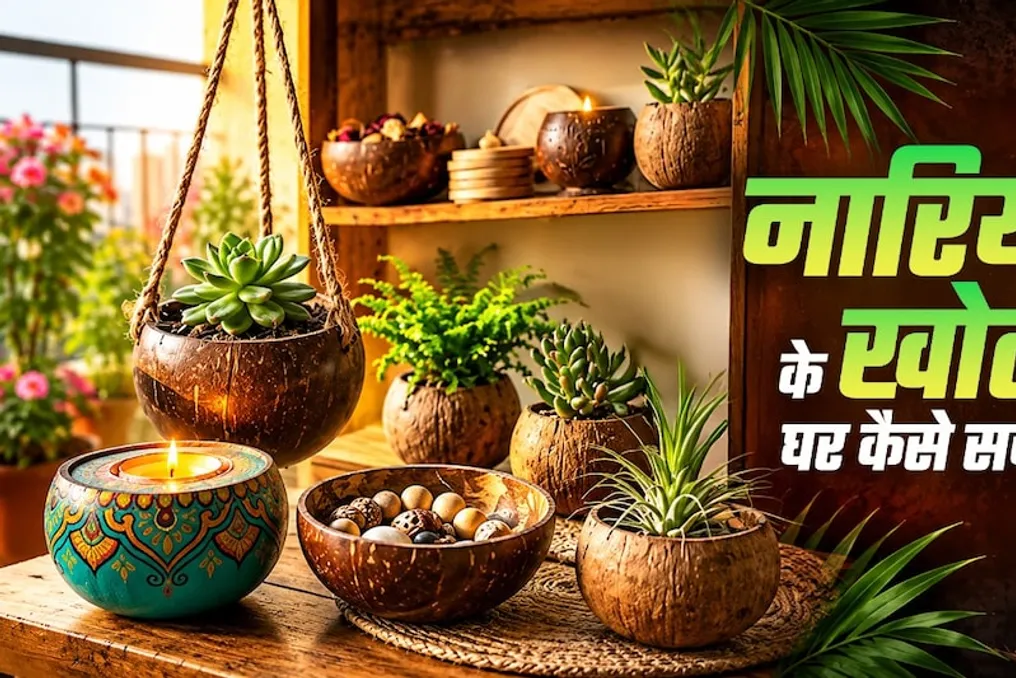
Coconut shells can be used as pots for small plants. Currently, the cost of pots on the market is very high, and decorative small pots are expensive. In this case, you can reuse coconut shells. First, thoroughly clean and dry the shell. Then, make one or two small holes in the bottom so that excess water can drain out. After that, fill it with soil and plant a small or decorative plant. Such a pot can be placed on a window, balcony, or table.

Making beautiful hanging planters

If you have little space in your home, you can make a hanging planter from a coconut shell. To do this, you need to make small holes on both sides of the shell and tie a strong rope to them. Fill it with soil and plant small plants, then hang it on the balcony or near the window. If you connect two or three such shells together, it will look even more decorative.

Candle holders or candle holders

During Diwali, people light candles and lamps in their homes, and you can create holders for them. This will allow you to easily decorate the house by placing them on the table or floor. Since the coconut shell is small and has a bowl shape, it will look beautiful when holding decorative lamps or candles. Thoroughly clean and dry the shell, then paint it and create a design. Place a small candle or lamp in it and decorate the place of worship or balcony. When burning the candle, keep it in a safe place, away from flammable materials.

Creating small bowls

Small bowls are sometimes required to decorate the home during Navratri and Diwali, and coconut shells can be used for this purpose. After thoroughly cleaning the shell, you can paint it if you wish. After that, it can be used to hold artificial flowers, small stones, beads, or other light objects, placed on a central table or shelf to give the home a new look.

Making a stylish jewelry hanger

A wall hanger can be made from coconut shells. For this, take 4-5 shells and paint them with colored paints. Then, tie them in a row with string so they look like a real hanger. After that, hang it near the mirror in your room to store your daily jewelry and necessary items.

How to make crumbly semolina halwa that won't stick to the pan
Read more
www.aajtak.in

How to make crumbly semolina halwa that won't stick to the pan

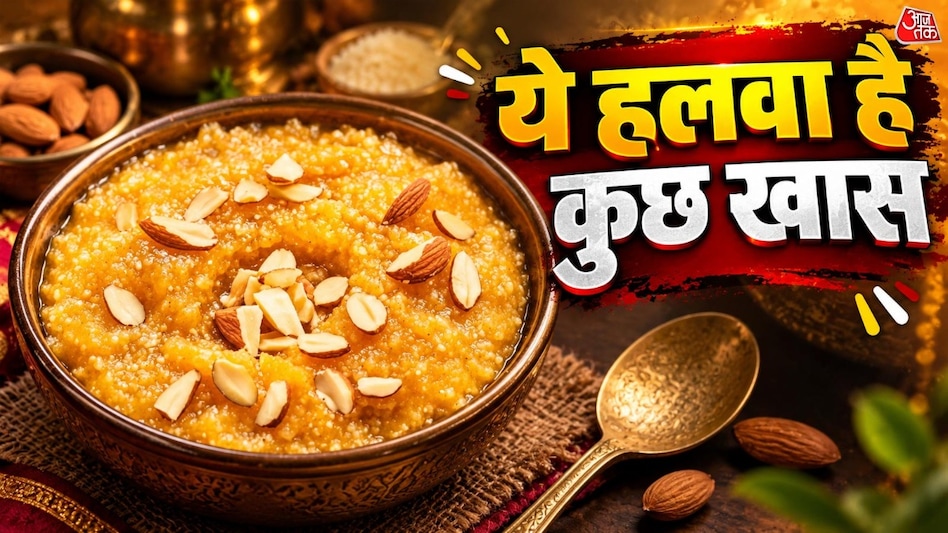
Semolina halwa is one of the most beloved and popular sweet dishes in India, prepared during religious ceremonies, festivals, or rituals with girls.

However, problems often arise: the semolina sticks to the bottom of the pan when frying, lumps form in the halwa, and after cooling, the dish becomes hard and dry.

If you encounter such difficulties, do not worry. Professional chefs who prepare halwa for bhandara (community feast) use specific proportions and a special technique that allows every grain of halwa to open up, and the dish does not stick to the pan at all. Below is the most accurate and simple instruction for making crumbly and juicy semolina halwa in the bhandara style.

The following ingredients are required for preparation:

  • 1 cup of semolina (preferably coarse-grained)
  • 1 cup of ghee (clarified butter)
  • 1 cup of sugar (to taste)
  • 4 cups of water (or 3 cups of water + 1 cup of milk)

Additional ingredients:

  • 1 tablespoon of chickpea flour (besan) or wheat flour (a secret ingredient for texture and color)
  • 1/2 teaspoon of cardamom powder
  • 8-10 strands of saffron (soaked in warm milk)
  • Chopped cashews, almonds, and raisins

First, heat 4 cups of water, 1 cup of sugar, saffron strands, and cardamom powder in a separate pot on the stove. It must be heated until the sugar is completely dissolved and the water begins to boil; syrup should not be made.

Add 1 tablespoon of ghee to the pan and fry the cashews, almonds, and raisins until lightly golden, then remove them.

Technique for frying semolina

Next, add the remaining full cup of ghee to the same pan. When the oil is slightly heated, add 1 cup of semolina and 1 tablespoon of chickpea flour. Adding chickpea flour prevents the semolina from sticking to the pan and also gives the halwa a pleasant aroma and color, like that prepared by professionals.

On low or medium heat, stir the semolina constantly for 8-10 minutes. The semolina is considered properly fried when its color turns light golden and the oil starts to separate.

Secret technique for adding water

Lower the heat to the minimum. Then, gradually pour the boiling sweet water into the semolina while continuously stirring with the other hand to prevent lumps from forming. It is important to add the water very carefully, as steam and splashes can be abundant.

After adding the water, continue cooking on medium heat. When the semolina has absorbed all the liquid, cover the pan for 2 minutes and reduce the heat. This allows each grain of semolina to swell, making the halwa soft and crumbly.

Final touch: remove the lid, add the fried dried fruits, and sprinkle with 1 tablespoon of ghee. The halwa will start to separate from the sides of the pan and take on a juicy appearance.

The finished crumbly and juicy halwa, worthy of a temple and bhandara, is ready to serve. It should be served hot.

Popular