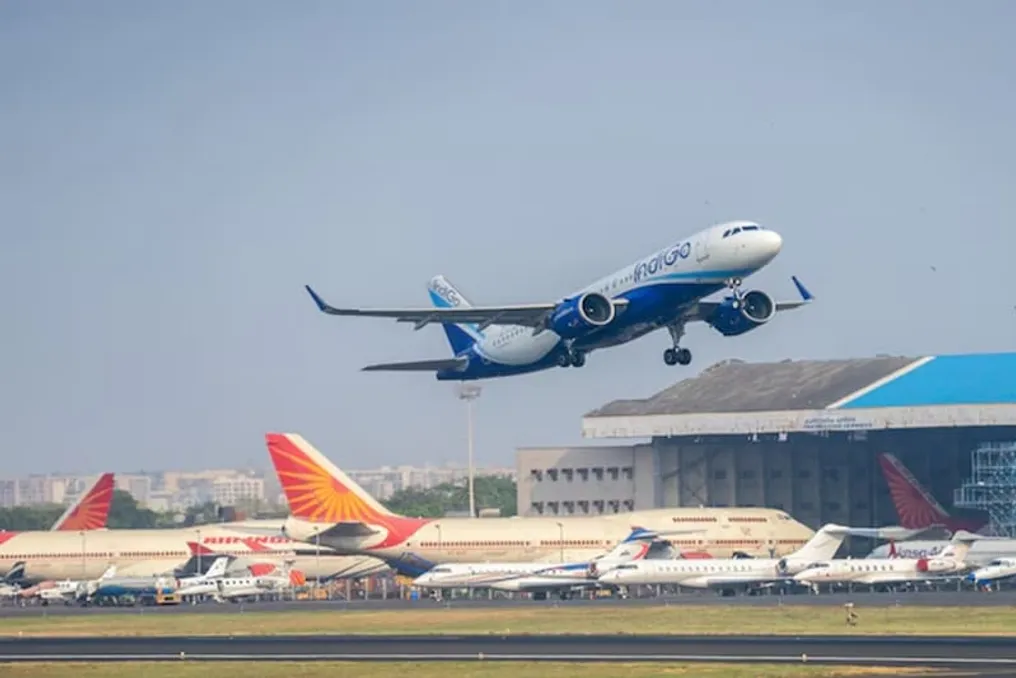
Passengers planning flights from Mumbai should pay attention to the terminal from which their flight will depart. Mumbai Airport Terminal-1 (T1) will be closed for service starting from October 25, 2026, as it is planned for complete reconstruction. No flights will operate there during the renovation period. According to available information, the new terminal may be ready for operation in 2029–2030.
Due to this, flights previously operated through T1 may be redirected to another terminal or to Navi Mumbai Airport.
The removal of the old Terminal-1 and the construction of the new complex are part of a large-scale demolition and restoration project. This project is being implemented under the direction of the Airports Authority of India (AAI) and is overseen by Mumbai International Airport Limited (MIAL). Initially, the project was planned to start in mid-2025, but at that time, there were not enough alternative options for redirecting flights. Now, after the opening of Navi Mumbai International Airport (NMIA), the plan has been adjusted and advanced.
Mumbai International Airport Limited has informed stakeholders that T1 will cease accepting flights from October 25, 2026, and reconstruction work is scheduled to begin in early January 2027. Airlines that used T1 will have three options: they can transfer their flights to Mumbai Airport Terminal-2 (T2), begin operations from Navi Mumbai International Airport, or temporarily suspend their activities.
It is expected that some domestic flights may be transferred to T2. Furthermore, to free up space in T2, some international flights that operated there may be moved to Navi Mumbai Airport. The airline Akasa Air has already begun the process of relocating its flights, and negotiations with other airlines are ongoing. However, full information on which specific airline and which flight will be served from which terminal or airport has not yet been disclosed.
After T1 closes to passengers, the most important task will be the thorough inspection of the terminal and the airport where their flight is directed. Since there is a distance between Mumbai Airport T2 and Navi Mumbai Airport, choosing the wrong destination could cause problems. Therefore, it is crucial to study the airline's announcements, the information provided on the ticket, and the current flight status before traveling. If your flight terminal changes, you must obtain confirmation from the airline. Plans for transferring all airlines are currently expected to be published.
In total, both terminals of Mumbai Airport serve approximately 950 flights daily. With the closure of T1, redirecting flights to other locations will not be a simple process. Airlines will have to structure logistics considering available slots, flight schedules, and passenger flow. In the fiscal year 2025–26, T1 handled about 1.5 million passengers, while T2 served approximately 4 million people. This data indicates that after T1 closes, the load on the remaining terminals and Navi Mumbai Airport may increase.
MIAL stated that after the launch of the new terminal, the rights to existing airlines' slots will be respected. Slots refer to the established time allowed for an airline to arrive or depart a flight. This issue is significant given that the number of flights at Mumbai Airport is already quite high. While T1 remains closed, airlines will have to change their operational schemes. Additionally, it will be important to determine how the existing slot system will be implemented upon the opening of the new terminal.
The existing T1 complex is estimated to be 84 years old. The possibility of its complete reconstruction has been discussed for a long time. The goal of the restoration is to create more comfortable conditions for passengers and increase the terminal's capacity. This work is also part of the plan to strengthen the two-airport model in Mumbai. The opening of Navi Mumbai International Airport has provided an additional option for handling growing air traffic in the Mumbai region. The Airports Authority of India (AAI) has also begun providing incentives to stimulate new international flights from Navi Mumbai Airport.