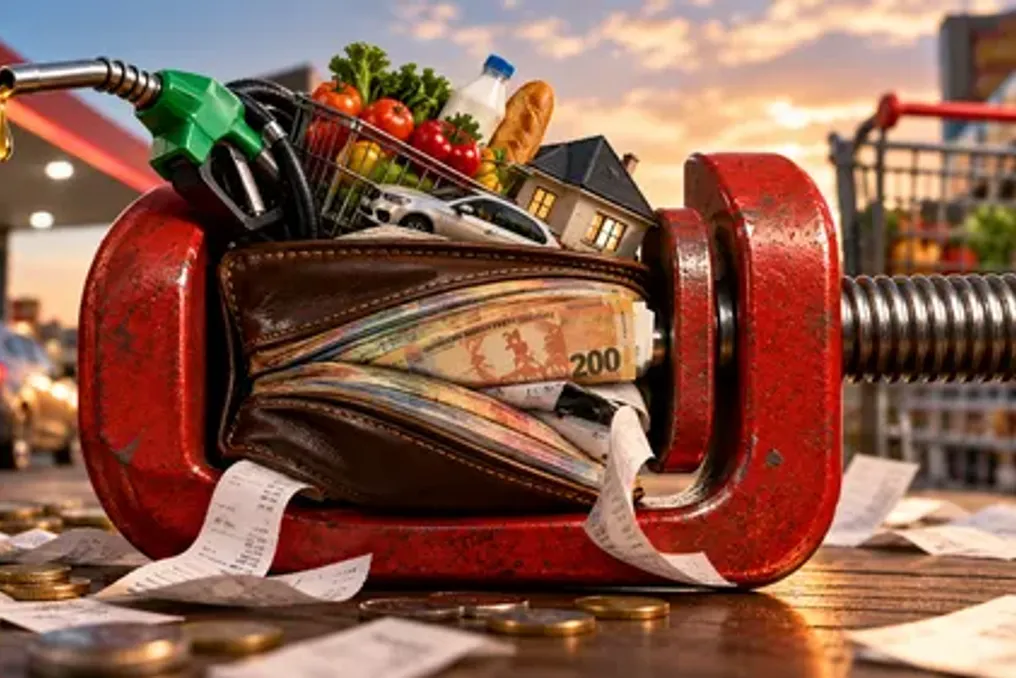
The increase in fuel costs could trigger inflation and potentially lead to higher interest rates. South Africans may face another rate hike as rising petrol prices contribute to inflation, starting a vicious cycle that undermines already strained household budgets.
Investec Chief Economist Annabel Bishop forecasts that in October, petrol and diesel prices will rise by approximately 3 rand per liter. She noted that this will again push CPI inflation to an annual rate of 5% and could prompt another repo rate hike for South Africa in November.
In August, inflation stood at 4.4%, slightly exceeding the July figure. Meanwhile, transport cost growth increased by 8.8% year-on-year.
Bishop pointed out that market concerns regarding fuel prices, linked to the Middle East war and its impact on oil, petroleum products, and commodities, have grown as the conflict escalates and fears of its spread in the region mount.
She also reported that a further rate hike of 0.25 percentage points is expected for the remainder of the year. If the 25 basis point increase raises the base rate to 11%, it will affect households even before they fill up their cars.
Up to 11%
If another rate hike raises the base rate from 10.75% to 11%, the monthly payment for a R1.5 million mortgage over 20 years will increase from approximately R15,228 to R15,483, adding R255 to monthly payments.
Furthermore, a car loan of R500,000 over six years will rise from about R9,453 to R9,517 per month, increasing the burden by another R64 monthly. Thus, for a household with both debts, this amounts to about R319 per month, not including the impact of higher costs for fuel, transport, and food.
According to the latest quarterly bulletin from the South African Reserve Bank, household debt in the first quarter was 62.2% of disposable income, with the cost of servicing debt reaching 8.4%.
The situation appears significantly worse among consumers who are already under financial pressure. A DebtBusters Money-Stress Tracker survey, based on data from nearly 18,000 respondents, showed that 53% spend more than 40% of their net income on debt repayment, up from 48% the previous year.
Among respondents earning over R20,000 per month, 75% spend more than the recommended 30% on debt, while those earning over R50,000 per month theoretically might be paying more on loans than they earn.
No More Money
Consumers seeking debt restructuring are in an even more difficult position. The South African Financial Stress Index showed that the median applicant at Debt Solutions 4U between June and August was already dedicating 58.4 cents of every rand received to debt repayment.
This data covers 1,174 debt restructuring applicants and is not representative of all South African households.
Next comes the need to fill the tank.
Available funds to cover these expenses have barely increased. PayInc data shows that average net income rose from R21,399 in March to R21,622 in August, representing only slightly more than 1%.
In real terms, the average net income in August was R20,164, which is 2.6% less than the previous year.
Reality Hits
Meanwhile, the price of 95 petrol in rural areas has risen from R20.30 per liter in March to R26.92 in September. Latest data from the Central Energy Fund indicates an additional increase of approximately R3.16 per liter in October.
This will raise the price of 95 petrol to approximately R30.08 per liter before other adjustments are factored in.
In March, filling a 45-liter tank cost R913.50, corresponding to 4.3% of the average wage at that time. At a price of R30.08 per liter, this will cost R1,353.60, or 6.3% of the latest average wage.
Filling a 60-liter tank will increase from R1,218, or 5.7% of the net income, to R1,804.80, or 8.3%.
Filling a 70-liter tank will rise from R1,421, or 6.6% of the average income, to R2,105.60, equivalent to 9.7%.
After that, there is still to eat.
This shock in diesel prices also affects trucks transporting goods and other commodities across the country. The Road Haulage Association states that fuel accounts for between 35% and 55% of road transport companies' operating costs. Based on the increase in diesel prices in September, they estimate that transport operating costs could rise by approximately 4% to 6%.
Over 80% of land transport is conducted on roads, including the movement of produce between farms, processors, distribution centers, and retail stores.
However, the increase in transport costs does not always directly lead to a proportional increase in supermarket shelf prices.
Some Good News
PSG Senior Economist Johann Els noted that there has been no noticeable transfer of higher prices for petrol and diesel into the prices of food and other consumer goods. He stated: 'Food inflation has actually decreased compared to the beginning of this year to the current level.'
Instead, consumers forced to spend more on fuel and transport have less money for other purchases, which, according to Els, creates a substitution effect. Els also suggested that wholesalers and retailers might absorb some of the increase instead of passing it on to consumers and risking lost sales. Consequently, higher fuel costs could cause 'deflationary forces' as consumers spend more on transport and less on other items, while businesses try to maintain sales volumes.
Despite this, the cost of the food basket, measured by the Pietermaritzburg Economic Justice and Dignity Group Household Affordability Index, has increased by 2% year-on-year, averaging just under R5,500. The annual increase in the cost of staple foods purchased in the household basket was 2.9%.