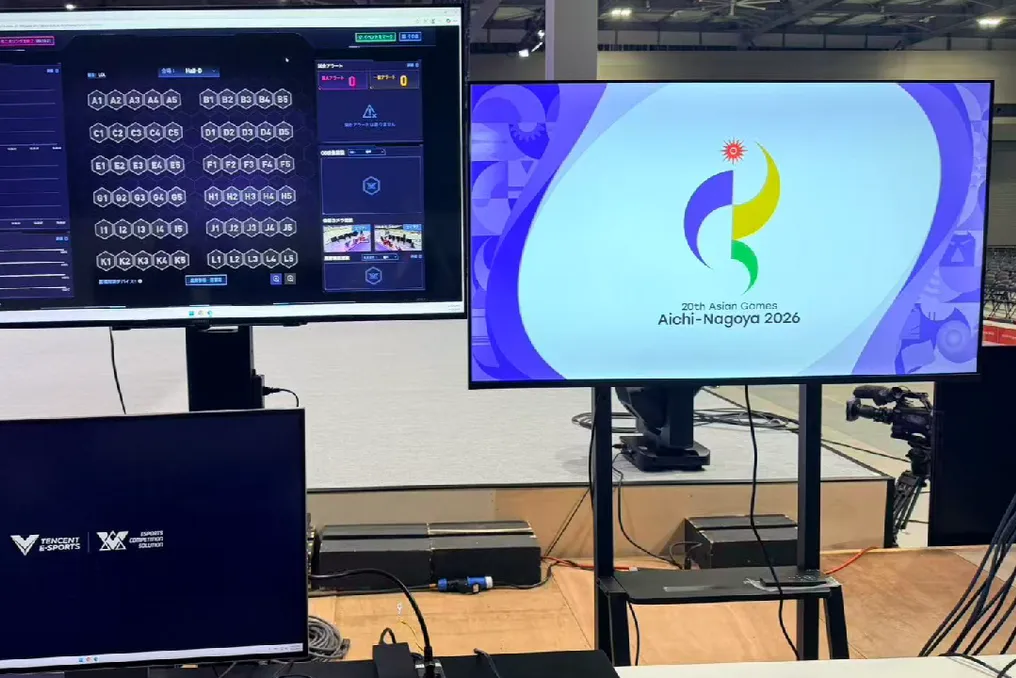
Tencent, a Chinese technology firm, has developed the ECS (Esports Competition Solution) system, which provided comprehensive technical support for esports competitions at the Asian Games in Haiti-Nago, Japan, in 2026.
Before the start of the competitions, the system conducts thorough checks of network conditions, interfaces, and equipment, helping to detect unauthorized plugins, macros, and peripheral devices that could be used for cheating. During matches, ECS monitors over thirty metrics in real time and provides players and broadcasters with multiple viewing angles, supplying referees with additional visual data for decision-making.
After the competitions conclude, key recordings and video materials are securely saved for subsequent analysis, allowing incidents to be tracked and studied through structured reports.
In previous Asian Games, 217 matches supported by ECS proceeded without any technical failures. In January 2026, Tencent Esports became the official partner for esports technology of the Olympic Council of Asia (OCA). From January to June 2026, ECS supported three test events of the Asian Games in Japan, Singapore, and Vietnam.
Esports competitions differ from traditional sports in that they heavily rely on complex network infrastructure and hardware. Unexpected equipment failures or network fluctuations can occur, making them difficult for referees to detect or predict in real time.
In this situation, technology plays a critical role. As esports continues to integrate into the broader sports ecosystem, competitions require a more sophisticated monitoring system that provides referees with reliable data to ensure fair play.
In an interview with CGTN, Zhang Yati, Esports Manager at the Olympic Council of Asia (OCA), emphasized the importance of simplifying the organization and management of esports at various stages of the Asian Games.
She noted that 'a very important aspect of long-term, stable development is how we can help each Asian Games organizing committee optimize, improve, and simplify the overall complexity of organizing esports competitions.'
Unlike professional esports tournaments, the Asian Games bring together organizing committees and staff from various sporting fields. Not all participants have extensive experience in esports operations.
Zhang explained that conducting the competitions requires rules, tools, and operational guidelines that are simple, accessible, and applicable, allowing people with different levels of esports knowledge to work effectively together during a limited preparation period.
In this context, a stable and transparent judging system, backed by reliable core technologies, is an integral part of integrating esports into the general sporting environment.