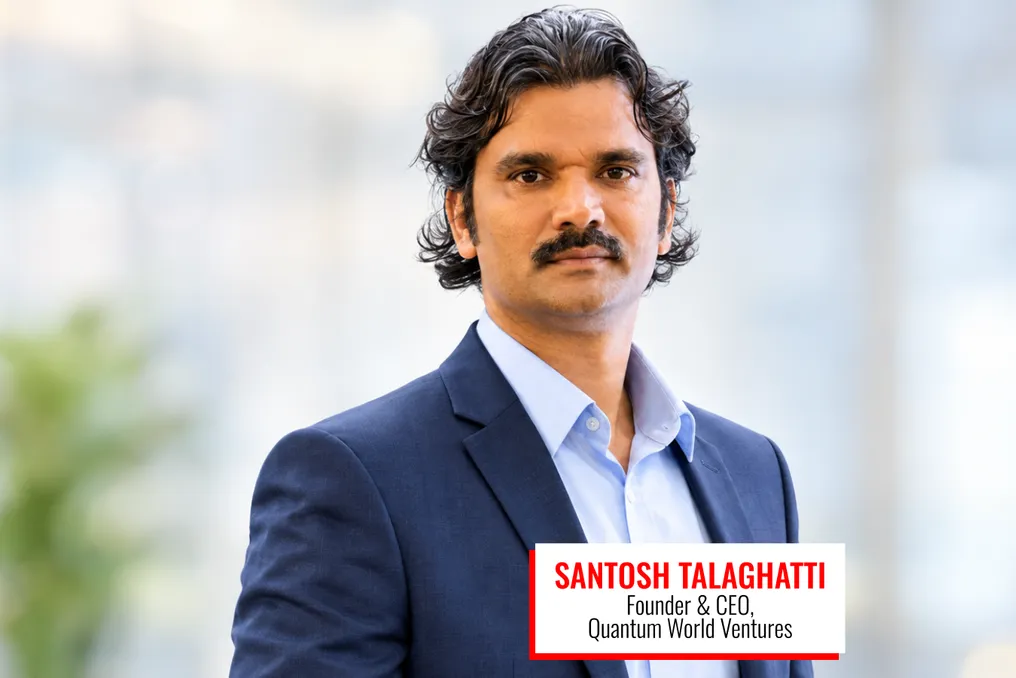
After Santosh Talagatti witnessed his mother's battle with cancer, he had a question that defined the direction of his next project. He wondered why the detection of serious diseases still depends on slow, complex, and difficult-to-access processes, despite the possibility of instant information access through technology.
Talagatti stated the need to create technologies capable of detecting cancer significantly earlier. His idea did not arise in a vacuum; he spent years working on digital transformation projects in public administration, education, and public services. Furthermore, he considers his work with initiatives related to former President A. P. J. Abdul Kalam important, especially the idea that complex achievements should be understandable and useful to ordinary people.
Instead of developing quantum hardware, the Bengaluru-based company Quantum World Ventures (QWV) uses quantum computing, artificial intelligence, and related technologies in medical development, education, public safety, and fintech.
QWV began its quantum activities in healthcare. According to Talagatti, the company's research includes AI-powered medical imaging and edge AI, where part of the data processing occurs directly near the device rather than being sent to a remote cloud server. One project is a diagnostic imaging system designed to work with devices such as endoscopes, CT, and MRI. The QWV website describes research in quantum-assisted imaging, sensing, and hybrid quantum-classical AI models. Currently, QWV's work in MedTech is at Technology Readiness Level (TRL) 4–5, while the work on endoscopy is assessed at TRL 3–4. It is important to understand that the laboratory prototype is still far from achieving the status of a certified medical product; QWV indicates that its development path includes testing, verification, regulatory work, and production readiness.
Talagatti also described an adaptive hearing aid that could connect to a mobile phone and use brain-computer interface (BCI) technology. He noted that the proposed device would combine hearing assistance with noise cancellation and connectivity to family members' phones for monitoring and ensuring safety.
There is a broader scientific question regarding the use of quantum computing in healthcare. A systematic review published in npj Digital Medicine in 2025 found no consistent evidence that machine learning methods based on quantum computing outperform classical approaches in digital healthcare. Of the rigorous studies examined, only 16 included realistic quantum hardware or noisy simulations. The data suggests that this field remains predominantly experimental, rather than possessing established clinical advantages.
The commercial opportunity seen by QWV is partly linked to the structure of the Indian medical device market. According to a 2024 study by the Competition Commission of India, about 80% of medical devices were imported in 2022, and the diagnostic medical equipment industry was characterized as being highly dependent on imports. The same study revealed a high degree of concentration in certain market segments: five original equipment manufacturers (OEMs) accounted for about 98% of the CT scanner market and over 91% of the MRI market. For QWV, the proposed approach is not so much about creating a quantum computer as it is about developing software and integrating devices that can work with existing medical systems. Talagatti notes that most of the commercial benefit will be at the application level, although his assessment of a 10% to equipment versus 90% to applications ratio is the company's opinion, not an established industry metric.
Education has become part of the company's activities because Talagatti sees a lack of practical understanding of quantum technologies and AI. He spoke about working with approximately 18 universities, including Bengaluru City University and Tumkur University, as well as Centers of Excellence using existing campus infrastructure. The courses discussed cover quantum computing, quantum mechanics, qubits, circuit design, quantum communication, quantum machine learning, and quantum cryptography. A qubit is the basic unit of quantum information, and quantum cryptography is a method of protecting communications using the principles of quantum physics.
This emphasis on education preceded the creation of QWV. Earlier projects by Talagatti included the Global Classroom initiative, aimed at connecting rural students and teachers with wider networks of experts and institutions. He also mentioned work on a smart village model in Maharashtra. These previous projects explain why training and workforce development coexist with the company's technological activities.
QWV has also discussed the application of AI and quantum technologies in law enforcement, forensic science, and public safety. Talagatti reported that the company studied image recognition based on quantum principles for evidence analysis. The company's current website describes research in quantum-secure cryptography, AI-driven investigations, and public safety analytics. Talagatti makes very large assumptions about the speed at which quantum systems can recognize patterns in criminal evidence, but he does not provide independent testing results to confirm these claims. A similar caution applies to claims of significantly reduced diagnostic time. Talagatti himself admits that AI results in the medical environment will still require human verification.
Talagatti reported that QWV started with initial capital of about 1 crore rupees and sought about $10 million to transition its medical technologies to a product stage. These figures represented target fundraising goals, not completed financing. Currently, the company's website states a fundraising goal of 100 crore rupees. The funding issue is central, as the transition from research to a commercial medical product requires engineering, testing, clinical validation, regulatory approval, manufacturing, and distribution.
India's National Quantum Mission, approved in April 2023 with allocations of ₹60,036.5 crore until 2030–2031, aims to support research, industrial development, and application in quantum computing, communication, and sensing. For QWV, the next step is turning prototypes into robust, regulated products that can demonstrate a measurable advantage over existing tools. This is particularly important in the medical field, where new systems must pass technical, clinical, and regulatory hurdles before reaching patients. Talagatti concludes by explaining the company's ambition: 'This is not just a technological revolution; it must be a human revolution.'