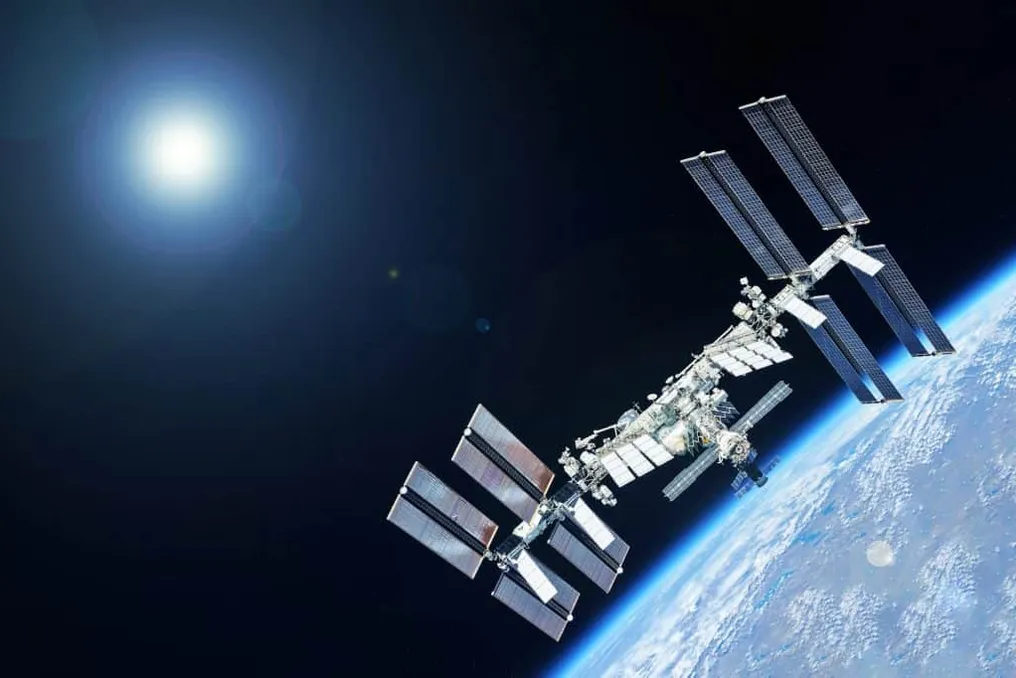
The Dragon capsule, developed by SpaceX, achieved a new milestone by completing the fastest journey made by an American spacecraft to the International Space Station (ISS). The spacecraft took a total of 7 hours and 55 minutes from launch until docking with the orbital laboratory.
The Dragon, named Grace, was launched on Thursday, the 1st, at 12:10 PM (Brasília time), using a Falcon 9 rocket. The docking process was completed at 8:05 PM, specifically at the Harmony module of the ISS.
The Crew-13 mission transported four crew members: Jessica Watkins and Luke Delaney, both American; Joshua Kutryk, Canadian; and Sergei Teteriatnikov, Russian. This group will remain at the station for about six months, during which they will conduct scientific research, perform maintenance, and demonstrate new technologies.
Jessica Watkins, who serves as the mission commander, is a NASA astronaut and was making her second visit to the space station. In her previous mission, Crew-4, in 2022, she spent 170 days in orbit. With Crew-13, Watkins becomes the first NASA astronaut to complete two flights to the ISS aboard a SpaceX Dragon spacecraft. Previously, she studied geology and was part of the scientific team of the Curiosity rover, which explores Mars.
Luke Delaney, who serves as the pilot for this mission, is making his first space flight. He has prior experience as a naval aviator and test pilot, in addition to having worked as a research pilot at NASA's Langley Research Center.
Other members beginning their space journeys are Joshua Kutryk, representing the Canadian Space Agency, and Sergei Teteriatnikov, belonging to the Russian space agency Roscosmos. Kutryk was a CF-18 fighter pilot and test pilot before being chosen as a Canadian astronaut. Teteriatnikov, meanwhile, has a background in naval engineering and has performed various roles related to propulsion system engineering for vessels.
Research and Maintenance on the ISS
During their stay on the ISS, Crew-13 will be involved in various scientific experiments and station maintenance tasks. Objectives include studies on astronaut health, the impacts of microgravity, and the development of technologies applicable to future space expeditions.
The arrival of these four astronauts also marks the start of the command transition with the Crew-12 mission, which is already at the station. Crew-12 consists of Jessica Meir and Jack Hathaway, American astronauts; Sophie Adenot, a French astronaut from the European Space Agency (ESA); and Andrei Fediaiev, a Russian cosmonaut. This group is scheduled to return to Earth starting Monday, the 5th, after a period dedicated to transferring responsibilities between the teams.
Originally, Crew-13 had a different arrival schedule, but the mission had to be postponed due to a technical issue detected in the capsule. The launch could only take place on October 1st, after resolving this setback. With the success of the mission, the Dragon established a new record for the transit route between Earth and the ISS in under eight hours.
The ISS continues to receive crews from various nations. The combined presence of astronauts from NASA, the Canadian Space Agency, the ESA, and Roscosmos consolidates the station as a crucial international platform for microgravity research and long-duration space operations.