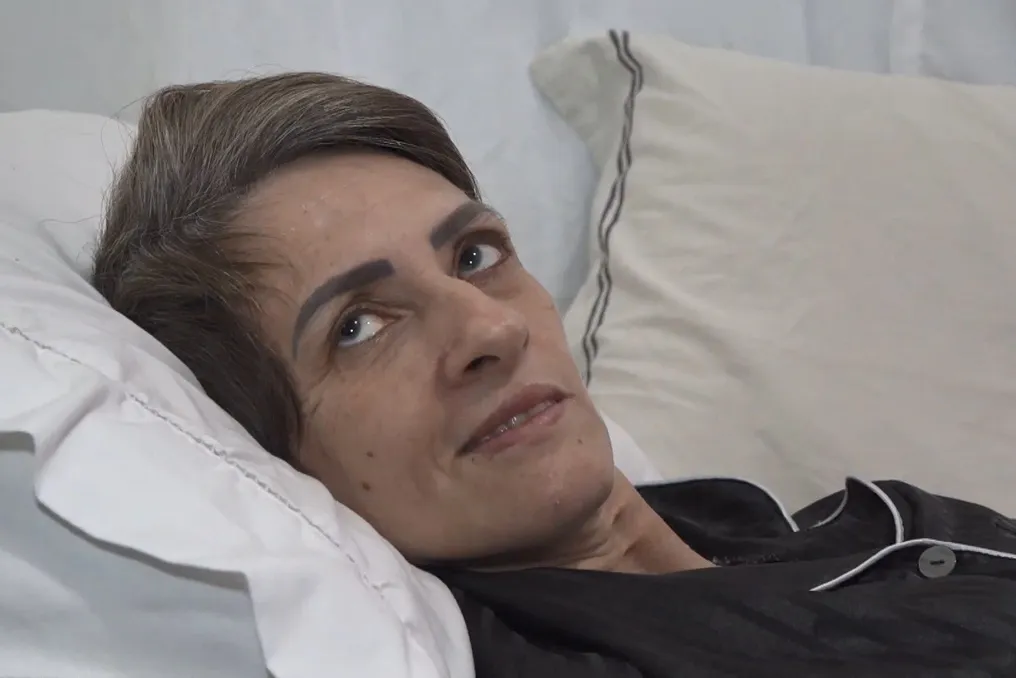
Almerinda Nemeg, a resident of Cariacica in Greater Vitória, was diagnosed with Creutzfeldt-Jakob Disease (CJD). This condition drastically changed her life in just a few months, with the first signs appearing in early 2025. Currently, after a little over a year and a half, she faces severe difficulties walking and speaking.
The journey to diagnosis began when Almerinda started having trouble performing simple daily activities. Initially, the family reported insomnia and memory lapses. The turning point occurred during a motorcycle fall, which led the patient to São Lucas Hospital.
Amanda Neimeg, the patient's daughter, described the onset of symptoms: 'It started with keys, which she forgot too much. To leave the house, she had to go up the stairs three times because she always forgot something. And she started seeing a psychiatrist, but didn't take it very seriously. Until she had a motorcycle accident and went to São Lucas Hospital.'
The disease is the same one that affected influencer Lito Sousa, 59, who passed away on Thursday (the 1st). He had received the diagnosis in August. Specialists indicate that CJD is extremely rare, serious, and progresses rapidly, affecting the brain and causing memory loss, tremors, and mobility problems.
During the medical investigation, the family observed significant behavioral changes. The daughter recalled: 'She had episodes of great anxiety. She thought she was a teenager, remembered things from when she was younger, but didn't remember that we were her daughters.'
The condition progressed rapidly; in May of this year, Almerinda already depended on a wheelchair, unable to walk. A neurological reassessment raised suspicion of CJD, a disease the family was unaware of. The daughter stated that since there is no treatment or cure, the focus is on 'improving her quality of life.' Today, she also cannot communicate verbally.
The disease is considered very rare
International data suggests that between 1 and 2 cases of CJD occur per million inhabitants annually. In Espírito Santo, a survey conducted by the State Health Secretariat, covering the period from 2005 to 2021, counted 10 suspected or notified cases, five of which were confirmed.
Nationally, 1,576 notifications of suspected CJD cases were registered in Brazil, with the highest incidence among residents of the South, Southeast, and Northeast regions. The states that presented the highest volume of suspected cases in this interval were São Paulo, with 32.5% (512 cases); Paraná, with 12.0% (189 cases); and Minas Gerais, with 10% (158 cases).
According to the secretariat, most diagnosed patients were in the age group of 55 to 74 years. Regarding gender, 53.6% (845) of suspected cases were reported in females, while 46.3% (730) were reported in males.
Signs of the disease
Creutzfeldt-Jakob Disease (CJD) is classified as an uncommon neurological condition that can manifest as memory loss, behavioral changes, difficulty with motor coordination, and movement impairment.
It is a prion disease, meaning it is caused by the abnormal modification of a protein called a prion. This protein replicates in the brain, attacking neurons.
According to the Ministry of Health, the disease is progressive and fatal, starting with clinical symptoms of dementia, cerebral disorganization, memory loss, and tremors, accompanied by other neurological and multifocal signs. The patient's decline is rapid and continuous after the onset of symptoms, being faster compared to other forms of dementia.
Neurologist Daniel Escobar explained that CJD belongs to the group of rapidly progressive dementias, where the individual goes from full functionality to inability to perform usual activities in less than six months. Unlike Alzheimer's, the patient does not just lose memory; they lose the ability for abstract reasoning, calculation skills, and information processing speed, affecting multiple domains simultaneously.