After one year of operation in Brazil, Leapmotor has yet to gain prominence in the national market, ranking below other Chinese manufacturers in the National Federation of Automotive Vehicle Distribution (Fenabrave), such as GAC, Omoda&Jaecoo, Geely, GWM, Caoa Chery, and BYD.
The brand, which has a partnership with Stellantis, the owner of Fiat, opted to focus on the most popular electrification type in the country, the plug-in hybrid, expanding its offering with the REEV version of the Leapmotor B10.
This model uses an 'inverted system,' where the combustion engine serves exclusively as a power generator to feed the electric unit that drives the wheels. It is important to differentiate between types of electrified vehicles: Mild Hybrid (MHEV), which is simpler, offers about 10% fuel economy savings, exemplified by the Jeep Renegade, Fiat Pulse, and Peugeot 208; Full Hybrid (HEV) has an electric motor capable of driving the wheels, potentially achieving over 18 km/l, as seen in the Toyota Corolla Cross; and Plug-in Hybrid (PHEV), with a larger battery and more electrical power, allows for long distances without using fuel, such as the GWM Wey 07, which travels 128 km purely on electricity.
The Leapmotor B10 falls into the PHEV category but utilizes this modified system, called REEV (Extended Range Electric Vehicle), where electricity generated by the gasoline engine powers the batteries and consequently, the wheel motors.
Discreet design and minimalist interiors
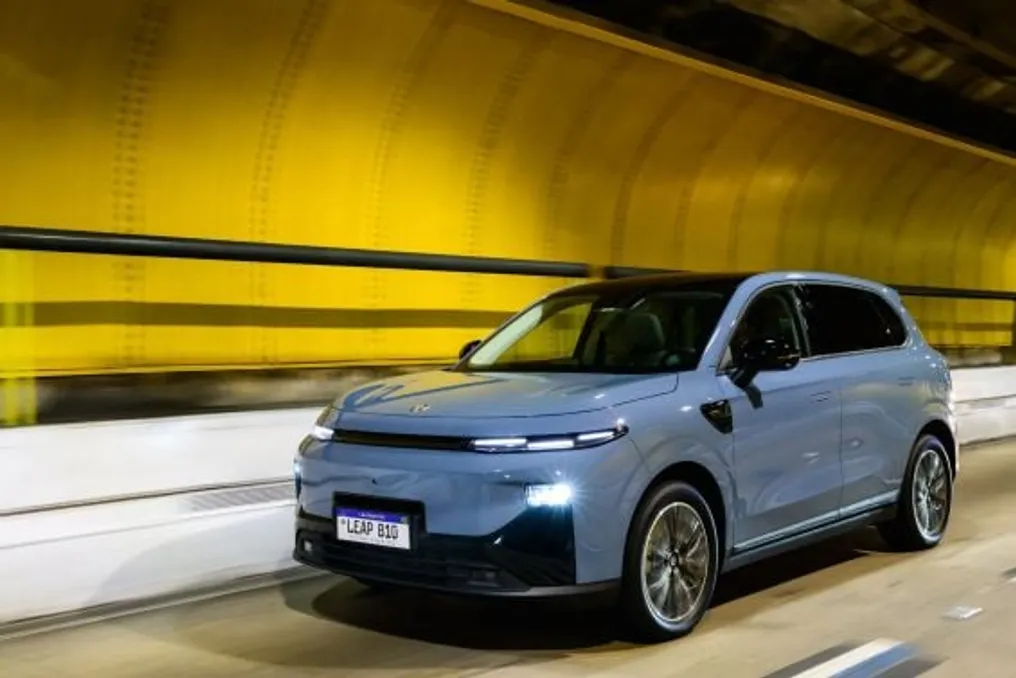
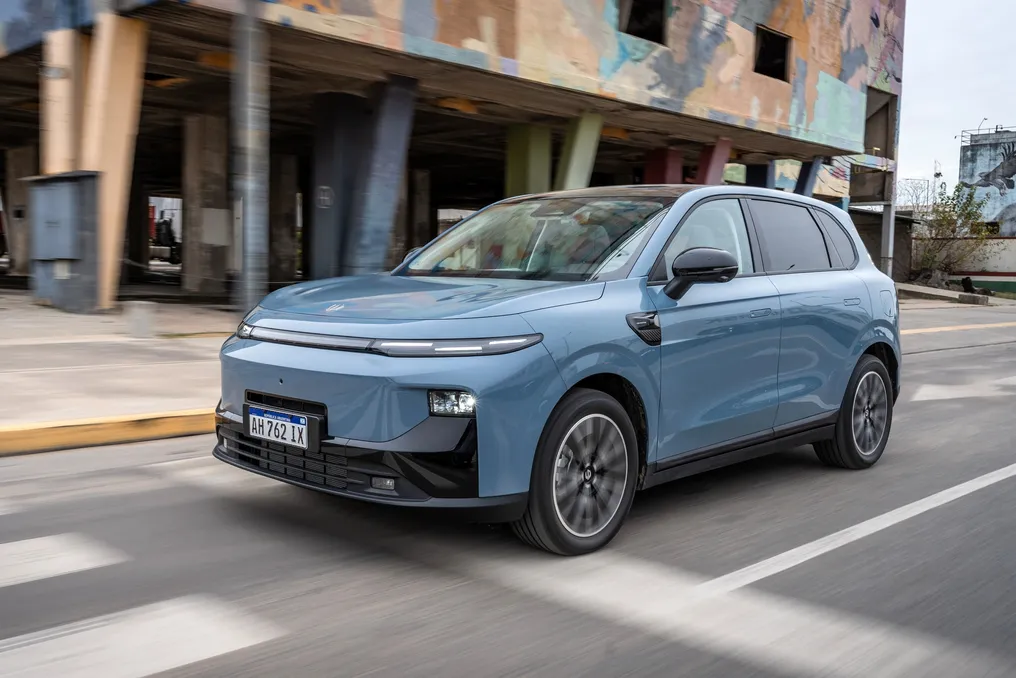
The external design of the B10 features sober lines and a minimalist look across the entire body, complemented by a reduced front grille and flush door handles. The taillights are connected in a straight line. Although it possesses an unusual touch of modernity in Western cars, the model follows a design standard common to other Chinese brands, causing the B10, in its electric or REEV versions, not to attract much attention nor convey creativity, which can be advantageous for those who wish to go unnoticed.
The entry experience into the vehicle is marked by a Tesla-inspired solution: the key is an NFC technology card that unlocks the car when placed on the left rearview mirror. Alternatively, a digital key can be configured on the mobile phone. However, this functionality is considered less practical than a conventional physical key.
Inside, the Chinese minimalism is accentuated by the absence of buttons to control the air conditioning, the opening and closing of the sunshade, the adjustment of side mirrors, and the control of the headlights. The Tesla influence extends to the sunroof, which has no opening, and to the steering wheel, which contains two small multifunctional wheels. These wheels adjust the side mirrors after selection on the multimedia center, and in standard use, they control audio volume and adaptive cruise control speed. Similar to Teslas, activating adaptive cruise control requires double activation of the gear lever, located behind the steering wheel, which is seen as an improvement over having the gear integrated into the multimedia center.
Comfort versus Originality
In contrast to the lack of aesthetic originality, the comfort of the B10 is notable. The car features soft surfaces at all contact points, and the leather upholstery provides a feeling of a more sophisticated material, with few visible seams, and those present maintaining the same color as the finish to remain discreet.
Sitting in the front seats or the second row provides a cozy feeling, comparable to a sofa. Even those occupying the middle of the second row enjoy comfort, thanks to the flat floor, the lack of seat elevation, and the central console that does not advance excessively, allowing feet to be accommodated without conflict with the side occupants. The standard carpet is soft, suitable for those who do not prefer very plush materials.
Despite the internal comfort, the trunk could be larger, as the focus on interior space resulted in a capacity of only 350 liters. For comparison, the Jeep Renegade, known for its compact trunk, has only 20 liters less than the B10, indicating that long-distance comfort requires planning when loading luggage.
When driving, the Leapmotor B10 hybrid presents mixed characteristics. With the electric motor positioned on the rear axle, the traction is rear-wheel drive, which can give it a sportier character. During a stretch on the Castello Branco Highway (SP-280), where it reached 120 km/h, the B10 demonstrated restraint; even in sport mode, the 218 hp and 24.5 kgfm of torque seemed moderate. There was no perception of delay between acceleration and vehicle response, but rather an impression of contained power. Rear-wheel drive, typical of sports cars, requires caution in sharp curves and high speeds, although the report felt such effective stability control that it mitigated this need for care.
A relevant aspect observed during the fully electric test was the extremely soft suspension, which made the vehicle feel like a boat on calm waters when passing over speed bumps. After a year, this experience has improved significantly. The suspension remains softer than that of German brands like Volkswagen and Audi, but it is better adapted to the Brazilian driving style, with less oscillation when crossing speed bumps or rounding 90-degree curves at high speed. The test was conducted with the vehicle fully loaded and the tank full. The 18.8 kWh battery ensures an autonomy of 68 km, covering almost half of the journey. On the return trip, using the 1.5 naturally aspirated engine for energy regeneration, the acoustic insulation was considered well executed.
Is it worth buying the Leapmotor B10 hybrid?
Although this hybrid system is exclusive to Leapmotor, it essentially operates as a plug-in with an altered logic. The car offers comfort for both drivers and passengers, but the lack of creativity in various elements represents a negative point. The main drawbacks are the NFC card format key and the scarcity of physical buttons, which can impact safety, forcing the driver to divert focus from the road to operate functions through the multimedia center, such as closing the sunshade.
Direct competitors, which are traditional plug-in hybrids, include the BYD Song Pro (R$ 196,990), Geely EX5 EM-i (R$ 191,490), Jaecoo 7 (R$ 189,990), and GWM Haval H6 PHEV19 (R$ 250,000), all positioned in higher price ranges.
The competition is robust. According to the Brazilian Electric Vehicle Association (ABVE), three of these models rank at the top of the best-selling hybrid list in Brazil between January and August 2026: BYD Song (45,096 registrations), GWM Haval H6 (32,248 registrations), Omoda 5 (32,248 registrations), and Jaecoo 7 (11,772 registrations).
BYD and GWM gain an advantage due to their more original design and because they already produce in Brazil, in addition to offering a flex engine. The Leapmotor B10, however, will not remain imported indefinitely, as it will have production in Goiana (PE).
The Jaecoo 7 has a more characteristic look, but in practice, it is a larger SUV equipped like a sophisticated urban utility vehicle. In summary, the lower price compared to competitors, the comfort provided, and the efficient acoustic insulation outweigh the negative points, although for those who prefer a more traditional approach, the BYD Song Pro adopts a more direct and simple concept.