An American friend of China named 'Saikosi,' whose real name is Ronald Scorsky, who supports China's efforts to combat desertification, arrived at the Sinzheng International Airport in Henan Province on August 27. He enthusiastically praised the local sour bean noodles, stating that he was willing to eat the dish for breakfast, lunch, and dinner, while speaking Chinese.
Scorsky's history with China began in Luoyang. Between 1999 and 2000, he came from the United States as part of an exchange program and taught at the Luoyang Chinese School of Foreign Languages. He still recalls the local cuisine and old friends, especially the noodles.
Sour bean noodles, also known as 'jianfan,' are a traditional local snack of Luoyang. According to the 'Han Feizi' treatise, Zilu, a disciple of Confucius, served this dish to workers building roads when he held the position of county magistrate of Hou. Legend has it that Emperor Han Liu Xu also ate these noodles while fleeing Wang Man's troops in the Luoyang area, so the dish is locally known as 'Liu Xu noodles.'
The base of the dish is a fermented liquid made from green beans, which has a characteristic sour taste. The beans are soaked until swollen, crushed into a coarse mixture, and strained, leaving the liquid in a large vessel for natural fermentation. Once the liquid acquires a sour, fermented taste, noodles are boiled in it. During the Republic of China period, there were about 30 workshops in Luoyang producing the base, including military, temple, and Muslim institutions. Many of them pass down their traditions from generation to generation and continue to operate today.
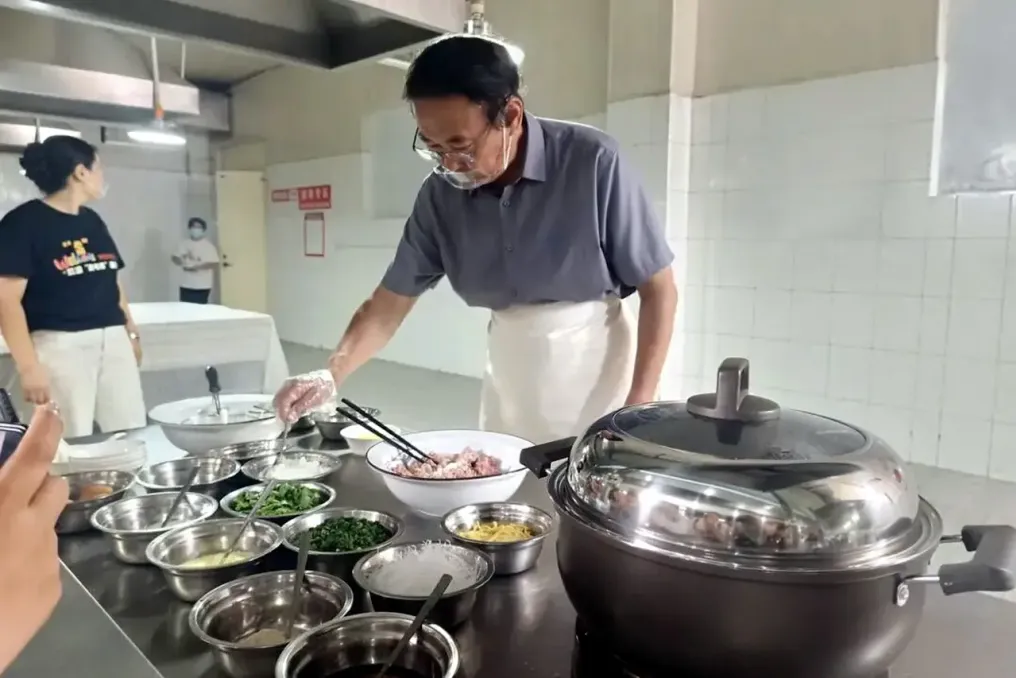
Twenty-seven years ago, Scorsky first encountered these noodles through his first colleague in Luoyang, Zhai Guandong. One day, Zhai taught the American how to cook the dish at his home. Scorsky wrote everything down in a notebook and immediately ate three large bowls, but still did not feel full. For his guest, Zhai Guandong took the largest aluminum pot in the house and two buckets of the sour base.
Zhai Guandong told journalists that 'the sour base from Luoyang is somewhat similar to Beijing's dozhji.' He added that when Luoyang residents cook these noodles at home, they usually make a large quantity, and if they cannot eat it all at once, they save it for the next meal. Locals say: 'Sour bean noodles reheated three times are not even comparable to meat.' Mixing the base with the noodles does not spoil it; after reheating and further fermentation, the flavor becomes even richer.
On the afternoon of August 28, in front of the Lao Luoyang restaurant, which serves ancient Luoyang cuisine in the city center, two large pots were set up. Visitors took fresh noodles with white sour base, added ingredients at the counter, and ate on the go. The restaurant owner, Wang Tianxi, noted that 'guests eat with spoons, locals use chopsticks, and true Luoyang elders just slurp the noodles straight from the bowl.' He is a representative of the intangible cultural heritage of Henan Province related to the traditional preparation of Lao Luoyang noodles and is very meticulous about preparing this dish.
When the base is about to start foaming, vegetable oil is added and stirred clockwise to ensure the oil is completely mixed with the liquid. When it approaches boiling point, noodles, followed by strips of carrots, celery, large green beans, and other components, are added to the base. The final additions are two tablespoons of the 'main secret ingredient'—onion flowers.
Almost everyone in Luoyang knows how to prepare this dish, and it is eaten in almost every household. Zhai Guandong explained, recalling why he once cooked noodles for Scorsky at home: 'Food is one of the most unique forms of folk art. It allows a person to quickly feel at home in life in Luoyang.' The cries of vendors pushing carts of sour base through the streets and the queues around the barrels became memories of the ancient city.
Today, the noodles are still prepared in ordinary households, but they are also served in expensive restaurants for guests from China and other countries. According to available data, the Lao Luoyang restaurant sells over 2 million bowls per year. Along with Henan Lohan noodles and Hualatang pepper soup, the noodles are also available in convenient packaging for travelers across the country.
Luoyang served as the capital under 13 dynasties, and its cuisine has long been famous for its diversity. Wang Tianxi describes it through 'three characteristics': 'People drink soup sitting at the entrance; noodles are sold after they have soured; and soups and dishes with a lot of broth constitute a separate cuisine.'
More than 10 types of soups traditionally eaten for breakfast in Luoyang are usually sold in small street stalls where visitors often eat while sitting right at the entrance. After fermentation, sour bean noodles acquire a unique flavor, so visitors sometimes mistakenly mistake them for spoiled food. Meanwhile, 24 types of soups and broth-heavy dishes make up Luoyang's famous 'Water Bank,' a traditional feast that has become one of the symbols of local cuisine.
During his current trip, Scorsky tried all three 'characteristics' presented in his breakfasts, lunches, and dinners. These dishes evoked forgotten memories, and walks through familiar places with old friends prompted him to emotionally say: 'Even if there is little paper, feelings last a long time.' This is a Chinese metaphor meaning that true friendship does not require many words. Scorsky stated: 'This is not just food. It is the taste of home.'
On the evening of August 29, during his last dinner in Luoyang, his former colleague Bai Fan prepared a large bowl of soup with tender meatballs cooked directly in the broth, while Zhai Guandong himself prepared the same sour bean noodles. The taste, which remained unchanged for 27 years, left the guest unwilling to say goodbye and with a deep sense of friendship.