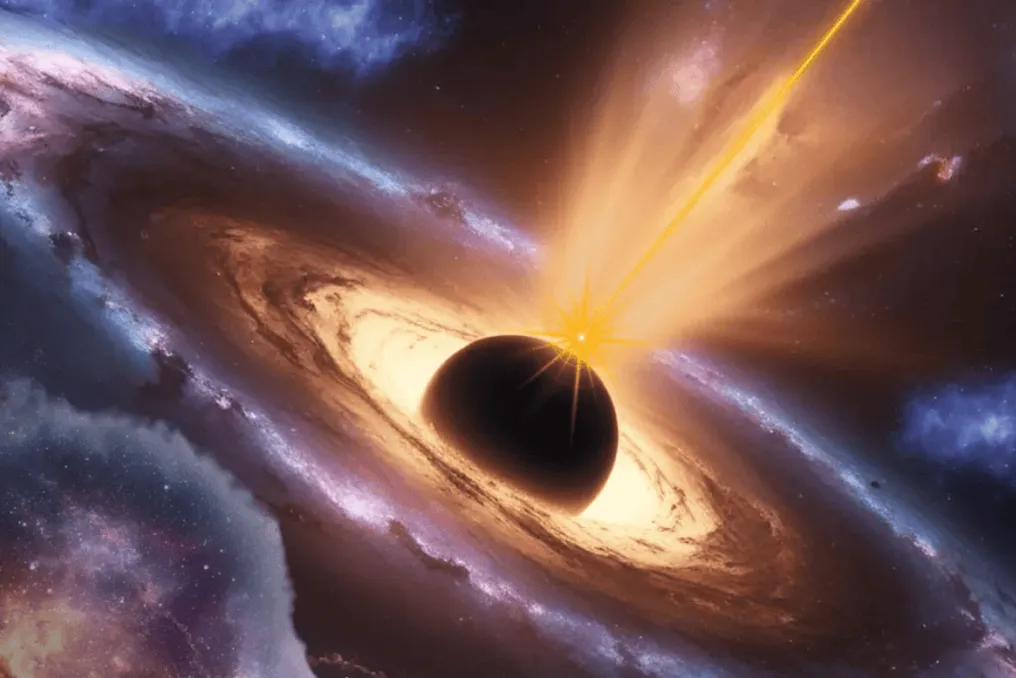
Massive black holes may play an even more significant role in galaxy evolution than scientists previously assumed. A new study shows that plasma jets ejected by these objects can reach regions far beyond the galactic center and interfere with the process of new star formation.
This discovery helps explain a long-standing astronomical question: why galaxies do not contain significantly more stars. Large galaxies, such as the Milky Way, are surrounded by vast structures of gas and dust known as the intergalactic medium. This material serves as raw material for star formation. During periods of high activity, gas moves into galaxies, stimulating the birth of new luminous bodies.
However, at some point, this process is interrupted. The gas stops cooling and accumulating to form stars or simply stops flowing into the galaxies. It is at this moment that massive black holes can exert a decisive influence.
Although massive black holes have a mass equivalent to millions or billions of solar masses, they remain relatively small compared to the galaxies they inhabit. One galaxy can contain hundreds of billions of stellar systems. Nevertheless, these objects are capable of releasing enormous amounts of energy into the surrounding environment through their jets and radiation.
Namrata Roy from the Raman Research Institute, who also led the team, asked: 'What an amazing question: how can something so small energetically affect something so huge?'
Study of jet influence
To study this effect, Roy, Bortakur, and their colleagues analyzed hundreds of galaxies with active black holes and jets. They used observations obtained from the Dark Energy Spectroscopic Instrument (DESI) survey, as well as measurements of radio jets using the LoFAR Two-meter Sky Survey (LoTSS).
The researchers found regions along the jets where ionized gas glowed brightly. According to the team, this glow indicates that the plasma reached and penetrated the gas clouds around the galaxies, transferring energy to this material.
The influence of the jets is also not uniform. The strongest effects were observed closer to the outer edges of the galaxies, where the jets first collide with the intergalactic medium, as well as at the outermost edge of this medium—the region where the jets release the most energy.
The results demonstrate clear signs that black hole jets are capable of affecting material that could become the basis for new stars, even in regions very far from the galactic center.
Roy explained: 'What impresses me most is the scale of this connection. A black hole is incredibly small compared to a galaxy, but its influence can extend hundreds of thousands of light-years, penetrating the outermost regions of the galaxy. The jet carries energy outward, and the gas glows along its entire path.'
For the researchers, these results also provide a new way to test how jets produced by massive black holes affect their host galaxies.
The study was published in The Astrophysical Journal Letters. The initial publication about massive black holes that can 'kill' galaxies with plasma jets appeared on Olhar Digital.