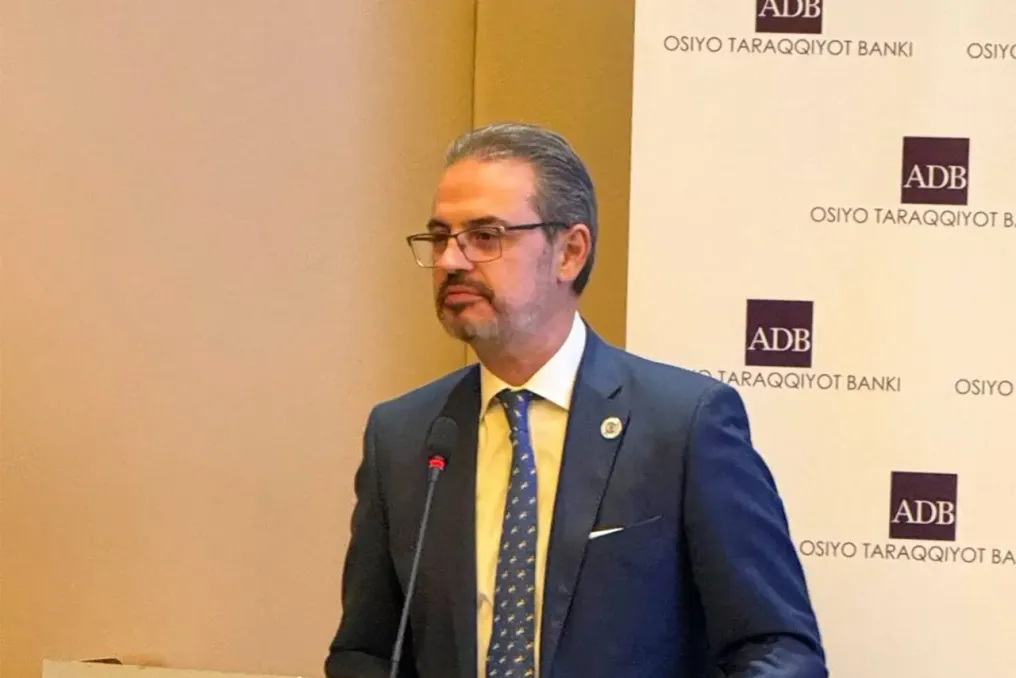
Andi Aranitasi, Director and Head of the EBRD office in Uzbekistan, stated on September 30 that the completion of the privatization process of Asaka Bank and Uzsanoatqurilishbank (SQB) will for the first time transfer the majority of Uzbekistan's banking assets into private hands. He made this statement at an event on the country's economic prospects organized by the American Chamber of Commerce in Uzbekistan (AmCham).
Representatives from the International Monetary Fund (IMF) and the Asian Development Bank (ADB) also noted at the same event that the success of privatization is directly linked to reducing subsidized lending and developing the capital market.
The first major deal in the banking sector was the sale of Ipoteka Bank to the Hungarian OTP group, which acquired a controlling stake in the bank in 2023. The next object of privatization, according to Andi Aranitasi, is Asaka Bank, with which the EBRD has been working with authorities for about six years.
In early 2026, the Ministry of Economy and Finance, the EBRD, and Asaka Bank signed an agreement on the basic terms of the deal. According to this agreement, the EBRD will receive a 15% stake in the bank during 2026. In April, the process was accelerated by a presidential decree: approximately 95 million US dollars were allocated from the state budget to replenish the bank's capital, and its debt to the Ministry of Economy and Finance, amounting to about 2 trillion soms, can be converted into equity capital.
Simultaneously, work is underway with the International Finance Corporation (IFC) on the privatization of SQB, which accounts for 11% of the banking sector's assets. Previously, the EBRD provided SQB with a convertible loan of 50 million US dollars. If this loan is converted into shares, the state's stake in the bank will fall below 50%. EBRD's public project documentation confirms that this convertible financing was provided in support of SQB's privatization and may contribute to reducing state ownership below 50%.
Andi Aranitasi emphasized that the completion of these operations will be a 'tectonic shift in the banking sector of Uzbekistan,' as the majority of banking assets will be in private hands for the first time. The head of the EBRD in Uzbekistan explained that the state of the banking sector reflects the state of the economy: when most assets belong to private enterprises, the private sector gains more opportunities for growth.
Koba Gvenetadze, Resident Representative of the IMF in Uzbekistan, confirming that work on the privatization of the two banks continues, drew attention to an issue that the change in ownership itself will not solve. This concerns subsidized and targeted lending programs, which are primarily implemented through state banks. He acknowledged the existence and continuation of such programs but noted that their scale must decrease as the economy grows.
Asel Aitkhozhina, Senior Regional Specialist for EBRD Policy for Central Asia and Mongolia, explained the importance of this aspect. The high share of subsidized lending, characteristic of both Uzbekistan and Kazakhstan, weakens the influence of central bank interest rate decisions on the economy.
ADB Senior Economist for Uzbekistan, Sherzod Akbarov, linked bank privatization to capital market development. He called the initial public offering of the National Investment Fund of Uzbekistan (UzNIF), the largest in the country's history, a positive signal. After listing on the stock exchanges of London and Tashkent in May, the deal amounted to 691.5 million US dollars.
According to the economist, this paves the way for the accelerated privatization of other large state-owned enterprises. The connection between these processes is direct: UzNIF received a 40% stake in SQB, which, according to Fitch Ratings, improves the bank's governance and risk management ahead of privatization.
However, rapid deals should not be expected. It was initially planned to privatize SQB by the end of 2025, but the sale has been postponed, and Fitch's base case does not foresee it happening before 2027. Currently, the state owns nine banks: National Bank, Agrobank, Uzsanoatqurilishbank, Asaka Bank, Xalq Bank, Business Development Bank, Microcreditbank, Aloqabank, and Turonbank. By 2030, the authorities plan to retain control over four of them.
The current EBRD assessment for the country also identifies the privatization of state commercial banks as a key priority, noting that state banks still constitute the majority of the banking system's assets, and directed and subsidized lending remains significant.