
Supabase raises $150 million and acquires Turso amid 600% growth in databases driven by AI agents
Read more
Ventureburn
ventureburn.com

Supabase raises $150 million and acquires Turso amid 600% growth in databases driven by AI agents

As problems become describable and begin to form themselves, a serious challenge remains: databases. Every autonomous agent requires a place for instant storage of state, memory, and information.

Creating traditional infrastructure for millions of small, fleeting AI tasks is extremely slow and financially burdensome. To solve this problem, Supabase raised $150 million to completely rebuild its backend architecture. The company also acquired Turso as part of its movement toward creating the core engine for an AI-oriented internet.

Just four months after a $500 million Series F round, Supabase announced additional funding of $150 million as equity growth, at a moment when humanity is crossing an exciting threshold. Humans are no longer the sole creators of software. In the last year alone, Supabase has recorded an astonishing 600% growth in database creation by autonomous AI agents.

Today, 70% of new databases on the platform are created directly by AI-driven coding tools and assistants. These digital builders produce complex applications at a speed unattainable by humans.

However, such high speed demands a completely different type of backend. Agents refuse to wait ten minutes for a heavy cloud instance to load. They need instantaneous, lightweight, and strictly isolated data environments to function correctly.

In addition to the $150 million funding round led by GIC, the company announced the strategic acquisition of Turso. Turso quietly mastered the fine art of low-cost, on-demand databases.

Its internal architecture is perfectly suited for this specific AI use case. Instead of allocating a massive, cumbersome server for every new project, Turso provides seamless resource allocation for each agent. Turso is characterized by compactness, lightning speed, and infinite scalability without excessive cost.

The acquisition will allow the integration of Turso's founder, Glauber Costa, and his brilliant engineering team into Supabase. With Turso's experience, this move could be equivalent to installing a rocket engine into the Supabase ecosystem. They seamlessly combine the reliable, open power of Postgres with highly efficient edge computing.

Supabase is preparing for a future where we transition from 'software as a service' to something more like 'conversational software.' When a user asks AI to create a custom CRM for their small bakery, they need a database right then and there.

The brilliant synergy of this capital injection and the Turso acquisition means that developers can finally let their AI assistants work freely. They no longer have to constantly monitor the infrastructure. Platforms like Mastra and Superhuman already use this microdatabase philosophy to create remarkably fast and deeply personalized user experiences. The traditional hurdle of backend setup has effectively vanished overnight.

For the average developer sitting at a laptop, this step promises absolute creative freedom. With over 13 million developers already working in the Supabase ecosystem, this massive move sets a new industry standard. You no longer need to be an expert DevOps master to deploy at scale. The infrastructure is finally smart enough to match the boundless imagination of both human coders and their AI assistants.

As coding agents continue to evolve, the fundamental infrastructure of the internet must be invisible, frictionless, and extremely scalable. Supabase is not just anticipating this wild future; they are actively building it right now, one tiny microdatabase at a time.

Similar stories

Ema raises $77 million to replace corporate software with AI-powered employees
Read more
ventureburn.com

Ema raises $77 million to replace corporate software with AI-powered employees

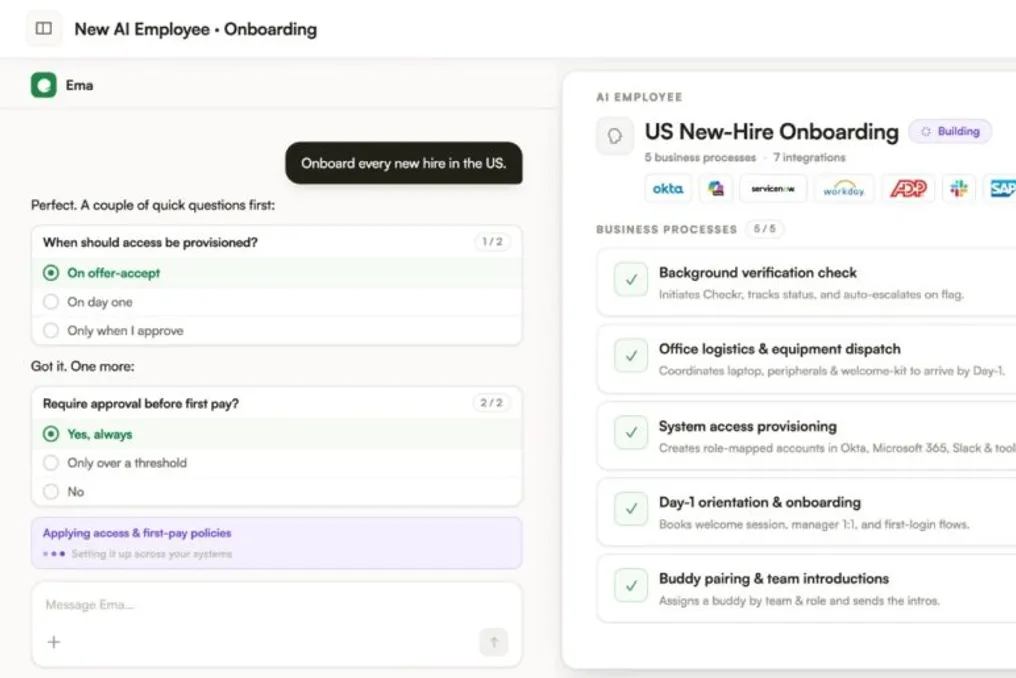
Enterprises spend billions on disparate SaaS tools and manual labor in HR, IT, and finance departments, yet they still struggle to complete work tasks. Company Ema has raised $77 million to solve this problem by creating AI employees that manage entire workflows through existing applications.

The $77 million Series B funding round was led by Creaegis, based in Bengaluru. These funds will be used to scale the platform and implement it in more enterprises currently in pilot testing. All major existing investors joined the round and increased their investments, including Accel, Section 32, Prosus Ventures, Hitachi Ventures, and Wipro Ventures. The company confirmed that the round was 100% funded by primary equity, without debt or secondary sales.

As a result, Ema's total funding reached $140 million. Ema was founded in 2023 by Surajit Chatterjee and Souvik Sen. The company was created to address an obvious problem faced by many organizations.

Most companies use over a hundred different software applications. To complete one task, an employee has to manually move data from one application to another. This leads to wasted time, errors, and increased software costs.

Ema's solution is called AI employees. These are not just chatbots answering questions; they are teams of AI agents that collaborate to execute an entire business process. One agent handles task planning, another executes steps across more than 250 connected enterprise applications, and a third verifies the final result.

The company is specifically targeting the cash flows that enterprises spend on SaaS and IT services. According to Chatterjee, Ema first integrates with existing SaaS applications, utilizing them, and then helps clients reduce their dependency on them. In many cases, clients completely replace large SaaS applications, turning the old software into merely a database while the AI employee performs the actual work.

The company reported that revenue has grown 50 times in the last 24 months, and the total order volume exceeds $150 million, including multi-year contracts. Ema currently has over 50 active enterprise deals and more than a million active users among businesses. Clients include NTT DATA, Hitachi, ADP, PwC, Google, KPMG, Wipro, and Microsoft. The platform is also showing strong expansion among existing customers, reporting a net dollar retention rate of 180%.

This means that clients who spent $100 last year are spending an average of $180 this year. Over 90% of clients who started with one use case, such as IT, expand their usage to two or three additional areas like HR and finance. Clients are now using AI employees in production environments to handle millions of interactions per year, rather than in experiments. Chatterjee emphasized that enterprises do not need more software; they need the work to get done.

He added that clients are already using AI employees for core operations in HR, IT, and finance, not just in test mode, and this funding will help spread this capability to more enterprises that are still stuck in the pilot phase.

Ema will use the $77 million to address two goals. First, expanding the sales department and increasing market reach in the Asia-Pacific (APAC) and Europe, Middle East, and Africa (EMEA) regions. Second, investing more in its corporate platform to support a greater number of workflows beyond HR, IT, and finance. Thus, through this round, Ema positions itself as a replacement layer for traditional enterprise software, focused on delivering completed work rather than selling additional tools.

Palma.ai raises $1.8 million in seed funding to manage enterprise AI agents
Read more
ventureburn.com

Palma.ai raises $1.8 million in seed funding to manage enterprise AI agents

The adoption of enterprise artificial intelligence has moved beyond simple chatbots. Startups are now actively working to give autonomous agents direct access to companies' core infrastructure, creating significant security gaps for IT department heads.

Palma.ai secured $1.8 million in a seed funding round to address this specific problem. The round was led by D11Z, with support from Plug and Play Ventures, Deel, Scale Now Ventures, and business angels from Cisco and Deel.

Patrick Eden and Julian Kolbe founded the company to manage the transition to multi-agent ecosystems. As AI tools increasingly perform workflows autonomously, managing permissions across isolated applications becomes nearly impossible for traditional security services.

Most modern AI agents connect to internal business data using an open standard—the Model Context Protocol (MCP). While MCP connects models to databases, historically each AI tool managed its permissions in isolation.

Palma.ai solves this by implementing a centralized integration layer. Administrators define policies, approved MCP tools, and recurring workflows on major platforms such as Claude, Gemini, and Microsoft Copilot. The platform dynamically enforces these rules during execution while logging every transaction in an immutable audit log.

According to Patrick Eden, CEO and co-founder of Palma.ai, 'Every company is about to hand over the keys to its systems to automated agents. The question is, is anyone watching the door?' He added, 'We created Palma.ai so that enterprises can grant agents real permissions while knowing exactly who did what, with which tool, and according to which policy across all platforms the enterprise uses.'

The raised capital will be directed towards actively expanding both engineering and marketing teams as corporate demand for controlled AI workflows grows.

Baselayer raises $35 million to scale AI agent identity infrastructure
Read more
ventureburn.com

Baselayer raises $35 million to scale AI agent identity infrastructure

Baselayer has raised $35 million in a Series A funding round to expand its identity infrastructure for artificial intelligence agents. The round was led by M13, with participation from Torch Capital, Picus Ventures, Afore Capital, and Matt Thompson of Socure. In addition to securing funding, the New York-based company has launched its Agentic Identity Suite.

The platform's primary goal is to help financial institutions detect autonomous agents before they can complete transactions. Baselayer was founded in 2023 by Jonathan Avad and Timothy Hyde. Jonathan Avad serves as CEO, and Timothy Hyde is the CTO.

Previously, the company focused on business identity and risk infrastructure for financial institutions. Currently, the platform supports over 2,300 financial institutions and payment companies. Baselayer claims that its technology has helped clients prevent over a billion dollars in fraud losses.

As AI agent systems increasingly perform tasks previously assigned to humans—such as opening accounts, moving funds, making purchases, and conducting business operations—a new trust challenge arises for financial infrastructure. Traditional identity systems were built with people and companies in mind but are not designed to verify autonomous software acting on behalf of a third party.

The company aims to become the trust layer for institutions dealing with autonomous agents, as they need to know which specific agent is operating and who authorized its actions. Furthermore, they need to understand the agent's scope of authority. Baselayer states that static fraud controls can block legitimate users while ignoring sophisticated attacks. Its Agentic Identity Suite is designed to close this gap and assess the possibility of a secure transaction by an agent.

The system is intended to provide cryptographic verification around agents and the organizations they represent. Baselayer is extending its existing business identity network into the realm of the agent economy. The company already provides identity verification services and risk infrastructure for financial and payment enterprises. Its network includes over 2,300 institutions across the United States. Baselayer also collaborates with agent developers, card networks, and payment companies. Among its partners and clients are FIS, Prove, Socure, Exa, and Parallel Web Systems.

The company is involved in shaping new standards for agent authentication and identification, including the FIDO Alliance Authentication Working Group and the x402 Identification Working Group. Baselayer works alongside companies such as Cloudflare, Google, Visa, and Mastercard.

According to the company, common standards will become critically important as agent commerce expands. This funding comes amid large payment companies developing infrastructure for AI-driven commerce. Stripe reported that about 70% of API requests now come from AI agents. Visa, Mastercard, and American Express have also implemented agent commerce protocols, and Shopify has provided agent sales channels to approximately one million merchants. These developments point to the broader application of autonomous systems in commercial operations.

McKinsey predicts that agent commerce could redirect between $3 trillion and $5 trillion in retail spending by 2030. Baselayer believes that such growth will require more robust identity and fraud prevention infrastructure. The company plans to evolve around emerging standards while expanding its agent products.

Karl Alomar, Managing Partner at M13, noted that Baselayer already possesses valuable operational infrastructure, citing its network of financial institutions and existing risk data. Baselayer stated that the new funding will be directed toward expansion into this nascent market.

Popular