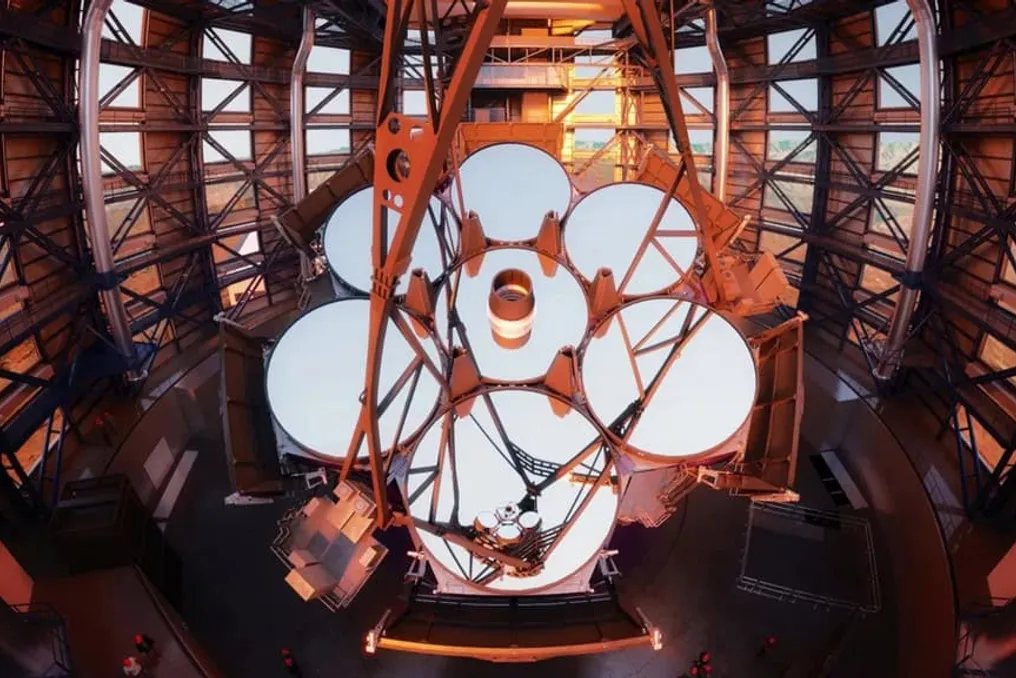
A new generation of telescopes is being built to expand the capabilities of observing the Universe, among which stands out the Giant Magellan Telescope (GMT), which is being erected in the Atacama Desert, Chile. This observatory will be equipped with seven primary mirrors with a diameter of 8.4 meters, providing a collecting area equivalent to a single 25.4-meter mirror.
The project was the topic of the Olhar Espacial program last Friday (25), where it was presented by astronomer Marcelo Zurita. Eduardo Cipriano, coordinator for scientific dissemination of GMT Brazil and a professor at IAG-USP, was a guest on the program. During the broadcast, he explained in detail how the various instruments of the telescope will complement the work of other observatories.
Despite the existence of many operational or forthcoming telescopes, the equipment does not necessarily have to compete directly, as each project possesses its unique characteristics. In the case of GMT, one of the key capabilities is spectroscopy—a method of analyzing different wavelengths of light.
According to Cipriano, the telescope will have instruments capable of operating with different levels of resolution and spectral ranges. He noted that 'GMT is absolutely versatile. We have instrumentation that suits all sciences, but I think there is a specific focus on the issue of exoplanets.'
The researcher also emphasized that the instruments can satisfy very diverse goals. 'GMT is practically a spectrograph. It is many spectrographs because spectroscopy depends on what wavelength you want, what overall range you need, and what spectral resolution you require,' he stated.
This diversity will allow research ranging from studying galaxies and clusters to more focused analyses. Cipriano explained: 'I can see the entire spectrum of a galaxy. For other studies, for example, you can study the presence of uranium in stars, then you need a very specific spectral region, but with very high resolution to separate details.'
Brazilian participation in the project is coordinated by FAPESP through the GMT Brazil consortium. National researchers and institutions are working in areas such as engineering, optics, mechanics, electronics, and software. The project also opens opportunities for national industry in the field of highly complex technological demands.
Among the areas that can benefit from GMT are the study of exoplanets, first stellar populations, and first galaxies. The telescope will also contribute to so-called galactic archaeology, which seeks to reconstruct the history of the Milky Way based on traces of smaller galaxies absorbed during its formation.
Cipriano added: 'G-CLEF, which will be the first instrument, an optical high-resolution spectrograph, will be phenomenal for this. It will also play an important role in first stellar populations and first galaxies.'
Nevertheless, it is difficult for the researcher to predict what discoveries will be major in the new observatory. 'Every time we get a new instrument observing beyond the known limit, we get surprises,' he said.
Cipriano also referred to the progress of astronomical observations to explain why new telescopes can reveal phenomena that were not part of their main expectations. 'Every time you start observing in territory you haven't observed before, nature surprises you,' he noted.
GMT is part of the trend of building large observatories, but costs also impose limitations. Cipriano explained, comparing the current state of astronomy to the concentration of efforts on large accelerators in particle physics: 'It is impossible to build another dozen billion-dollar telescopes.'