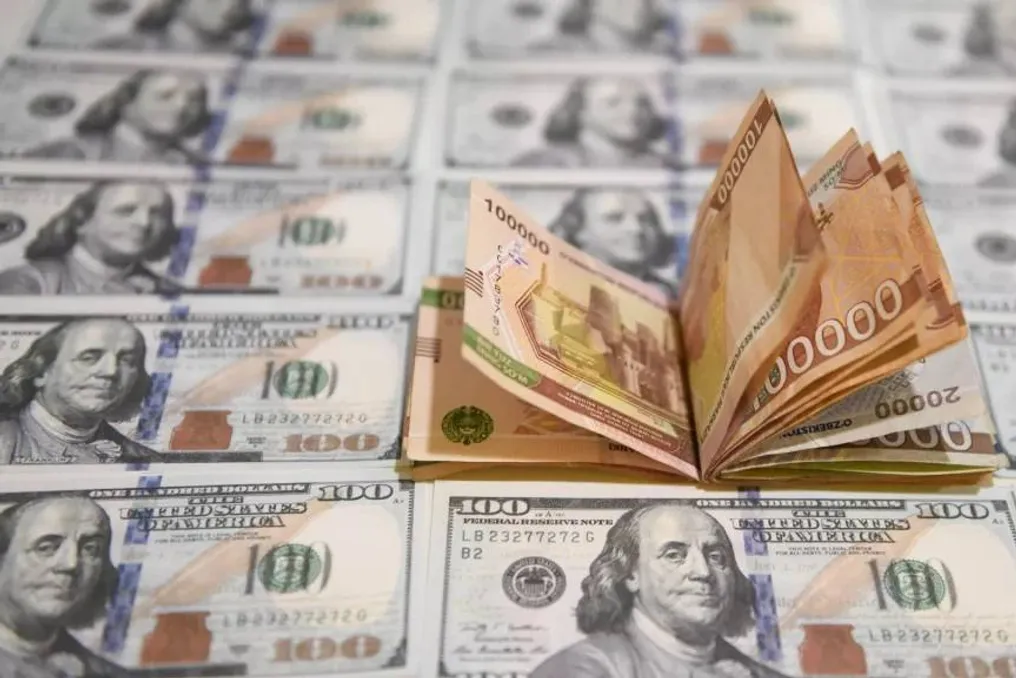
According to a market research on payment organizations prepared by KPMG in Uzbekistan at the request and with informational support of the Central Bank, the volume of non-cash payments via bank cards in Uzbekistan reached approximately 72% of nominal GDP in 2025. This figure represents a significant increase compared to approximately 25% in 2021.
The study covers macroeconomic conditions, the development of non-cash settlements, regulatory changes, and a comparative analysis of the largest market participants. The authors note that Uzbekistan is among the regional leaders in the share of card non-cash payments in GDP; only Kazakhstan shows a higher figure—around 121%.
Between 2021 and 2025, the volume of transactions via bank cards increased from 297 trillion soms to 1,493 trillion soms, corresponding to an average annual growth of 50%. Over the same period, the share of non-cash payments in the structure of card operations grew from 68% to 81%, while the share of cash withdrawals decreased from 32% to 19%.
Payment organizations also demonstrated rapid growth in transaction volumes, although mobile banking applications are becoming the main channel for digital payments. In 2025, transactions worth 412 trillion soms were processed through payment organizations, while this amount was 646 trillion soms through banking applications. In 2021, the corresponding figures were 53 and 58 trillion soms, respectively.
The authors explain the growth in the use of banking applications by the expansion of functionality and the development of ecosystems. Regarding payment organizations, 82% of turnover comes from peer-to-peer transfers and other non-cash payments.
In 2025, Paynet became the largest player in terms of payment transaction volume, processing 142 trillion soms across 988 million operations. KPMG believes that the company's leading position is supported by integrations with other platforms and its work with cash. Click processed transactions worth 106 trillion soms, and Payme processed 85 trillion soms. Click has the largest user base among payment organizations, with over 22 million registered users, more than 5 million active monthly users, and about 49,500 connected merchants.
Alif Tech, Beelab, Solutions Lab, Tezpay, Plum Technologies, Quick Payments Solution, and National Pay were also among the top ten leaders. Tezpay and National Pay showed the highest average transaction values, both specializing in transfers from Russia.
The Central Bank's registry includes 51 payment organizations whose services cover P2P transfers, acquiring, international money transfers, and other areas.
According to KPMG, the tightening of regulatory requirements contributes to market consolidation. Starting from July 1, 2024, payment organizations are required to operate as joint-stock companies, and from July 1, 2025, their minimum charter capital increased from 10 to 20 billion soms. Furthermore, starting from April 22, 2026, remote financial services must comply with enhanced cybersecurity and anti-fraud requirements, including identification, OTP control, biometrics, and transaction monitoring.
Starting from April 1, 2026, a number of payments, including public and utility services, fuel, alcohol, and tobacco, as well as purchases exceeding 400 basic calculation units, must be made exclusively by card or through electronic payment systems. By 2030, the share of non-cash payments in trade and services is expected to reach 75%.
To support this transition, the Central Bank is introducing the unified code UzQR, which legal entities are obliged to accept starting from July 1, 2026. A separate part of the study examines the Pix instant payment system from Brazil, created by that country's central bank. The authors believe that Uzbekistan is beginning a similar transformation from a stronger starting position than Brazil before the launch of Pix, and that UzQR could become the basis for a unified payment infrastructure.
According to the authors' estimates, the transition to such a model may increase pressure on the income of market leaders from P2P transfers and acquiring, shifting competition towards ecosystems, lending, B2B payments, and loyalty programs. Macroeconomic factors will also contribute to market growth: by 2030, the country's population may reach 40 million people, nominal GDP grew by an average of 16% annually in 2021–2025, and mobile coverage reaches 97% of the population.