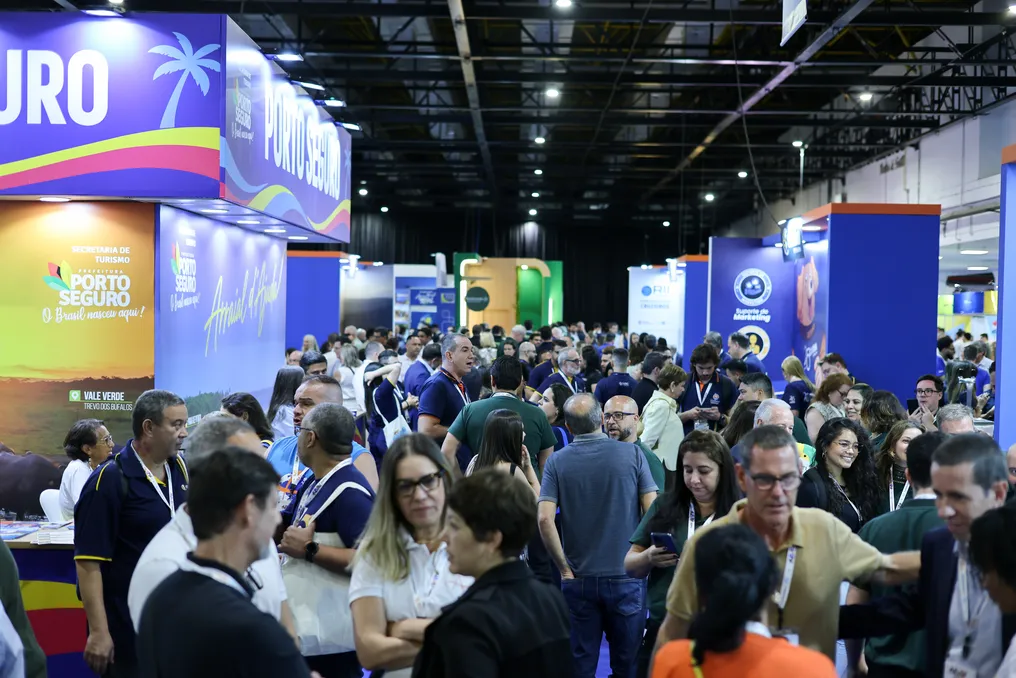
A destination only becomes a trip when an itinerary, an experience, a hotel, a reception service, or a specialized agent emerges that can connect the product to the interested traveler. This dynamic was the focus of the second day of the 53rd ABAV Expo, held on Thursday, the 1st, at the Expo Center Norte in São Paulo.
Gathering over 2,000 companies, the largest tourism fair in Latin America served as a vast showcase, bringing together travel agents, operators, suppliers, and both Brazilian and foreign destinations. The event demonstrates what will be available in agencies in the coming months, ranging from consolidated offers to less conventional experiences for the national market.
Among the participating international markets were China, Peru, Uruguay, Dominican Republic, Costa Rica, South Africa, Italy, and Canada. In the Brazilian scene, several states such as São Paulo, Minas Gerais, Tocantins, Paraíba, Ceará, Alagoas, Mato Grosso do Sul, Manaus, Paraná, and Rio Grande do Sul exhibited new products and itineraries.
The basic premise is that the more direct the contact between the creator of the experience and the seller of the trip, the higher the chances of the product reaching the end consumer. In this edition, over 500 travel agents from across the country were involved. Furthermore, the ABAV Buyers Club integrated 30 international buyers and 20 national DMCs (local agencies responsible for planning and executing logistics and itineraries) in business sessions with exhibitors.
Ana Carolina Medeiros, president of ABAV Nacional, emphasized that the ABAV Expo is fundamentally a business environment. She highlighted the crucial role of the travel agent, as they are the ones who know the client and select from the vast range of products displayed at the fair.
One of the initial activities on the second day focused on experiences outside the most well-known tourist routes. Through an immersion organized by Sebrae, journalists, influencers, and guests were able to discover experiences created from the unique characteristics of different Brazilian regions. The objective is to convert elements such as gastronomy, nature, culture, and lifestyles into marketable products for agencies.
In Ceará, the Gastronomic Courtyards of the Winds Route celebrate affective cuisine and the work of small cooks trained by Sebrae. In Rondônia, the Amazon Beradeira route explores the Cuniã region, blending history, nature, and river tours. In Chapada dos Veadeiros, the Viva Veadeiros Route focuses on wellness tourism.
The journey promoted by Sebrae also covers the Special Coffee Route of the Serra da Canastra, in Minas Gerais, allowing visitors to get close to producers and coffee plantations. Additionally, the Southern Canyons use the Georoute to unite two states and seven municipalities in a single route.
These experiences share the characteristic of originating in their own territories and depending on local chains to reach the visitor. For small entrepreneurs, the fair is a chance to find market channels; for the traveler, it means access to rare experiences in common routes.
Regarding international destinations, Peru presented a clear message: there is much more to discover beyond Machu Picchu. The country took advantage of the ABAV Expo to launch Peru Week 2026, marking the 13th edition of the promotion and commercialization campaign. Between October 5th and 23rd, 89 tour operators will participate, offering special packages and itineraries, valid even for trips in 2027.
The Peruvian offer includes combinations of Lima and Paracas, as well as routes through Cusco, Puno, Arequipa, and Ancash, expanding options for those seeking culture, gastronomy, nature, and adventure. Milagros Ochoa, director of PROMPERÚ, stated the desire to show Brazilians and agents that Peru transcends Machu Picchu.
China also increased its participation in the fair, with representations such as Beijing. The purpose is to bring the destination closer to Brazilian agents and operators, presenting products that can enrich new itineraries, aiming to increase professional familiarity with the Chinese offering.
Uruguay uses the expansion of air connectivity as a strategy to encourage Brazilians to explore areas beyond usual destinations. At the ABAV Expo, the country combined the promotion of new locations with a sensory approach centered on gastronomy, presenting regional flavors to agents.
Serrana Diaz, responsible for the marketing of the Uruguayan Ministry of Tourism, declared that better air connectivity facilitates access and allows one to learn more about the country.
Costa Rica continues a line of diversification, promoting offers linked to regenerative and sustainable tourism, combining nature, adventure, and wellness. The experiences shown include hot springs, surfing, bird and whale watching, mountains, beaches, and gastronomic and coffee routes, seeking to broaden the perception of the country beyond traditional paths.
For those seeking an unconventional view of Africa, Rovos Rail showcased its luxury rail itineraries. There are 11 options, with durations ranging from two to 16 nights, combining train journeys with excursions, gastronomy, and beverages. New additions include the inclusion of Malawi and the continuation of trips through Angola, started in 2019. Regárdo Lewis, International Sales Manager for the company, highlighted that the train serves as a link to know African diversity, which encompasses deserts, forests, and beaches.
In the Dominican Republic, the focus was on the new development of Puerto Plata, with the Punta Bergantín project and the arrival of large hotel chains. The country also aims to improve air connectivity with South America, considering the Brazilian market strategic, having registered over 250 thousand Brazilian visitors until September, according to the Dominican Ministry of Tourism.
Canada is also seeking to strengthen its presence in products sold by Brazilian agencies. The initiative at ABAV Expo involves 14 partners and offers options for different traveler profiles, such as aurora borealis routes, train travel, motorhomes, and slow travel. Sheila Nassar, CEO of VBRA, emphasized that the goal is to give security to the agent to sell Canada, by offering training and products suitable for the Brazilian market.
São Paulo holds a unique position, being the host of the fair and, at the same time, a market benefited by the diversification of its offering. The state has a robust tourism infrastructure, composed of 78 Tourist Districts, 206 Municipalities of Tourist Interest, 49 tourist regions, and nine Tourist Districts, covering nature, adventure, gastronomy, culture, rural tourism, and business.
The capital of São Paulo focuses on gastronomy, culture, major events, and leisure. In 2025, the city received 47.2 million tourists, of which 2.5 million were international, and recorded 25.4 million visitors in the first half of 2026. During the event, urban experiences were presented, an exclusive activity for members at the ABAV Agent Space, and the panel 'São Paulo, Gastronomic City'. The Vai de Roteiro product offers 37 routes through the city, encouraging knowledge of neighborhoods and experiences outside the main circuit.
In the interior, Joinville, in Santa Catarina, promoted an offer that combines rural tourism and event calendar. Highlights include the Christmas season, which attracts more than 700 thousand people, the Flower Festival, and more than 50 attractions related to rural tourism.
Minas Gerais, Tocantins, Paraíba, Ceará, Alagoas, Mato Grosso do Sul, Manaus, Paraná, and Rio Grande do Sul also used the ABAV Expo to bring their products closer to operators and increase the visibility of new experiences in the routes sold in the country.
Even if much of the ABAV Expo's activity occurs behind the scenes, through negotiations and meetings, the expected result manifests at the point of sale: new products available in agencies and more choices for the traveler. This link was the theme of the fair's content programming. In ABAV Talks, the panel 'Brazil Welcomes: Strengthening Receptive Tourism' debated the importance of aligning public power, the private sector, and all links in the chain to transform attractions into structured and marketable products. Professional training and operational organization were cited as crucial factors.
Another panel addressed community-based tourism, presenting examples of peripheries, quilombos, and indigenous lands. The discussion focused on the increasing demand for experiences linked to territories and the need to market them responsibly, ensuring the protagonism of the host communities.
Ultimately, it is this transformation that interests the end consumer. An area that was just a point on the map can gain an itinerary; a small producer can become a stop on a trip; a known destination can reveal an unexplored aspect; and the agent can include all of this in their catalog for the traveler.
This is the subtle movement behind a tourism fair: before appearing on a phone or at an agency counter, the next trip often arises from a conversation between the one who owns the product and the one who knows how to direct it to the right buyer.