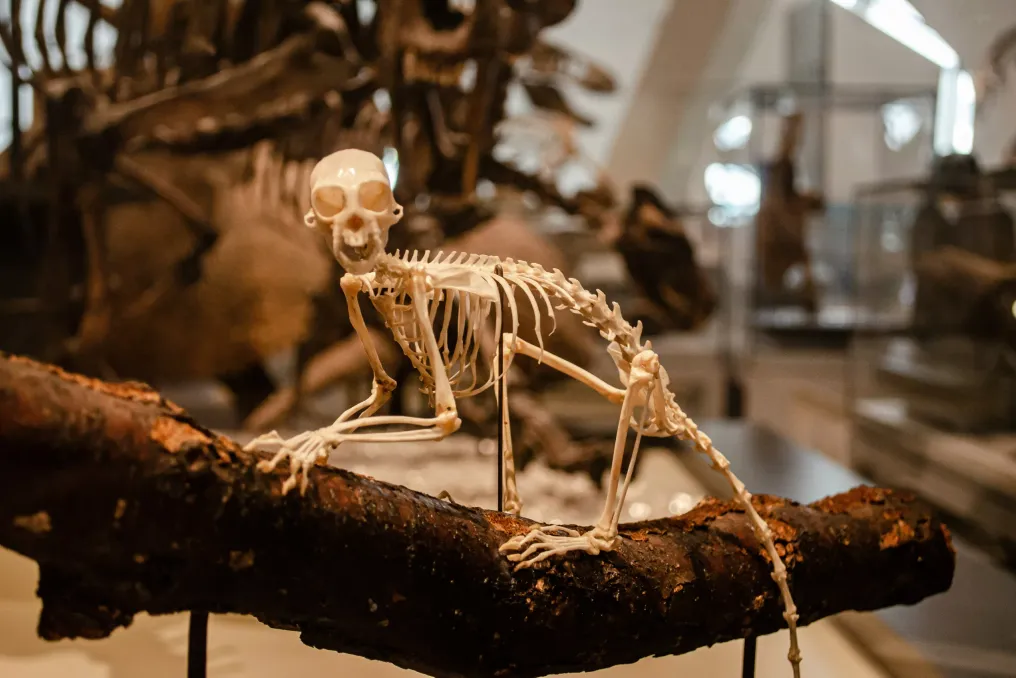
A small fossil discovered over twenty years ago in the Gobi Desert in Mongolia is helping scientists revise part of the mammalian tree.
This exceptionally complete specimen belongs to a recently identified species, Tamirkhan balcarceli, which lived during the Mesozoic Era when dinosaurs still dominated the planet. The animal was tiny, measuring between 15 and 18 cm from head to tail, but its discovery is highly significant.
For decades, researchers studied a group of Mesozoic mammals called zhelestids, based primarily on isolated fragments of jaws and teeth. Their rounded teeth suggested they might have been early relatives of modern ungulates or other placental mammals.
The new fossil presents a different picture. The specimen was found during an expedition to eastern Gobi in 2004 and preserved parts of the skull and hind limb, allowing researchers to gain a much clearer understanding of these animals' appearance.
Long hind legs, continuously growing incisors, and characteristic ankle anatomy indicate membership in a different group of ancient mammals—the lambdalestoids. Consequently, researchers concluded that zhelestids are not early placental mammals as previously thought, but belong to the lambdalestoid branch in the mammalian family tree.
This also serves as a reminder that fossils can be misleading when only fragments are preserved. In this case, the animal's teeth gave the impression that it belonged to a group it did not actually belong to.
The similarity was likely an example of convergent evolution, where unrelated animals develop similar traits due to adaptation to analogous environmental conditions or diets. Although the fossil was found in 2004, its significance only became apparent after many years of study. The species was officially described in the journal Nature in July 2026.
This long wait is part of what makes the discovery so exciting. In a desert already known for its dinosaur remains, one small mammal has changed scientists' understanding of an entire branch of early mammalian evolution. Sometimes, the most modest discoveries can have the greatest impact.