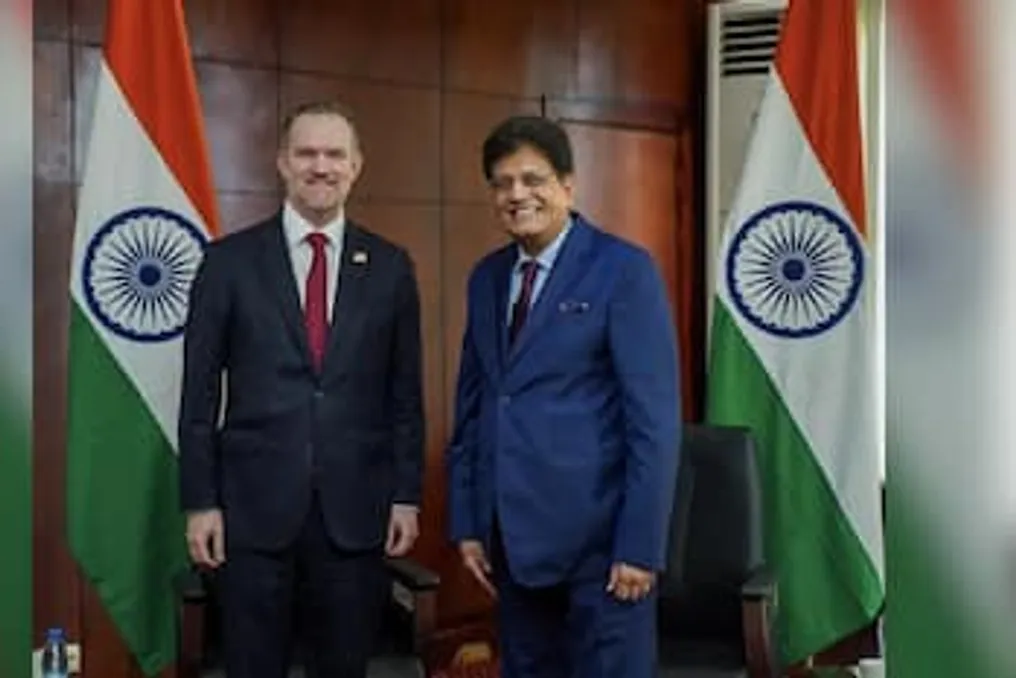
The US Trade Representative (USTR), Jamieson Greer, stated that despite active work by both sides to reach an agreement and define disputed points, a trade deal between India and the US 'is not inevitable.'
These statements were made after Greer's bilateral meeting with Indian Minister of Commerce and Industry Piyush Goyal, which took place on the sidelines of the G20 Trade Ministerial Meeting in Milwaukee.
During the press conference following the G20 ministers' meeting, Greer noted that the conversation with Minister Goyal was very constructive, and they are constantly striving to finalize the deal with India. He compared the current situation to the phrase 'we are in the short strokes,' emphasizing that the president and prime minister had a very productive call. Nevertheless, he does not believe the agreement will be signed anytime soon.
Greer's comments came after several months of speculation that the deal was almost complete. Recently, the prevailing opinion was that the main terms had been agreed upon, and New Delhi was waiting for Washington to develop a mechanism that would give India a tariff advantage over competitors and protect it from future tariff uncertainty. Goyal himself claimed last week that the deal was 'almost ready.'
Greer's meeting with Goyal took place on Thursday, one day after Modi spoke with Trump and discussed bilateral cooperation in trade, defense, energy, and critical technologies. This meeting and phone call were the first between the leaders of both countries since the US Congress passed a law allowing Trump to impose a tariff of up to 100 percent on imports from India due to its energy purchases from Russia. Trump's final decision regarding the rate and scope of this tariff has not yet been announced.
Greer added that the parties have clearly defined all contentious areas and are working hard to resolve them. He believes that the president and prime minister may have another call soon to assess progress. Experts believe that the main problem has been the lack of clarity in the US proposal within the trade agreement. Ajay Srivastava, founder of the Global Trade Research Initiative (GTRI), noted that 'after the US court ruling, the deal disappeared for the US.'
On February 7, India and the US published a joint statement on the first tranche of the agreement, agreeing to reduce mutual tariffs on Indian goods to 18 percent. However, shortly thereafter, the Supreme Court of the United States overturned the legal basis for this mutual tariff. Srivastava added that while India may remain firm on its commitments from the joint statement, the tariff rate proposed by the US became irrelevant, and in his opinion, they could not offer anything better.
Separately, at the G20 Trade Ministerial Meeting, where four areas were discussed—food militarization, structural surplus of capacity and production, Most Favored Nation (MFN) principle, and forced labor in global supply chains—agreement was reached only on the issue of food militarization on Thursday. Washington included structural surplus of capacity and forced labor in the G20 agenda amid the USTR's Section 301 investigation against India and other economies. In July, USTR imposed a 10 percent duty on India as part of its Section 301 investigation related to forced labor. The investigation into structural surplus of capacity is not yet complete.
Speaking on the topic of structural surplus of capacity and production at the G20 meeting, Goyal stated that India's production capacity meets domestic demand and economic growth rates. According to the Ministry of Commerce press release, 'India's production capacity meets its domestic and global needs, and India does not have a structural surplus of capacity in the sectors identified by the G20 Presidium.'
Goyal also emphasized at the meeting that trade measures should be based on specific and verifiable data, not on assumptions about an entire country, region, or sector.