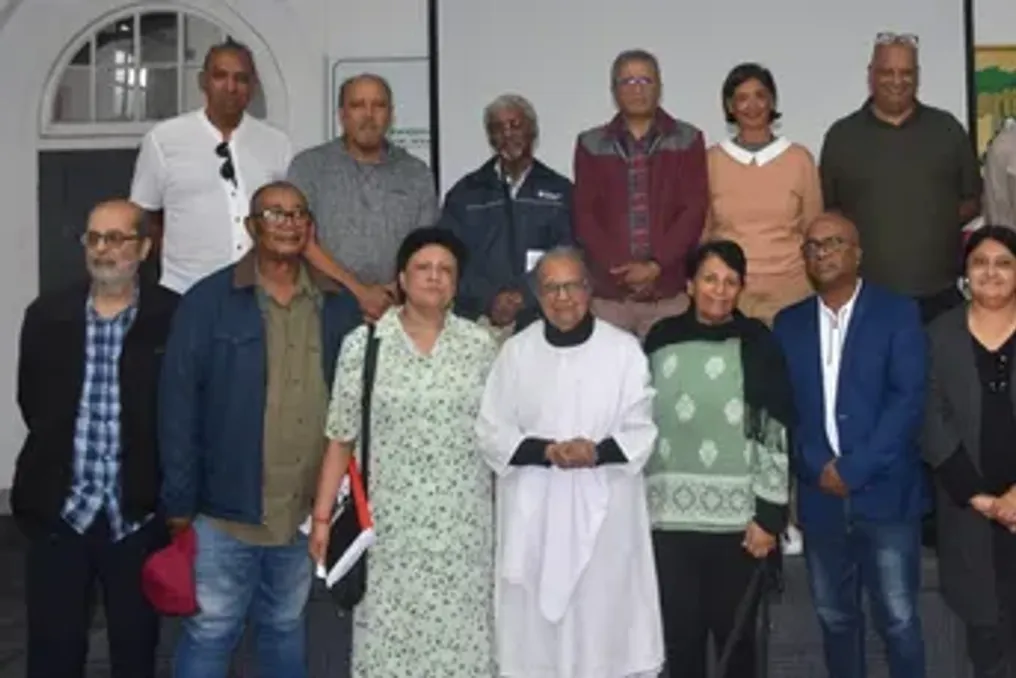
The new Natal Indian Congress Legacy Foundation (NICLEF) seeks to preserve the history and values of the liberation movement, urging the new generation to learn from the lessons of the past.
The Foundation recently held its first meeting at the 1860 Heritage Centre in Durban. Its goal is to preserve the legacy of the Natal Indian Congress (NIC) while providing youth with an opportunity to learn from the experiences of those who fought against apartheid.
Jiven Padayachi, a member of the NICLEF Governing Committee (Manco), stated that the foundation's main tasks include preserving the name, heritage, and intellectual property of the NIC, as well as collecting and archiving documents, artifacts, and oral histories related to the organization.
He added that the foundation also intends to promote the NIC's heritage through public events and collaborate with similar organizations to popularize progressive history and nation-building. Secondary goals include promoting non-racism, social cohesion, youth and leadership development, and democratic rights. The Foundation hopes to become a permanent center for education, research, public dialogue, and community engagement.
Padayachi explained that the decision to create NICLEF followed growing public interest in the organization during its 130th anniversary celebration in 2024. He also noted that a significant part of the NIC's history was at risk of disappearing, especially since many former activists are aging. 'Our documents, protocols, photographs, banners, and artifacts are stored in the garages and homes of elderly veterans and their families. If we do not collect them now, they will be lost forever.'
The Foundation is also concerned about preserving the oral testimonies of surviving NIC figures, including their experiences participating in the Defiance Campaign, the Congress Alliance, and the fight against racism. Padayachi emphasized the importance of not forgetting the broader role of the NIC in the struggle for liberation, as the NIC is often reduced to an ethnic organization, despite having evolved into a significant force in the wider non-racial struggle since 1894.
NICLEF plans to create a digital archive accessible to students, researchers, and the general public, as well as an NIC Youth Scholarship program that will connect young leaders with veterans through mentorship, leadership training, and intergenerational dialogue. Furthermore, the foundation intends to hold heritage lectures, exhibitions, Charter of Freedom dialogues, and constitutional literacy workshops in schools and communities. The youth engagement program will include newsletters, short videos, social media storytelling, and essay and debate competitions in schools. Padayachi concluded that the youth must value the path achieved through courage, sacrifice, and solidarity.
Despite its political roots, Padayachi clarified that NICLEF will not become a political party or participate in elections according to its Constitution. However, he stated that NICLEF cannot be considered apolitical, given that the NIC tradition has always participated in the political sphere. He explained that abstaining from modern party politics means the foundation will not be an appendage of any party or run in elections. 'We are civil society, a heritage and education foundation—not a political party. Nevertheless, we will be political in the best tradition of the NIC; we will participate in the political space to defend and promote non-racism, democracy, social cohesion, constitutional rights, and social justice.'
Yeshelen Govender, a civil society activist and humanitarian also on the Manco, explained that his motivation stems from family ties to the NIC. He shared that much of his childhood was spent surrounded by NIC activists fighting the apartheid regime in South Africa. Govender is aware of the NIC's important contribution to the political struggle against apartheid and its role in shaping a more conscious society committed to the values laid out in the Charter of Freedom and, ultimately, the national Constitution. He expressed concern that reactionary elements in society undermine these values, posing a danger to the foundation of a non-racial, humane society.
Govender believes that NICLEF can play a vital role in transferring the experience of senior activists to younger generations. He posits that NICLEF, with access to a base of experienced, progressive activists, will play a crucial role in ensuring this experience is passed on to young activists and humanitarians. For him personally, he sees his role in helping bridge the gap between older and younger generations of activists.
According to the NICLEF Constitution, two structures were officially established for the oversight and governance of the foundation: the Board and Manco. Members of the Board include NIC veteran Elu Gandhi (Chairperson), Yunus Karim, Don Gumede, Babu Baidhu, Spider Jagarnath, Greta Appelgren, Eric Appelgren, Selvana Chetty, Professor Bridge Maharaj, Alpha Karim, Dr. Abbu Omar, and Dr. Rashmi Badal. Manco consists of struggle and political veterans Maggie Govender (Coordinator), Ravi Pillai (Secretary), Logie Naidu (Treasurer), Yeshelen Govender, Dr. Lubna Nadvi, Jiven Padayachi, Dr. Hershily Narsi, and Roshan Jainath. The foundation will officially and publicly launch next year.