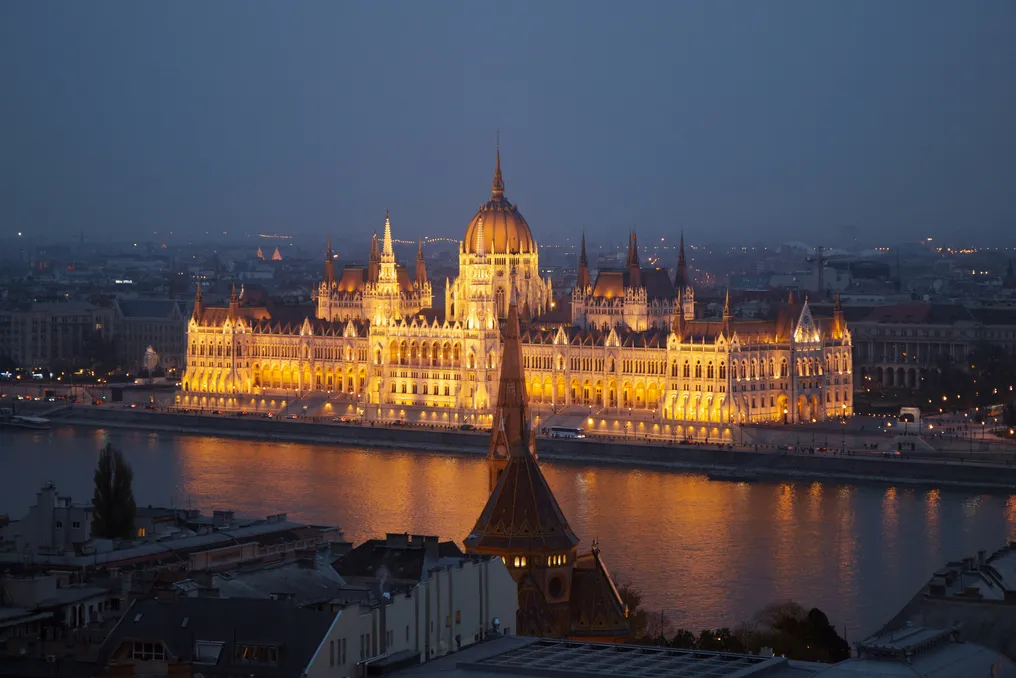
Budapest, the capital of Hungary, is a city marked by the cultural fusion of Magyar, Turkish, German, Slavic, and Romani peoples. Its period of greatest prosperity occurred in the late 19th century, when it functioned as a co-capital of the Austro-Hungarian Empire.
After World War II and decades under Soviet communist rule, the current metropolis has consolidated itself as a vibrant center, renowned for its thermal baths and the historical union of its two halves, Buda and Pest, separated by the Danube River.
In this urban context, peculiar miniature bronze statues have emerged—small sculptures placed in frequently unexpected locations across the capital. Pedestrians often encounter these works during mundane moments, whether walking along sidewalks, visiting historical landmarks, or cycling along the riverbanks.
Examples of these pieces include a mini Lisa Simpson portraying Joan of Arc, or a representation of the Austro-Hungarian Emperor Franz Joseph I, who governed the empire for a long time, resting in a hammock.
The creator of all this artistic production is the Hungarian-Ukrainian sculptor Mihály Kolodko, originally from Uzhhorod, western Ukraine. The concept of the miniature statues arose from the artist's dissatisfaction with the complex bureaucracy required to install public monuments.
Around 2010, Kolodko realized that small-scale art provided him with greater creative freedom and speed. Because they are small, the sculptures are simpler to model and can be installed at night in public spaces without prior permission. The artist maintains mystery about the location and timing of each new piece, stimulating public curiosity.
Generally, the statues celebrate aspects of Hungarian culture and the influence of American media in the country. Many feature characters from cartoons and popular children's programs on Hungarian television from the 1970s and 1980s.
Among the popular characters, stands out the biscuit goat Mekk Elek, a central figure in the series 'Mekk Elek az ezermester' (translated as 'Mekk Elek, the handyman'). Another icon is the checkered rabbit Kockásfülű nyúl, from the program 'The Checkered Rabbit', from the late 1970s, which can be seen atop Buda Castle Hill, observing the city through a telescope.
Kolodko also addresses delicate geopolitical and historical themes. One example is the Mini Tank ('Sad Tank'), positioned with its cannon pointed downwards, symbolizing the end of the Hungarian Revolution of 1956.
The miniature statues encourage visitors to explore the Hungarian capital attentively, as many are situated in traditional tourist spots, enriching familiar locations.
On the Buda side, near Batthyány Square, one of the most famous sculptures can be found: the Rubik's Cube, which pays tribute to the invention of Hungarian architect Ernő Rubik, presented in miniature.
The image of the Austro-Hungarian Emperor Franz Joseph I resting in a hammock is located on the eastern side of the Liberty Bridge, serving as a reminder of the annual period when the area is closed to traffic to allow citizens to rest.
Furthermore, globally known American characters can also be found. One of them is Kermit the Frog, a prominent face of the Muppets, who can be seen in Freedom Square, a rich spot in the capital, surrounded by Art Nouveau buildings, near the base of a fence adjacent to the park's main café.
In Fővám Square, in the southern quadrant of Corvinus University, there is a bronze statuette that intrigues both tourists and residents of the Pest area: it depicts the character Lisa Simpson tied to a stake, referencing a scene from The Simpsons series that draws a parallel with the story of Joan of Arc.