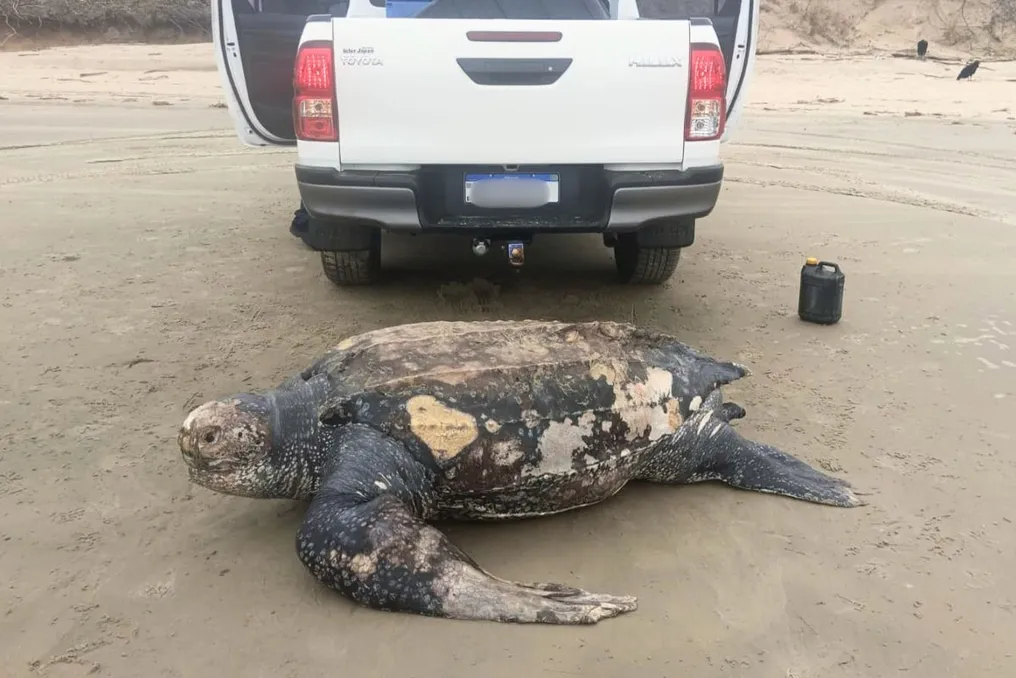
A leatherback turtle, also known as the giant turtle, was found dead on the sand strip of Ilha Comprida, located on the coast of São Paulo. The animal's body was removed by the Cananéia Research Institute (IpeC).
The Institute reported that the animal was sighted on the beach sand on Thursday (1). The necropsy evaluation has been completed, and the corresponding report should be issued soon.
Eric Comin, a marine biologist, clarified that the leatherback turtle represents the largest sea turtle species globally and possesses unique characteristics, such as a tough, leather-like skin.
He detailed that, unlike other species, it does not have a rigid shell formed by bony plates, but rather a layer of resistant, textured skin supported by thousands of small bone plates.
This species has the ability to reach over two meters in length and weigh up to 900 kilograms. Its main habitat consists of the deep waters of both tropical and temperate oceans.
Comin also mentioned that the leatherback turtle undertakes one of the longest migrations in the animal kingdom, traversing oceans between its feeding and breeding grounds. Currently, the species is classified as Vulnerable by the IUCN (International Union for Conservation of Nature).
Main threats to the leatherback turtle
The main threats faced by this turtle include plastic pollution, where animals mistake plastic bags for jellyfish, which can result in suffocation or digestive obstruction; incidental fishing, which occurs when they are accidentally caught in deep-sea fishing nets and hooks; and habitat destruction, caused by artificial lighting and urbanization on nesting beaches, which can disorient the hatchlings.
Curiosities
The specialist added that despite being able to weigh almost a ton, the diet of leatherback turtles consists exclusively of soft and gelatinous organisms. A single adult individual can ingest approximately 600 jellyfish daily, which is equivalent to consuming almost all of its body weight daily just to obtain sufficient calories.