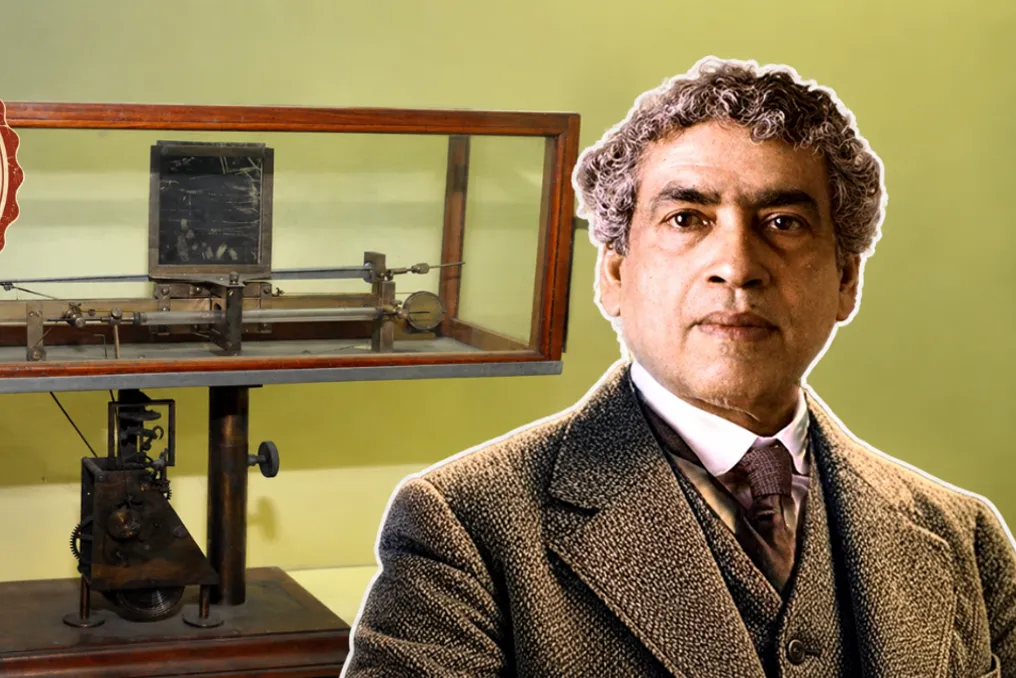
A plant may appear stationary, yet beneath its leaves and stems, it is constantly undergoing changes: roots penetrate the soil, stems reach for light, and cells react to surrounding factors. More than a century ago, the main problem was that these processes occurred too slowly for the human eye to perceive.
The Indian scientist Jagadish Chandra Bose made a breakthrough in this field. In the early 20th century, he developed the crescograph—a brilliant instrument capable of magnifying plant growth thousands of times and recording movements that would otherwise be practically invisible. His work opened a new approach to studying flora, allowing researchers to analyze the reaction of plants to light, temperature, chemical substances, and other irritants.
Ordinary observation methods faced difficulties due to the slow pace of growth; Bose noted that the average growth rate could be as little as about 1/100,000 inch per second. With standard magnification, hours had to pass to notice a measurable change. However, long experiments were complicated by fluctuations in temperature and illumination.
Bose sought a way to shorten this observation period. His solution was the crescograph, a name derived from the Latin word 'crescere,' meaning 'to grow.' This instrument used delicate mechanical and optical mechanisms to amplify the smallest movements at the growing tip of the plant.
In the highly magnified version, one lever increased the movement 100 times, and a second one increased it another 100 times, achieving a total magnification of 10,000 times. This movement was then recorded as a series of markings, turning plant growth into a measurable pattern rather than a guess based on observation.
The physicist, who became interested in plants, was born in Mymensingh on November 30, 1858. Before focusing on botany, he had already gained international recognition for his research on electromagnetic waves. He worked at Presidency College in Calcutta and later founded the Bose Institute. His interest in plants arose from a broader scientific question: can living and non-living matter react to external influences in a similar way?
He began creating sensitive devices to detect reactions in plants, studying species such as Mimosa pudica, whose leaves move upon touch, and Desmodium gyrans, known for its rhythmic leaf movement. Bose's experiments studied the electrical and mechanical responses of plants and how these responses changed under the influence of various stimuli.
The crescograph became one of the most significant instruments because it solved a fundamental scientific problem: how to measure what cannot be seen? Bose continued to improve the device, developing a magnetic crescograph that reduced problems associated with friction in mechanical systems. The operating principle was exceptionally sensitive: the slightest movement of the plant could disrupt the carefully balanced magnetic system, causing a much larger movement that could be recorded. Bose reported magnifications reaching millions times with magnetic amplification, allowing for the detection of extremely small changes in plant growth.
By 1917, Bose presented his work on the high-magnification crescograph to the Royal Society. The study was published in Proceedings of the Royal Society B in 1919. The contemporary record of the Royal Society described the instrument as part of Bose's broader research on plant growth and movement.
Understanding Plant Reactions
The significance of the crescograph lay not only in making the plant appear to grow faster. It provided scientists with an entirely new way of asking questions. Instead of simply observing visible changes, researchers could measure tiny changes in growth and compare how these changes reacted to different conditions.
Bose's work helped shape a more quantitative approach to the study of plant physiology, alongside his research on electrical reactions and plant movements. Over a century later, the principle underlying this invention remains relevant: when something is too small or too slow for our senses, more sophisticated tools are capable of revealing what is happening.
Bose's crescograph did exactly that for plants, transforming almost invisible growth into a measurable, documented, and scientifically accessible quantity.