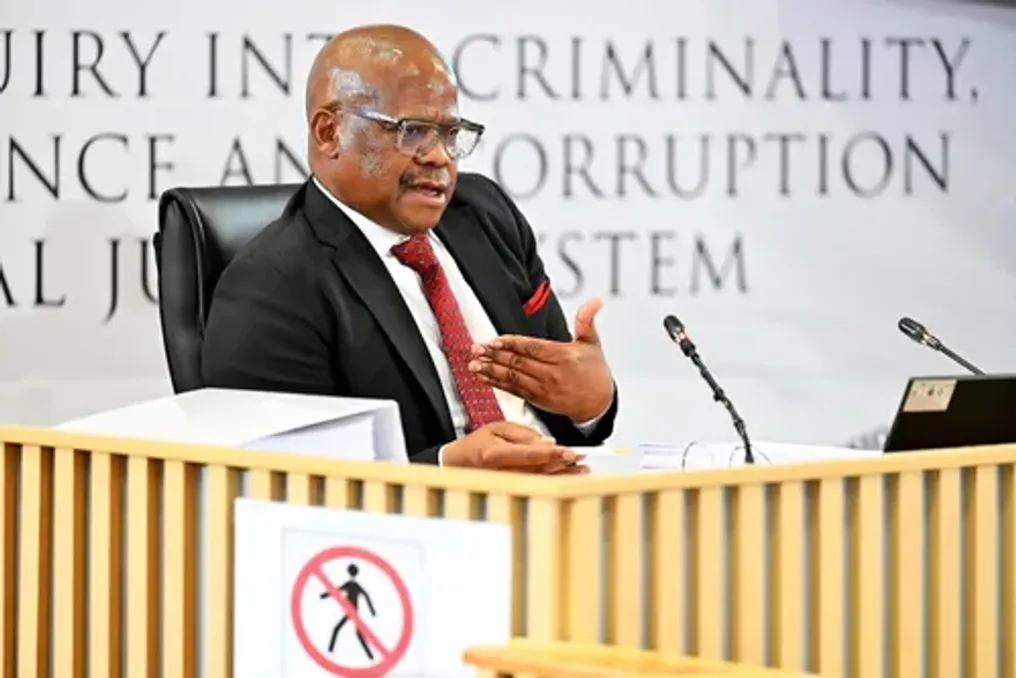
The testimony of Joe 'Ferrari' Sibanyoni, a taxi boss from the Mpumalanga province, presented to the Madlanga Commission, revealed mechanisms for exploiting the 30% local content rule in South Africa.
Professor Kedibone Phago, Dean of the Faculty of Economics, Development and Business Sciences at the University of Mpumalanga, noted that Sibanyoni's statements highlighted how state procurement systems and the concept of Broad-Based Black Economic Empowerment (BBBEE) in the country can be distorted and exploited.
In 2017, provisions of the South African Preferential Procurement Policy Framework Act (PPPFA) required allocating at least 30% of the value of certain government contracts to target groups, including rural and urban enterprises, provided they met technical requirements.
However, this policy unintentionally contributed to the rise of armed criminal syndicates, dubbed the 'construction mafia,' which began invading construction sites, demanding 30% of project costs under threat of violence.
Following numerous legal proceedings, the National Treasury Department revised the PPPFA in 2022, officially removing the mandatory requirement for 30% subcontracting.
During his appearance before the commission this week, Sibanyoni faced intense scrutiny over the demand for 30% local subcontracting work allegedly for community needs.
He is currently under investigation for extortion charges related to the mining sector and is suspected of ties to criminal syndicates. Sibanyoni himself denies any wrongdoing, and the allegations have not been proven.
The commission heard the statement of businessman Tengane Ntuli, who alleged that Sibanyoni and Oupa Bafana Sindane extorted bribes from him to secure a contract. Sibanyoni refuted this claim, stating that he legally assisted Ntuli in obtaining the contract.
According to him, Ntuli owned mineral rights at a quarry, and they met in 2021 to discuss what the latter termed 'local content.' On Wednesday, he was asked to explain his statement about 'us fighting for our own 30%,' concerning the Putco bus company.
On Tuesday, Sibanyoni was intensely questioned regarding reports linking him to an alleged R500 million for the modernization of Moloto Road 573, as well as his influence over contractors. He informed the commission that the 30% local content requirement applies to the entire project, with equipment and labor from other local contractors making up the remainder.
Phago believes that Sibanyoni's view on local content 'accurately reflects what went extremely wrong with BBBEE and the tendering system in South Africa.' He added that his presentation to the Madlanga Commission demonstrates a lack of leadership among South Africans interested in the country's development agenda.
Phago emphasized: 'It is clear that the application of local content, as described by Mr. Sibanyoni, is not supported by any legal basis or guidelines. To say that the meaning and application of the concept of local content in this case is a distortion would be an understatement.' He explained that this distortion occurs widespread, especially in municipalities.
'This shows that some individuals have seized our public institutions and hijacked the tendering system for their own benefit, acting with absolute impunity. Our public officials and supervisory bodies have completely abandoned and neglected their duties. It is unacceptable that whenever we need to advance and ensure the protection and proper functioning of our public institutions, we find rot in the investigative committee,' he stated.
Professor Zwelenzima Ndevu, an expert in public leadership from Stellenbosch University, noted that businesses must meet specific criteria to participate in procurement rules. He stated that 'business must comply with all requirements according to specifications. At first glance, it seemed that Mr. Sibanyoni did not possess the necessary business competencies and therefore should not have participated. There is also no evidence of a contract explaining the terms of appointment. This raises red flags.'
Neil Gopal, CEO of the South African Property Owners Association (SAPOA), reported that hundreds of engineers and other highly skilled technical workers have left the country over the years due to personal risks and job losses when construction projects stalled.
Gopal noted that construction projects were subjected to violent disruptions or halted, leaving workers jobless when developments ceased. He added: 'Over these years, we estimate that hundreds of engineers and highly skilled technical personnel have left the country due to personal risk and lack of employment when projects are stopped under the barrel of a gun.'
Deon van Zyl, chairman of the Western Cape Property Development Forum, also warned that extortion and intimidation delay or halt projects, increase security and construction costs, and create uncertainty for investors. He said: 'Community needs cannot be ignored, but criminality should not be allowed as an alternative procurement system.'
Security strategist Andy Mashaile stated that the 30% local content rule mentioned by Sibanyoni is not a legitimate local empowerment but constitutes 'criminal extortion.' He added: 'Local residents generally gain no benefit except for violent organized crime gangs who appoint themselves as owners of local content, as seen from Sibanyoni's current testimony before the Madlanga Commission.'
Mashaile concluded that the poorly managed implementation of the policy has become a convenient cover for organized crime networks to intimidate legitimate local residents and deprive them of rightful benefits. He called for: 'The government must review the implementation mechanisms and create oversight structures that ensure the free and fair distribution of 30% into a public trust that cannot be abused by trustees but is controlled by beneficiaries.'